The question I couldn’t answer
A few days ago, I was invited to speak at a “lunch and learn” session about antisemitism.
The room was full of people who were genuinely trying to understand what Jewish Australians have been experiencing over the past three years. They weren’t looking for an argument and they certainly weren’t looking to assign blame. They simply wanted to understand what had changed.
Towards the end of the discussion, someone asked a question that has stayed with me ever since.
“When did this happen?”
Without thinking very much about it, I answered the way I suspect most people would.
I spoke about October 7.
It wasn’t until I was driving home that I realized I wasn’t entirely convinced by my own answer.
October 7 changed many things. It changed the confidence with which antisemitism was expressed. It changed the way many Jewish Australians looked at their own country. It changed the willingness of others to say publicly what they may once have kept to themselves.
But I don’t think it was the beginning.
I think it was the point at which the rest of us began to notice.
That thought has stayed with me as I have followed the Royal Commission into antisemitism.
Like many in the Jewish community, I welcomed its establishment. It matters that Jewish students, parents, educators, and community leaders have the opportunity to describe what they have experienced. It matters that those experiences are now part of Australia’s public record.
But as I have watched the hearings unfold, I have found myself thinking that the commission is revealing something beyond the evidence itself. It is also revealing something about us.
Every hearing seems to follow a familiar pattern.
- Someone describes intimidation, exclusion, or fear.
- People listen.
- Then almost instinctively, the conversation shifts.
- What was the context? What exactly was meant? Does this fit the definition of antisemitism Could there be another explanation?
None of those questions is unreasonable on its own. We should always be careful before describing conduct as racist or antisemitic.
Yet taken together, they reveal a habit that I hadn’t fully appreciated before.
When Jewish Australians describe antisemitism, our instinct is often not simply to understand what happened. It is to interpret it, weigh it against something else, or see whether there is another way of looking at it.
I have found myself wondering whether we would do the same if another minority community described racism directed towards them.
My instinct tells me we probably wouldn’t.
Perhaps that is why so much of the conversation eventually finds its way back to Zionism.
Criticism of Israel is legitimate. It always has been. Democracies should be scrutinized, challenged, and criticized. Israel is no exception.
The difficulty arises when anti-Zionism becomes the language through which much older prejudices find a new expression.
It happens when Jewish organizations are viewed with suspicion because they support Israel. It happens when Jewish students are expected to explain where they stand on Zionism before they are accepted by their peers. It happens when assumptions about a government on the other side of the world are projected onto Jewish Australians who have never voted in an Israeli election.
The Royal Commission will spend considerable time examining the boundaries between antisemitism, anti-Zionism, and legitimate criticism of Israel. That work is important.
But Jewish Australians also understand something much simpler.
When “Zionist” is shouted as an insult, and when “Israel” is invoked as a reason to target people and institutions here, they are rarely talking about an abstract political philosophy.
They mean Jew.
The people saying it know exactly what they mean, and the people hearing it know exactly what they mean as well. Sometimes, I think the only people still debating the distinction are those with the least at stake.
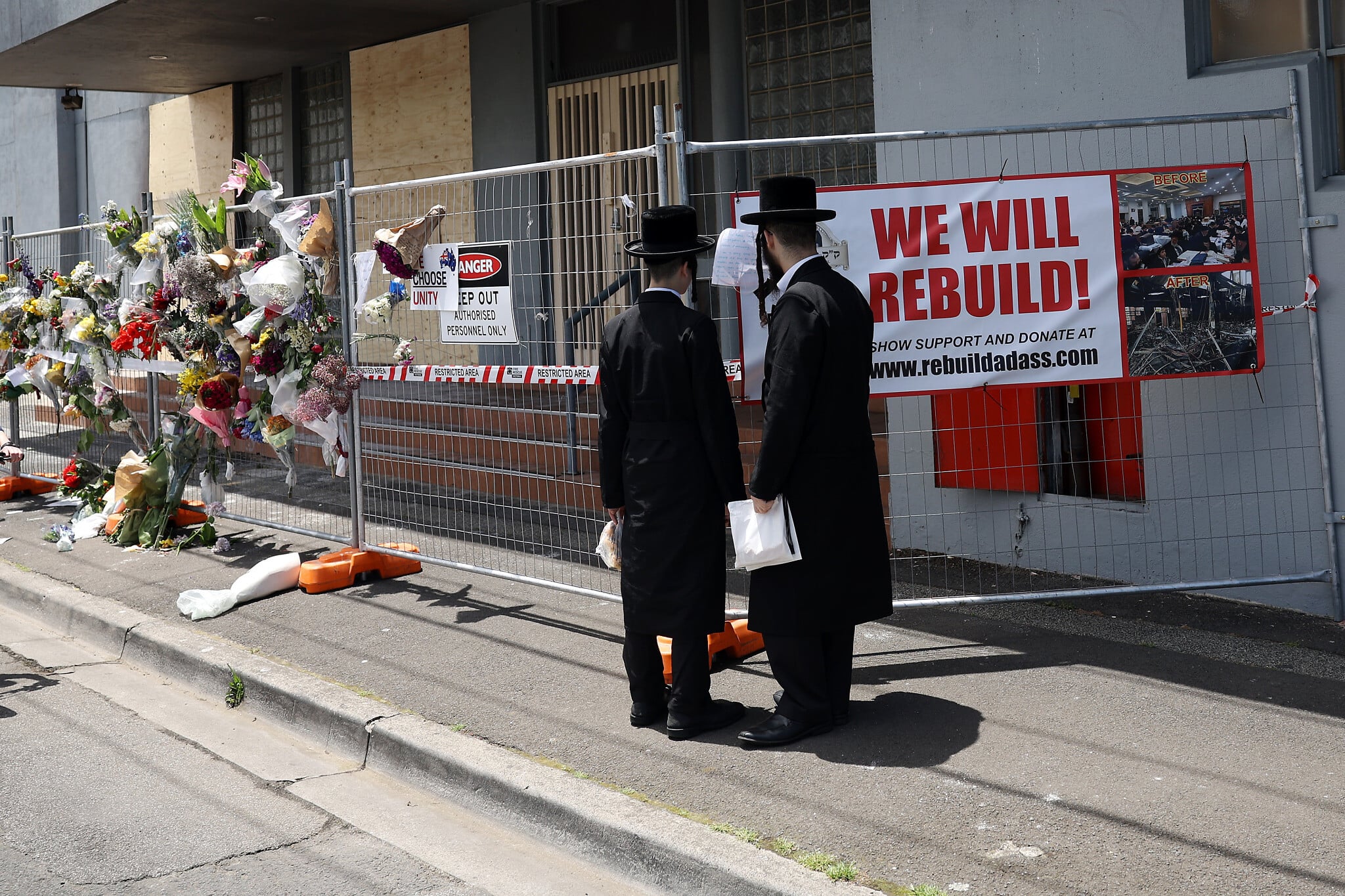
I found myself thinking about that after the Bondi attack.
Within the Jewish community there was a genuine hope that perhaps this would become a moment of national reflection. Not because tragedy should ever be needed to change minds, but because surely this was different. Surely this was the moment when Australians would stop debating whether antisemitism was really a problem and simply acknowledge what Jewish Australians had been trying to explain for months.
For a brief period, that seemed possible.
Then, gradually, the conversation drifted back to where it had been before. Political arguments resumed. Qualifications returned. Before long, Jewish Australians once again found themselves explaining why what they had experienced should even be recognized as antisemitism.
Looking back, I think that was when my own thinking began to change.
For a long time I assumed Australia’s greatest challenge was recognizing antisemitism.
I’m no longer convinced that is the problem.
I think we recognize it.
What we struggle with is allowing it to stand on its own. We seem uncomfortable confronting antisemitism without immediately searching for context, qualification, or another way of understanding it. If that’s true, then acknowledging the problem is only the beginning. We also have to ask ourselves why we are so reluctant simply to accept what Jewish Australians are telling us.
Perhaps that is what the Royal Commission is really revealing.
Not only the experiences of the Jewish community, but the habits of a society that still finds it easier to debate those experiences than to sit with them.
I still think about the question I was asked that afternoon.
“When did this happen?”
I don’t think the answer is October 7.
I think it happened gradually, one conversation, one qualification and one explanation at a time. The point wasn’t that antisemitism suddenly appeared. It was that we slowly became accustomed to responding to it differently.
That, more than anything I have heard during the Royal Commission, is what has stayed with me.
And that, I suspect, is the question Australia will still be grappling with long after the commission has finished its work.