
British Student Defending Israel
The Question Nobody Wants To Answer: Why Israel?
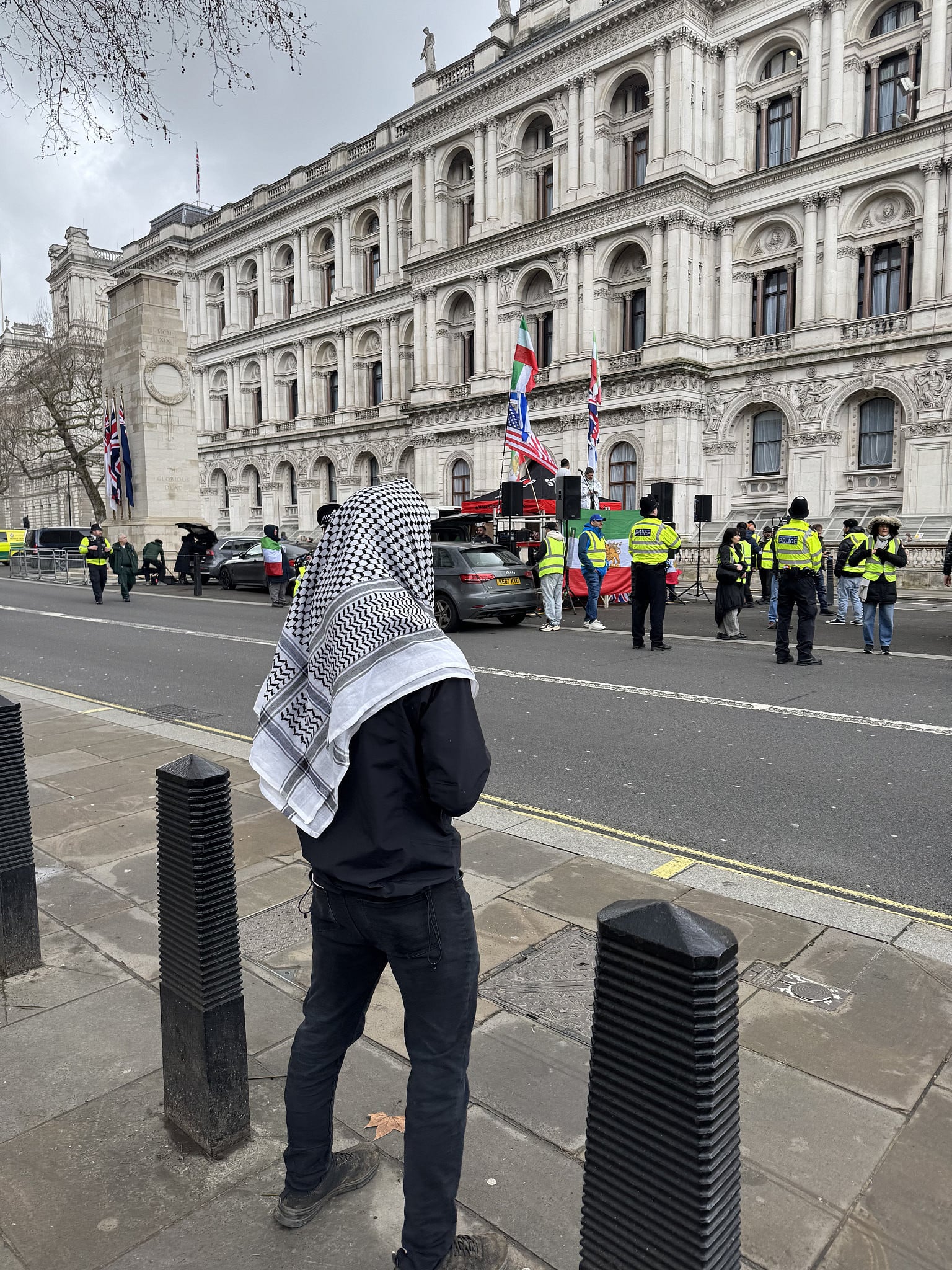
Keffiyeh-wearing activist monitoring Pro-Israel, Anti-IRGC gathering in London
Let’s get this straight. Every country deserves scrutiny. But why are ordinary Israelis met with hostility and seen as personally responsible for their government’s actions when citizens of any other country are not held to the same standard? The United Nations General Assembly reflects the public’s obsession with the World’s only Jewish state – the UN adopted 173 resolutions criticising Israel between 2015-24, more than all other countries combined! I’m not arguing that Israel is perfect or that the Israeli government shouldn’t be held accountable like every other government, but as a non-Jewish person, I can see firsthand that Israel is fiercely attacked more than countries like Iran and Afghanistan, which have deeply troubling records on Human Rights.
Why the double standards:
When I see across the West the constant attacks on Israelis, I think it’s important to distinguish between criticising the Israeli Government and attacking innocent Israelis and jews. Why Israelis? Why are Israeli-run restaurants in London rebranding to ‘Mediterranean’? Why are Israeli Bakeries being boycotted? Why are Israeli students in Britain finding themselves apologising for actions of a government it has no involvement in, just to be accepted in social circles? Surely we should expect the same standard to be applied to Russian students, blaming them for the brutal attacks that Putin has delivered in Ukraine. The same standards for Chinese students – being held accountable for the actions of the Communist Party. The same treatment for Iranian students, blaming them for the Islamic regime’s barbaric acts of violence and terror. I do not encourage hate toward any such groups, so the question still stands – why is it socially acceptable when it’s directed towards Israelis?
Most people can distinguish between a country’s Government and their people, yet Israelis are not afforded such a distinction. Whether it’s evil campaigns against Israeli academics like Professor Michael Ben- Gad at City, University of London, or the attacks on Israeli tourists in places like Thailand and Greece. It’s plain and simple. It’s racism. I hear the Pro-Palestine activists constantly call for boycotts of Israelis and their businesses, but I very rarely hear them raising concerns about specific government policies. Why is it that this exception doesn’t just exist, but is incredibly prevalent?
China and The Uyghurs –
Those on our streets shouting slurs against Israel surely cannot call themselves Human Rights activists if they aren’t talking about injustices like China and its treatment of Uyghur muslims. Where are the protests and obsessive headlines? Since 2017, the government in China has imprisoned over a million Uyghurs, predominantly muslim, and placed others under extreme surveillance, enforcing restrictions on their religion, forced labour, and the list continues. In 2021, the US Government even declared that such actions taken by China constitute genocide. Have you seen protests in Chinatown, central London? Have you boycotted your local Chinese? No, and I wouldn’t expect you to.
I haven’t heard a single “end the genocide” chant about the situation in China. Just like there appears to be no form of social stigma attached to identifying as Chinese. Chinese tourists aren’t hunted down and attacked, but Israelis are. Make it make sense. The headlines and activism that does exist around this issue target the Chinese government and not Chinese people as an ethnicity. So why is this distinction between the government and its people so prevalent for the Chinese, but the same standard isn’t maintained when we look at Israelis?
Iran and Islamism –
Mahsa Amini. A name that sinks the heart of anyone with compassion. But the truth is, many of the Gaza protest crowd don’t have a clue what I’m talking about. The strict obligatory hijab laws under the brutal Islamic Regime in Iran led to Mahsa, a 22-year-old girl, being imprisoned in custody where she died. The blood was on the hands of the Islamic Regime. According to Human Rights groups, witnesses described how she was beaten, transported to a detention facility to be re-educated on Islam, and later fell into a coma after hits to her head. She died in hospital 3 days later, aged just 22 years old.
Iran, to the ones who haven’t been brainwashed, depicts a bloody picture when we look at what the media described as a crackdown on protests in January 2026. But Iranians who I’ve spoken with describe it as an onslaught. A massacre. Tens of thousands were left without communication with family, and the whole country was shut off from the internet. I ask again, where were the protests? The Islamic regime in Iran isn’t only known for its domestic onslaughts, but also its proxies. They target all of us. Whether it’s Hamas, the Houthis, Hezbollah, jihadist groups in Syria and Bahrain, or more at home with Harakat Ashab al-Yamin al-Islamiyya, who have claimed responsibility for espionage and several attacks on Britain’s Jewish community. All of this happens, and yet everybody turns a blind eye. Ordinary Iranians, even the ones supporting the regime, are living abroad in places like Britain, and they don’t face any collective condemnation like the Israelis are subject to. Do you see the two-tiered approach yet?
Afghanistan and the taliban:
Where are the weekly protests about Afghanistan? Try putting yourself in the shoes of a woman or girl in Afghanistan, under taliban rule. In 2021, women were promised rights while operating under Sharia law, but 2022 saw the enforcement of a new law whereby Afghan women must cover their faces and their bodies. Later that year, women were banned from attending university. The most moving of all, in 2024, new legislation was introduced to stop women from using their voices in public. That’s right, women cannot and must not speak. While more recently, equalities have been stripped away, women must not travel further than 45 miles without a male ‘guardian’. Over 10 million women and girls are reported to need urgent aid, but this is impossible when Afghanistan operates strict regulations stopping women humanitarian workers from taking part in such activities. So you may wonder, when there are clear documented human rights violations and clear restrictions on women just living, why there is no outrage. I don’t recall ever seeing a call for boycotts of Afghans and Afghani businesses. In this particular case, it’s striking again how stark the distinction is between the people of Afghanistan and the government of Afghanistan. Now contrast this with the attitudes we see thrown towards the Israelis.
Russia and Ukraine:
When Russia invaded Ukraine in 2022, we didn’t just see masses of condemnations across the West, but also the Ukrainian flag being pinned to the top of public institutions like council buildings. But where were the flags for Israel when Islamic jihadists, along with Hamas terrorists and some Palestinian civilians, all from Gaza, invaded Israel by land, sea, and air? Sanctions were almost immediately imposed on Russian officials, but when the war between Israel and Gaza started in October 2023, all left-wing politicians could talk about was Israel’s response – how dare she defend herself! And then came the talks about a Palestinian state – that’s right, a reward for the terrorists who slaughtered as many jews as they could. But the truth is, despite Putin’s actions in Ukraine, Russians are not treated differently here in the West; they themselves don’t feel the guilty need to have to explain their ethnicity to friends and colleagues, or to have to change their name on Uber or lie about their origins. You don’t often see a Russian person having to immediately condemn their government when announcing that they are Russian – so why is the rule different for Israelis?
Russian students continue to study with ease and without prejudice, and the public rightly recognises Russian citizens as being separate from their government and its actions. Why is the principle inconsistently applied, only to Israelis?
Double Standards:
With the shockingly obsessive amount of headlines about Israel, the massive condemnation and activism amongst the public, you wouldn’t believe that Israel is actually approximately the same size as Wales, and is smaller than a number of cities, including some in China and the US. It remains the world’s only Jewish state, as opposed to about 50 Muslim countries, and yet is subject to far tougher scrutiny than any of its neighbours, some of whom have deeply troubling records on Human Rights. Israel receives an unprecedented amount of attention in the media, with CAMERA reporting that BBC Headlines are on average 3x as critical of Israel as they are of Hamas. While many headlines reference genocide, famine, or starvation within Gaza, readers rarely see headlines referring to Hamas’ war crimes, including public executions of Gazans who are ‘disloyal’ to Hamas.
As a university student in Britain, I see campus activists dedicate far more time and resources to the ‘Palestinian cause’ than they do for any other humanitarian concerns, including in Iran and Afghanistan, or towards other conflicts like Russia and Ukraine. Is this level of attention proportionate, I wonder? I will say that criticism is, of course, legitimate; Israel is a democracy, but when criticism becomes obsession, it requires a little bit of explaining. Why is it that Israel provokes a response far unlike any other country? Africa has seen more than 150,000 deaths linked to militant Islamist groups, but where is the outrage? Everyone is focused solely on Israel and Gaza.
The point at which Anti-Zionism meets Antisemitism:
It’s unwise to say every critic of Israel is antisemitic, but it’s also not easy to firmly separate the two. Genuine criticism of the government in Israel is fine; it’s healthy – this is why, if you speak to Israelis, almost everyone has at least one critique of their government. Jews themselves often call out the Israeli government; whether it’s about the involvement in Gaza or enlistment regulations, they hold them to account. But this doesn’t take away from the fact that many are using ‘anti-zionism’ to disguise their prejudice and, quite frankly, pure hate towards the Jewish people. I believe that when the world’s only Jewish state is treated far differently from any other nation, we must ask important questions. When Israelis are collectively judged for the actions of their government, that is when a line is crossed. Jewish students facing record amounts of antisemitism on campus, jews attacked in communities for wearing the kippah, activists protesting outside of synagogues- this is where a line has been crossed. We mustn’t fall for the narrative that every single one of these people cares so deeply about a conflict happening thousands of miles away – we must come to the reality that some, as hard as it may be to recognise, are bad actors.
Do not mistake any of this as new. Antisemitism is the world’s oldest hatred. Jews have been collectively hated for thousands of years. Jews are always singled out as responsible for society’s issues by antisemites – they are unfortunately an easy scapegoat. A lady from the Netherlands recently said to me, “Why do you care so much about the jews?” The truth is, what starts with the Jewish people never ends with the Jewish people. The persecution may begin with the jews, but next it will target Christians, Hindus, Women, Minorities, just to name a few. Once a certain prejudice becomes socially accepted against a singled-out community, it doesn’t just end there. If people can justify hating jews, who’s next?
Concluding remarks:
Israel, along with other powers across the globe, should always be held to account.
Israel should be criticised when criticism is deserved. But the same standards must apply to every country, and that includes the tough ones to talk about – China, Russia, Iran, Afghanistan, as well as humanitarian issues in countries like Sudan and Nigeria. What about the Islamist slaughter of Christians across Africa? Is it too much to ask for the same standard to apply to all other nations? It must be the case that we are able, for every country, to distinguish between its government and the people, and yes, that includes Israelis. The key word throughout all of this is consistency. We must have the same concern for human rights everywhere, regardless of who the victims are. So if you take anything away from this, ask people why they judge Israelis different to Russians, Chinese, Iranians, or Afghans; ask why?
What is it that allows everyone to condemn racism but to encourage it when it’s aimed at citizens of the World’s only Jewish state?
Related Topics
Related Posts