
A Moroccan Journalist
The Quiet Partner in a Symbolic War
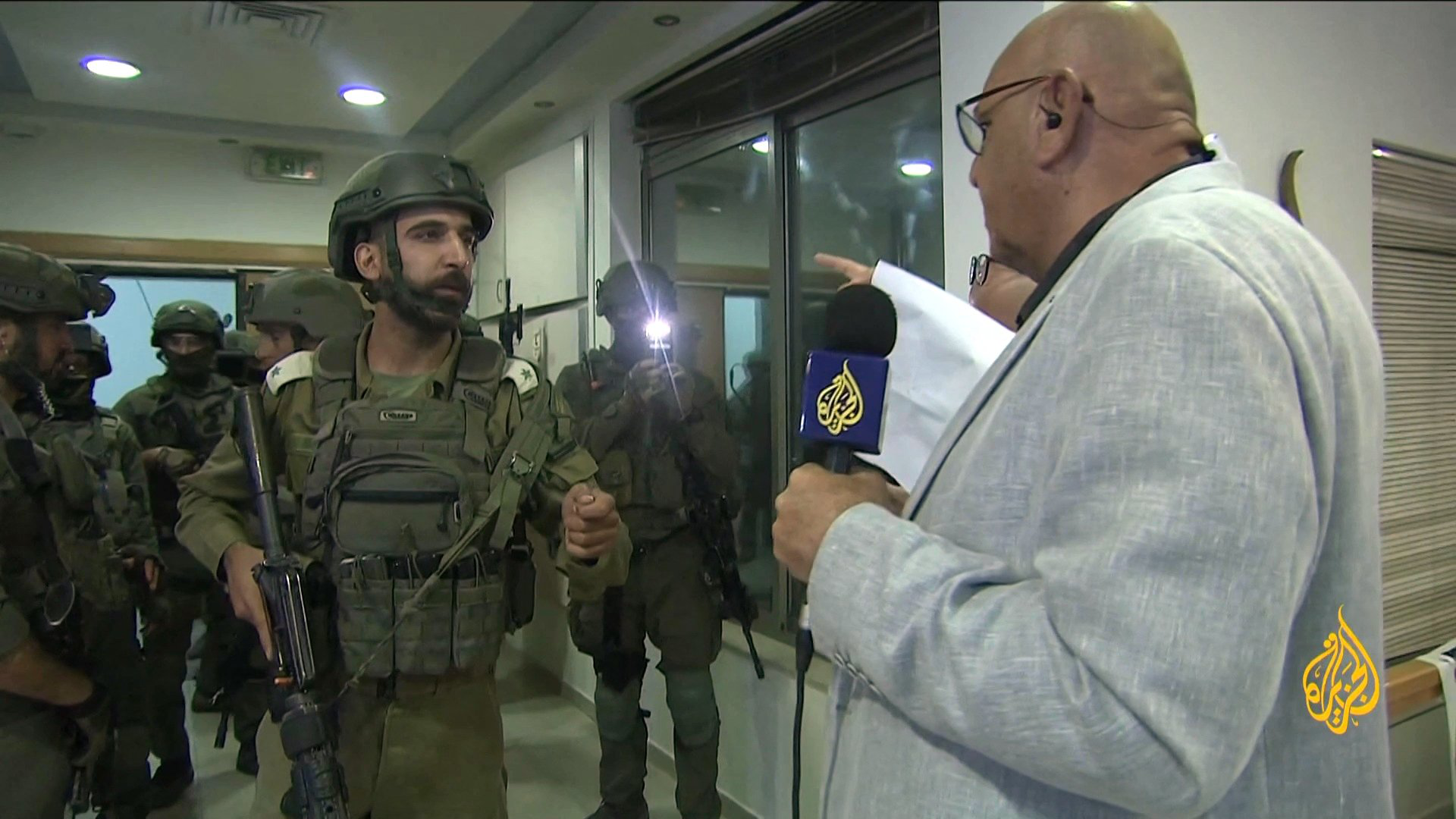
IDF soldiers hand an Al Jazeera reporter a military order directing the closure of his Ramallah office during a raid of the bureau on September 22, 2024. (Screen capture)
Al Jazeera did not liberate Arab political imagination; it domesticated it. The channel perfected what Pierre Bourdieu called symbolic violence, a quiet coercion that works through language and images rather than batons, until people end up policing themselves and turning fury inward. This is the exercise of power by fixing the categories through which people feel, judge, and act.
Night after night, Al Jazeera framed Palestine as a permanent emotional state rather than a political project, and the audience absorbed the cue. Outrage that should have targeted an external occupier was rerouted toward local institutions, police, ministries, and everything that could be blamed at home, producing catharsis without consequence.
That is how symbolic violence lands: the sign does the beating, and the beaten applaud the sign. The mechanism is editorial design rather than conspiracy. A constant loop of Palestinian pain and Arab indignation does two things at once. It keeps the moral temperature high enough to brandish on the world stage and it lowers the distance between the viewer and a domestic object of anger that can be attacked without international consequence.
There is nothing accidental about the architecture behind this effect. Qatar built a global media instrument with distinct faces for distinct audiences, and it learned to shape those faces to suit its power. Outside Qatar there are many Al Jazeeras, tailored by language and platform, from Al Jazeera Arabic to Al Jazeera English to AJ Plus and niche verticals. They interrogate rulers from Rabat to Riyadh with crusading energy and they frame the region as a rolling drama of moral exposure. Inside Qatar there is none.
The Arabic channel and the English channel often read like siblings raised in different houses, a pattern documented by comparative studies that find systematic differences in tone and ideological framing. Those editorial gaps are not quirks of translation. They are engineering choices that let Doha speak in many registers at once, stoking maximal heat in Arabic while smoothing the edges for global elites in English. The legal environment discourages it, the corporate culture avoids it, and the brand depends on keeping the home mirror dark. This is how the network can be a champion of dissent abroad and a model of discipline at home.
The hinge was in 2011. As Qatar’s foreign policy shifted from ostentatious mediation to muscular activism during the Arab uprisings, Al Jazeera’s Arabic operation followed with a harder, more instrumental edge. After 2011, the network’s editorial line repeatedly tracked Qatari foreign policy, and the famous gaps between Arabic and English output hardened into separate diplomatic horizons.
Scholars chronicled how a channel that once looked like a noisy town square began behaving like a political actor with a brief, especially when the story involved movements and governments that aligned with Doha’s bets. The resignations and leaks around Syria and Bahrain spoke to the same drift: when the narrative conflicted with policy, journalism yielded. The product was no longer only journalism. It became agenda-setting at scale, a managed moral economy of outrage that Doha could deploy, modulate, and withdraw.
Meanwhile, look at the home front. Qatar’s domestic political space remains tightly controlled, with no credible path for opposition to contest power and a press environment that does not scrutinize the ruling family with anything resembling the ferocity Al Jazeera aims at others. At home, the state nudges citizens away from politics and toward education, technology, and professional achievement. Politics is coded as risk. Abroad, politics is content. Even sympathetic analyses of the network concede the prevalence of self-censorship on Qatari matters.
The result is a one-way mirror: relentless moral theater abroad, disciplined quiet at home. That asymmetry is not just hypocrisy; it is design. Other people’s streets become the stage and other people’s institutions absorb the shock. The same machine that tells millions how to feel keeps its own public square quiet and neat, teaching that politics is a field to watch, not a field to enter.
If you want the clearest proof that Al Jazeera is a state instrument, return to the record. The 2010 diplomatic cables described how Qatar calibrated Al Jazeera coverage as leverage in foreign policy conversations, offering to modulate criticism in exchange for concessions. The network protested, as any network would, but the cables mapped what many journalists had sensed: this outlet is inseparable from the interests of the small elite that funds it. When policy requires conciliation, the volume lowers; when policy demands agitation, the drums roll.
Now consider the practical effect on Israel and Palestine. By staging Palestinian suffering as an endless moral spectacle while filtering out the patient, unglamorous work of politics, borders, institutions, and credible pathways to end control on the ground, the network supplies catharsis and withholds strategy. That arrangement is useful to Israel. It replaces sustained, organized leverage with diffuse, inward conflict across Arab societies.
A channel that incessantly humiliates Arab state structures while valorizing maximalist rhetoric leaves Palestinians with divided leadership, corroded institutions, and a region too busy burning itself to impose costs on an occupier. That is not resistance. It is a subsidy to the status quo. It floods the public sphere with images that travel faster than they can be translated into policy, invites Israeli officials to dismiss uncomfortable facts as partisan theater, and channels Arab anger toward their own bureaucracies rather than toward coordinated pressure where it could move realities that matter.
Even the Palestinian Authority, hardly a friend of Israeli policy, banned Al Jazeera from operating in the West Bank this year, accusing it of inflaming internal rifts. Israel, for its own reasons, has shut offices and blocked broadcasts as well. The point is not that both sides dislike the same channel. The point is that the channel’s signature achievement has been to keep Arab politics trapped in a loop where the loudest anger targets fellow Arabs, and the only consistent winner is the side that benefits from Arab fragmentation.
Al Jazeera’s defenders will say that powerful states always hate uncomfortable cameras and that the network gives voice to the voiceless. There was truth in that earlier period, when cross-border argument took shape and gatekeepers lost their monopoly. That is sometimes true. It is also beside the point. A media system can expose abuses and still function as strategic messaging for its patron.
In practice, Al Jazeera turns Palestine into a permanent spectacle that licenses moral fury while absorbing it into the domestic circuits of Arab resentment. The spectacle crowns the righteous and curses the enemies of the week, but it rarely builds the slow, disciplined coalitions that change facts on the ground. That is why, if you stand with Israelis who actually want a negotiated endgame or with Palestinians who want statehood rather than endless martyrdom, you should recognize the damage. A politics that never matures into institutions is a politics that serves the occupier by default.
None of this denies the reality of Palestinian suffering or the legitimacy of anger. It insists that anger has been instrumentalized in ways that empty the cause of strategy and turn solidarity into a mirror for domestic resentments.
A healthier media ethic would keep the primary wrong in focus and name it plainly, which means covering Israel’s regime of control with the same relentless attention granted to any Arab ministry, while refusing the easy slide from occupation to local vendettas. It would also submit the Qatari state to the same investigative scrutiny that Al Jazeera demands of everyone else, because moral authority abroad without accountability at home is not journalism but statecraft.
So let us be honest. Qatar’s channel mastered the art of manufacturing storms for other peoples’ streets and serenity for its own. It taught millions to chant at the mirror, not the wall. It taught governments that stepping into the arena means bleeding for someone else’s ratings.
And it taught Israel a lesson too: a region that performs revolution on television is a region that will not coordinate leverage in reality. In that sense, Qatar is the quiet partner in a symbolic war. One side holds land while the other holds the script, and the script is powerful enough to reorder attention even when it cannot move a single checkpoint. That is not journalism in the public interest. It is choreography in the national interest of a very small state, and the bill is always sent to the neighborhoods that can least afford to pay.
Until that symmetry exists, the region will keep supplying combustible publics, Qatar will keep supplying a frictionless studio, and the Palestinian cause will keep being performed rather than advanced. And the Palestinian cause does not need more televised tears if those tears are calibrated to ignite a thousand domestic fires while leaving the source of the blaze untouched.
Related Topics