CFO | Empower Society for Good I Author
The Real Battle Over Jerusalem Is the Meaning of Zion
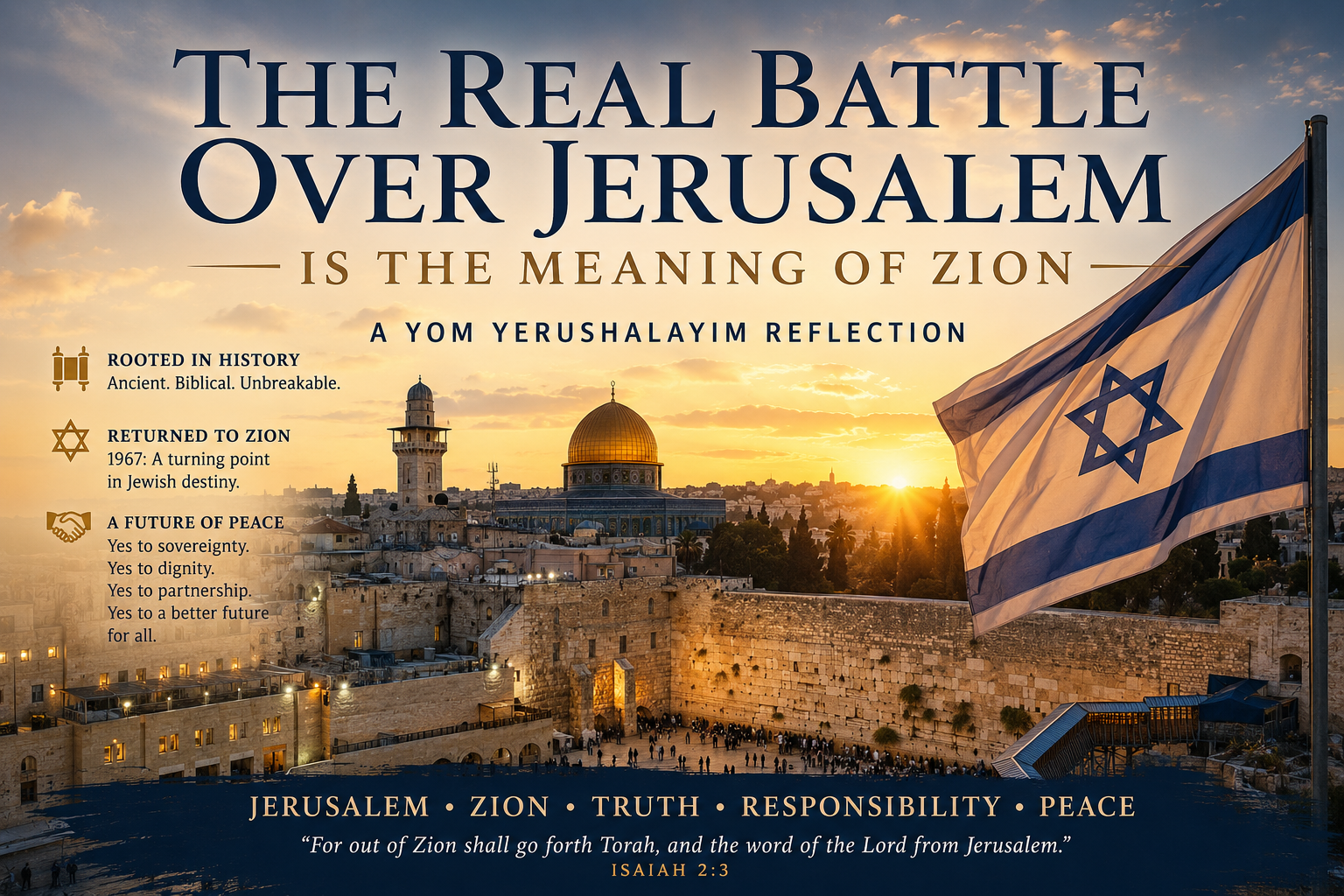
A Yom Yerushalayim Reflection – Zion and Zionism
The root of the word Zionism is Zion.
If Zionism were merely a modern political invention, then a provocative question must be asked:
Why is it called Zionism?
Why not Herzlism?
Why not Jewish nationalism?
Why not political Judaism?
The answer is that the movement drew its very name from Zion—a word rooted thousands of years earlier in the Bible, in Jerusalem, in the Psalms, in prophecy, prayer, exile, and longing.
The first biblical reference appears in the Book of Samuel:
“David captured the fortress of Zion, which is the City of David.”
At first, Zion was a physical place—a stronghold in Jerusalem captured by King David as he established the political and spiritual center of the Jewish people.
But the word quickly expanded beyond geography.
Sometimes the Bible speaks of Zion. Sometimes Jerusalem. At times they appear interchangeable, yet they also seem to represent different dimensions of Jewish existence.
Jerusalem is often the earthly city, the reality of politics, society, kingship, conflict, and history.
Zion becomes something deeper: the spiritual centre, the place of divine presence, redemption, longing, prophecy, and return.
This tension runs through Jewish history.
Is Zion merely a place?
A spiritual condition?
A prophetic vision?
A metaphysical ideal?
Or the soul of Jerusalem itself?
The Psalms cry out:
“By the rivers of Babylon, there we sat and wept when we remembered Zion.”
And Isaiah proclaims:
“For out of Zion shall go forth Torah, and the word of the Lord from Jerusalem.”
Perhaps the distinction itself matters.
Torah emerges from Zion—the spiritual centre.
The word flows through Jerusalem—the lived city of human beings and history.
The Dream of Return
For two thousand years, Jews did not simply dream of political independence. They dreamed of Zion.
Not merely for safety, but for return.
Not merely for sovereignty, but for presence.
Not merely for a state, but for meaning.
And this is what makes Yom Yerushalayim so extraordinary.
In June 1967, against all expectations, Jerusalem was reunified. What many feared could become another catastrophe became one of the most dramatic turning points in modern Jewish history.
The Jewish people returned not only to Jerusalem, but to the biblical heartland of Jewish history: Judea, Samaria, Hebron, Bethlehem, Shiloh, and the landscapes where so much of Tanach unfolded.
For many Jews, religious and secular alike, this did not feel merely political. It felt historical, emotional, even miraculous.
The Kotel was no longer a memory. Hebron was no longer inaccessible. The places mentioned in the Bible were once again physically present in Jewish life and consciousness.
For many Israelis, 1967 was not simply a military victory. It felt like history, memory, prayer, and destiny reconnecting in real time.
Jerusalem, Hebron, and the Biblical Heartland
This is often forgotten in modern discussions surrounding settlements and sovereignty.
For many Israelis and Jews, the connection to Judea and Samaria is not primarily colonial or political. It is civilizational, historical, spiritual, and biblical.
Jerusalem, Hebron, Bethlehem, and Shiloh are not isolated locations on a map. They form part of the biblical cord and foundation of Jewish identity itself.
Hebron is not simply a disputed territory; it is the city of the Patriarchs and Matriarchs. Bethlehem is intertwined with King David and Rachel. Shiloh once housed the Mishkan, the spiritual centre of ancient Israel.
The relationship between Jerusalem and the biblical heartland is almost organic—like a child connected to its mother. Jerusalem cannot fully be understood without the landscapes, stories, and covenantal memories that surround it. Remove Hebron, Shiloh, Bethlehem, and Judea from Jewish history, and Jerusalem itself becomes disconnected from much of its own spiritual and historical depth.
One does not need to support every settlement policy to recognize that the Jewish connection to these places is ancient, authentic, and central to Jewish consciousness.
But the argument is not only historical or biblical. It is also legal.
As legal scholars such as Natasha Hausdorff have argued, the legal status of Judea and Samaria is far more complex than the simplified language often presented internationally. The territories were not previously recognized as sovereign Palestinian land. The Jewish national home was recognized under the League of Nations Mandate, which included the right of Jewish settlement in these areas. Even after 1967, the application of international law to the territories has remained heavily disputed among legal scholars and diplomats.
For many Israelis, the phrase “occupied Palestinian territory” is therefore not simply a neutral legal description. It often feels like a narrative that erases Jewish historical, legal, and indigenous connection to the land while reducing the conflict entirely to modern colonial frameworks.
This does not remove the moral and political complexities surrounding borders, settlements, or Palestinian aspirations. But it does mean that serious discussion requires acknowledging that Jewish claims to Jerusalem, Judea, and Samaria are not recent inventions. They are rooted in history, religion, international diplomacy, and continuous Jewish presence.
At the same time, sovereignty creates difficult moral responsibilities. Ben-Gurion understood that power was necessary for Jewish survival, but power also carries danger. The challenge is not only how to regain sovereignty, but how to exercise it responsibly.
At times, this battle has also been accompanied by the creation of false narratives—attempts to deny or minimise the ancient Jewish connection to the Temple Mount, Jerusalem, and Judea itself. Yet Jewish history in these places is not modern or invented; it is woven throughout Tanach, archaeology, prayer, memory, and continuous historical presence.
And yet, recognising Jewish sovereignty and historical connection does not require rejecting coexistence, dignity, or partnership.
Quite the opposite.
The vision of Jerusalem in the prophets was never one of exclusion alone. The Temple itself is described as:
“A house of prayer for all nations.”
Yes to Jewish sovereignty and historical truth.
Yes to access and dignity for all faiths.
Yes to economic upliftment for both Israelis and Palestinians.
Yes to real peace, cooperation, and shared humanity.
The challenge is whether the region can move beyond denial, absolutism, and ideological hatred toward a future rooted not only in power, but in truth, responsibility, and mutual recognition.
Jerusalem, Al-Aqsa, and Competing Narratives
October 7 intensified this struggle dramatically.
Hamas itself called its attack “Al-Aqsa Flood,” recognising that the conflict is not merely about borders or checkpoints. The deeper battle is over Jerusalem, sovereignty, history, identity, and competing narratives.
The conflict today increasingly feels civilizational and theological, not only nationalistic.
In many ways, the existence of a sovereign Jewish state challenges centuries-old replacement theologies within parts of both Christianity and Islam that viewed Judaism as having been superseded by history. The return of the Jewish people to their land forces the world to confront an uncomfortable reality: the Jewish story did not disappear.
Perhaps October 7 also shattered another illusion — that Jewish sovereignty alone could solve the deeper questions of Jewish identity, unity, and purpose.
Who are we?
What binds us together?
What kind of society are we trying to build?
Rabbi Jonathan Sacks warned repeatedly that societies cannot survive on economics, military strength, or politics alone. A free society is ultimately a moral achievement built upon covenantal responsibility.
Perhaps that is the deeper challenge of Zion today.
Not merely whether Jews have returned to Jerusalem, but whether we understand what Zion asks of us.
The prophets envisioned Zion not only as strong but also as righteous. Not only sovereign, but holy.
At the same time, Jewish sovereignty should not require rejecting coexistence or human dignity. Isaiah described Jerusalem as “a house of prayer for all nations.”
Peace cannot be built upon denying Jewish history, nor upon erasing Palestinian humanity.
A sustainable future requires mutual recognition:
Recognition that the Jewish connection to Jerusalem and the biblical heartland is ancient and real.
Recognition that Palestinians also seek dignity, stability, and national expression.
Recognition that sovereignty must be accompanied by moral responsibility.
The prophets did not envision Zion as a fortress permanently at war with the world. They envisioned a society capable of combining strength with justice, identity with humanity, and sovereignty with moral purpose.
That remains Zion’s challenge today.
Because the real battle over Jerusalem has never been only about stones, borders, or territory.
It is about the meaning of Zion itself.
Related Topics
Related Posts