
Media Personality
The Rebuilding of the Bogotá-Jerusalem Axis
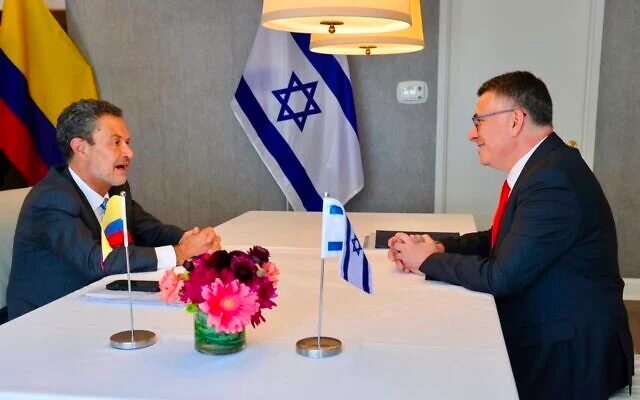
Colombia's incoming foreign minister Omar Bola Escobar meets with Foreign Minister Gideon Sa'ar in Washington on July 14, 2026. (Shmulik Almany/Foreign Ministry)
A nation’s foreign policy is often more enduring than short-term political circumstances. Governments change; national interests remain. It is against this backdrop that we should understand the eventual rebuilding of relations between Colombia and Israel—a strategic alliance forged over more than seven decades and fractured by diplomatic decisions in recent years.
The rupture was not a temporary accident, but rather the culmination of a deliberate process. On May 2, 2024, amid street protests in Bolívar Square, President Gustavo Petro announced that Colombia was severing diplomatic relations with the State of Israel, which he described as “genocidal.” His acting foreign minister, Luis Gilberto Murillo, later revealed that the decision had been eight months in the making, that is, it had been brewing since the first days following the massacre of October 7, 2023, when Hamas commandos murdered more than 1,200 people in southern Israel—including 364 young people dancing at the Nova festival—and took 251 hostages. Colombia was not immune to that tragedy: two Colombian nationals, Ivonne Rubio and Antonio Macías, who held dual Colombian-Israeli citizenship, died that day in the Re’im Desert, and a third, Elkana Bohbot, remained held hostage by Hamas for months. To this day, Petro has never publicly expressed condolences to those families—a silence that contrasts with his repeated ret
That pattern became even more pronounced months later, when Petro appointed Mauricio Jaramillo Jassir as Deputy Minister of Multilateral Affairs—an academic who, on October 7 itself, while the massacre was taking place, celebrated a “Palestinian Spring” on social media that humanity should support. Jaramillo Jassir never condemned Hamas’s crimes nor did he retract his statements; his appointment confirmed the ideological orientation of Petro’s Foreign Ministry and sent an unequivocal signal to Jerusalem and Washington: Colombian diplomacy had ceased to be an instrument of the state and had become a platform for activism.
Moreover, that episode was not an isolated outburst but part of a pattern that persisted throughout the entire term. In October 2023, Israeli Ambassador Gali Dagan denounced Petro’s statements as “fueling antisemitism” and announced, as a rebuke, the suspension of security exports. Petro wrote that he had already been to Auschwitz and now saw that horror “replicated” in Gaza, and that what is said today about the Palestinians is “what the Nazis said about the Jews”—a form of Holocaust distortion according to the definition of the International Holocaust Remembrance Alliance, which has been adopted by Colombian law itself. In January 2025, he went even further: he attributed the conflict to the “inept actions of Zionism, strongly backed by the international financial capital that they partially control”—a phrase that the Anti-Defamation League described as a classic anti-Semitic trope about Jewish control of finance. When confronted by U.S. Ambassador Deborah Lipstadt, Petro responded that Palestinians are also “Semites” according to the Bible, redefining the term rather than addressing the accusation. During the 2026 campaign, he posted “Heil Hitler” on social media in response to a column supporting the right-wing candidate—a gesture the American Jewish Committee described as reflective of a warped moral compass. This rhetoric was accompanied by institutional actions: the 2025 appointment of a so-called rabbi—who lacked recognized training and had ties to the Iranian ambassador—as director of Religious Affairs—a move condemned by the Simon Wiesenthal Center—and the expulsion, on October 1, 2025, of the Israeli diplomatic delegation.
Marcos Peckel, of the Confederation of Jewish Communities of Colombia, summed it up this way: Petro turned the term “Nazi” into a political weapon used routinely, exposing a century-old community to an unprecedented climate of hostility. That rift paralyzed essential cooperation in security, innovation, agriculture, intelligence, and trade—a situation exacerbated in August 2024 by the suspension of coal exports to Israel. The landscape, however, is shifting in a context marked by internal violence that has once again forced Colombia to face an uncomfortable reality. On June 7, 2025, Senator and presidential hopeful Miguel Uribe Turbay was shot in Bogotá; he died two months later, on August 11. In the Senate, Uribe Turbay was one of the most consistent defenders of Israel’s right to defend itself and had promised to restore bilateral relations; upon learning of his death, Netanyahu called him “a true friend of Israel and of the Colombian Jewish community.” The Attorney General’s Office attributed the masterminding of the assassination to the Segunda Marquetalia, a dissident faction of the FARC.
Beyond that attribution, Uribe’s death left a bitter lesson: being a visible ally of Israel and the Jewish community carries, in today’s Colombia, a political cost and, in extreme cases, a personal risk. That risk is not merely rhetorical. Recent intelligence investigations document that Hezbollah, funded by Iran’s Al-Quds Force, maintains a well-established operational presence in Colombia: Maicao, in La Guajira, serves as a logistics hub for money-laundering and drug-trafficking networks linked to its financiers, and the tri-border region with Panama and Venezuela is a focal point where the Cartel de los Soles, the ELN, and Hezbollah structures in a functional alliance with the Maduro regime.
Legislators such as Senator Bernie Moreno have denounced that this activity grew during Petro’s administration without being challenged, while financial triangulation schemes involving Qatar, Beirut, and Tehran ultimately fund conflicts in Gaza, Syria, Yemen, and Iraq. This is a hybrid threat—organized crime, transnational terrorism, and Iranian state sponsorship—that transcends any ideological considerations and that a future right-wing government, perceived by Tehran as a target for destabilization, will not be able to ignore. In this context, eventual normalization with Israel is more than a symbolic gesture: it is a strategic necessity. If Abelardo de la Espriella’s administration maintains its announced course, Colombia could initiate a normalization process that goes beyond the formal reinstatement of ambassadors.
The tenure of Secretary of State-designate Omar Bula Escobar will be decisive starting August 7: his challenge will be to restore a predictable foreign policy, shielded from political ups and downs, and capable of confronting—with Israeli and U.S. support—the concrete threat posed by Hezbollah and Iran on national territory. The first sign would be full normalization, which would reactivate the binational commissions and provide stability for investors. For decades, Israel was a key partner for Colombia in intelligence, cybersecurity, and the fight against organized crime; in the face of today’s hybrid threats, it is unfeasible to do without that expertise. This renewal could be facilitated by Washington: the Trump administration prioritizes supporting allies committed to regional stability, a vision shared by Secretary of State Marco Rubio. From Jerusalem, Isaac Herzog has emphasized strengthening scientific cooperation with the region, while Netanyahu and Foreign Minister Gideon Saar seek to expand technological alliances beyond the Middle East. Rebuilding the relationship will require more than mere ceremonial gestures: it will take restoring eroded trust and acting with determination against Hezbollah and Iranian networks.
The Free Trade Agreement remains an underutilized platform, and universities must play a central role in this agenda. Colombian diplomacy faces a historic opportunity to reclaim a basic principle: building relationships based on national interests rather than ideological whims. Relations between Bogotá and Jerusalem will never be the same again; every crisis leaves lessons, and this one has cost Colombian lives, both in the Re’im Desert and on the streets of Bogotá. For this very reason, this new phase must be built on more solid foundations: technological cooperation, security, science, and institutional respect. After more than seventy years of friendship, history shows that Colombia and Israel have too many common interests—and too many common threats—to remain estranged.
Related Topics