
The reckless Democratic letter on Israel’s alleged nuclear program
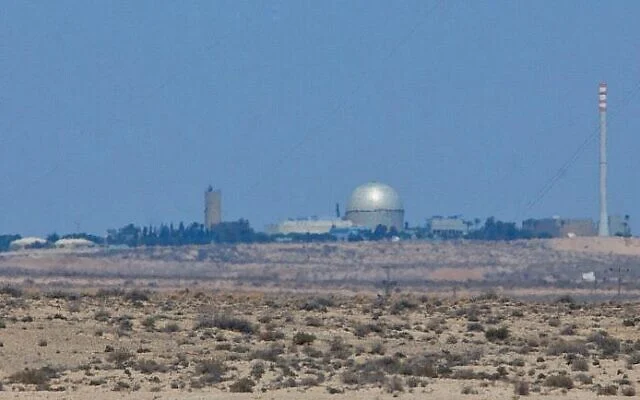
On Monday, May 4, 30 House Democrats, led by Rep. Joaquin Castro (D-TX) and including prominent progressives such as Reps. Rashida Tlaib, Ilhan Omar, and Alexandria Ocasio-Cortez sent a formal letter to Secretary of State Marco Rubio. The letter demands that the United States end its decades-long policy of official silence on Israel’s alleged nuclear program and publicly disclose highly sensitive details: the number and types of warheads Israel is widely believed to possess, delivery systems, uranium enrichment capabilities, activities at the Dimona reactor, and Washington’s understanding of Israel’s nuclear doctrine and “red lines.” The lawmakers frame this as a matter of transparency, consistency, and congressional oversight.
The letter has virtually no chance of success in the current Congress. But the real significance lies in the corrosive intent behind it: a growing radical faction within the Democratic Party that is willing to risk automatic cuts to U.S. aid to Israel during wartime, a potential regional nuclear cascade, and broader Middle East instability, all to play gotcha with Israel on false premises.
The legal and political trap
A formal U.S. determination that Israel possesses nuclear weapons, precisely what the lawmakers are demanding, would automatically trigger the Symington and Glenn Amendments. That would cut off nearly all American military and economic assistance to Israel, currently about $3.8 billion per year plus emergency supplements. But that is only the first problem. The letter’s most revealing sentence is its deliberately vague assurance that if a disclosure “would implicate U.S. laws concerning nonproliferation, we are ready to work with you to address those concerns through legislative action.” This wording offers no real commitment. It gives the signatories complete deniability: once the legal trigger is pulled, the damage is done. Reversing the cutoff would require new legislation, which Democrats could block with a filibuster in the Senate. Given that many of the signatories have repeatedly voted against Israel aid packages and supported efforts to condition or restrict that assistance, such cooperation is highly doubtful.
The legal asymmetry the letter ignores
The request conveniently omits a fundamental legal distinction. Israel has never signed the Nuclear Non-Proliferation Treaty (NPT) and is therefore not legally bound by its prohibitions, a position shared by India and Pakistan. Iran and Saudi Arabia, by contrast, are NPT signatories. Iran is in repeated breach of its safeguards obligations. Treating Israel as if it were violating the same rules is not “equal treatment.” It is selective application of international law.
The strategic value of ambiguity and the risk of ending it
For more than 55 years, both Israeli and American governments have deliberately preserved nuclear ambiguity. The policy rests on the informal 1969 understanding between Prime Minister Golda Meir and President Richard Nixon: Israel would neither test nor publicly declare nuclear weapons, and Washington would stop pressing it to sign the NPT or allow inspections of Dimona. Every subsequent U.S. administration, Republican and Democratic alike, has upheld this understanding, as has every Israeli government.
That ambiguity has been a net stabilizing factor in the Middle East. Before the late 1960s, Israel faced repeated existential multi-country, multi-front conventional wars (1948, 1956, 1967, 1973). Once the policy took hold, no Arab coalition launched a full-scale conventional assault aimed at destroying the Jewish state. And the ambiguity gave Arab governments a political off-ramp: they did not have to respond formally to a capability Israel never formally declared.
Even Avner Cohen, the leading scholarly critic of Israel’s nuclear opacity and author of the definitive work The Worst-Kept Secret: Israel’s Bargain with the Bomb (Columbia University Press, 2010), has acknowledged that this policy of amimut (Hebrew for deliberate ambiguity) has served as a durable stabilizing framework for over five decades. When the policy’s most prominent academic opponent concedes its strategic logic, the case for dismantling it in the middle of an active regional conflict becomes very difficult to sustain.
The same ambiguity enabled Israel to conduct decisive preventive strikes – one in 1981 that destroyed Iraq’s Osirak reactor, and the 2007 strike on Syria’s al-Kibar reactor that took the reactor out – without triggering all-out regional war. Both programs were halted in their tracks. Even Libya’s 2003 decision to abandon its WMD program occurred in a regional environment where Israel’s presumed capabilities were an accepted fact of life that Arab states had learned to live with, unlike Iran’s ideologically driven program.
Forcing an end to this ambiguity would not promote nonproliferation; it would risk the opposite. Saudi leaders have repeatedly stated that an Iranian bomb would compel them to acquire one. In February 2026, Turkish Foreign Minister Hakan Fidan warned that Iranian nuclearization could force Turkey into the same race. A formal U.S. declaration would strip Arab states of the last plausible deniability they have used for decades and could trigger precisely the nuclear cascade Washington and Jerusalem have worked for half a century to prevent.
Timing that cannot be ignored
The timing makes the maneuver especially dangerous. The letter arrived during the fragile pause after Operation Epic Fury, the joint U.S.-Israel campaign against Iran that began on February 28. Secretary Rubio declared the kinetic phase over on May 5, barely 24 hours after the letter was sent. Yet, the region remains tense, and large-scale hostilities could resume at any moment as talks are not really progressing. In recent weeks, the United States has rushed more than 115,000 tons of munitions and equipment to Israel, even as Dimona itself was targeted by Iranian missiles. This follows multiple failed Democratic War Powers resolutions aimed at halting operations against Iran. Unable to stop the war directly, the progressive wing appears to have found an indirect route: threaten the resupply lifeline of America’s key partner in the conflict.
The likely outcome and the longer-term trend
Secretary Rubio and President Trump are experienced enough to see through the trap. They will almost certainly ignore the letter and maintain the bipartisan U.S. policy of respecting Israel’s nuclear ambiguity, a policy that has served American and Israeli interests and regional stability for more than five decades. Yet the letter remains significant. Today, this faction is still a minority in Congress. But its influence has grown steadily: the original “Squad” of four members has expanded into dozens of lawmakers, with more expected in the upcoming midterms as the Democratic Party continues shifting further left. One day this faction may possess the numbers to force such an issue. The consequences laid out, like automatic aid halts, a potential nuclear cascade in the Middle East and heightened regional instability, would hurt not only Israel but broader U.S. interests in the Middle East.
The Castro letter is not a serious proposal for better oversight. It is a calculated attempt by a growing radical faction to use the language of “transparency” to achieve what its signatories have been unable to achieve through open votes: weakening Israel at a moment of strategic vulnerability. In wartime, such maneuvers are not merely partisan. They are reckless.