
The Reckoning We Have Been Too Blind to See
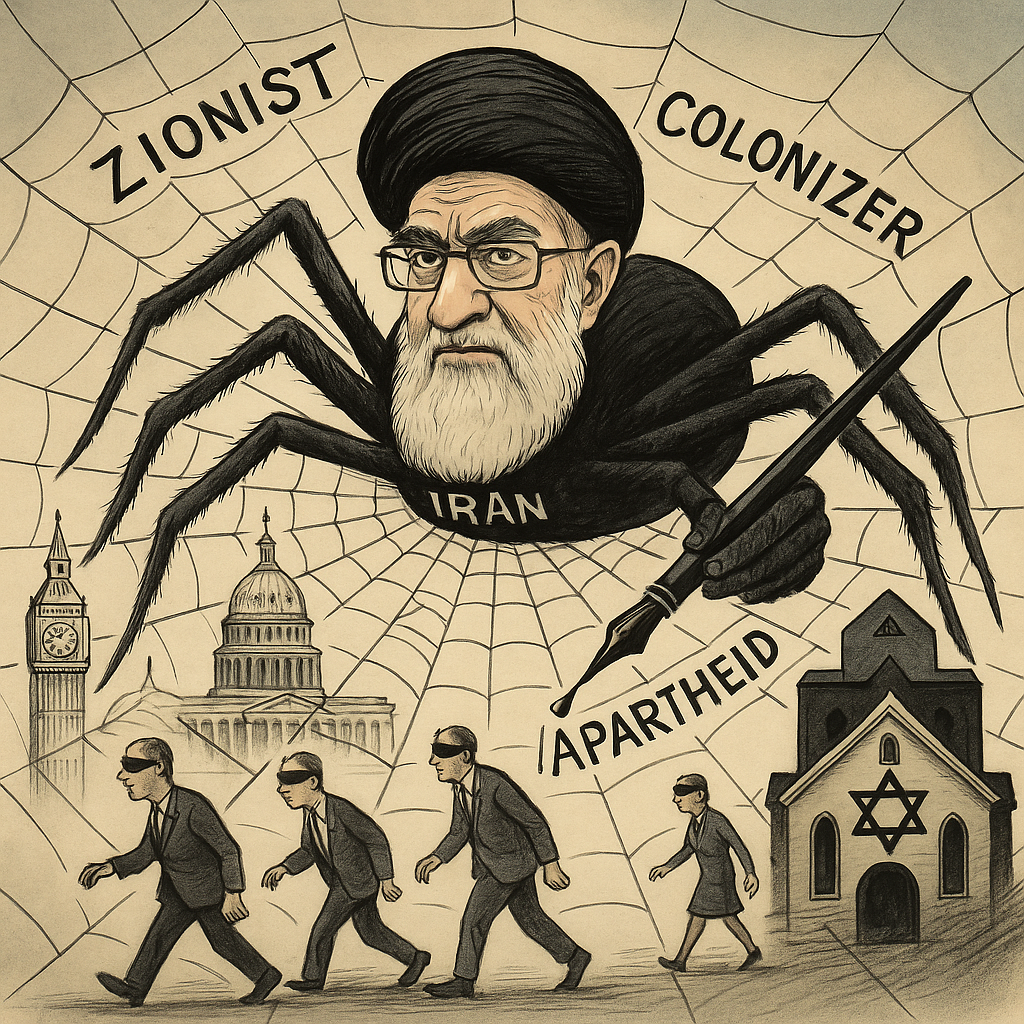
There are moments in history when one feels the chill draught of inevitability, the gust that rattles the shutters before the storm properly breaks. We in the West have been enjoying our dinner, pouring the wine, raising toasts, and pretending that all is well, even as the windows tremble and the floorboards creak. Now comes the icy blast.
The news that the Islamic Republic of Iran has been linked to the planning and execution of antisemitic attacks in Australia should shock us. Yet I fear it will not. Too many have grown inured, too many have learned to accept the absurd as normal, to call the grotesque mere eccentricity, to dismiss as “alarmism” the very warnings that demanded attention.
For years, analysts, journalists, campaigners — yes, myself included — have sounded the alarm. We have written, lectured, testified, pleaded: The regime is not a faraway curiosity, not simply a Middle Eastern theocracy whose dysfunctions are to be patronised at a distance. It is a spider at the centre of a global web, weaving threads of violence and hatred with patient skill, and one particular thread is spun of venom older than any state ideology: the hatred of Jews.
Why Jews? Why always Jews? There is a temptation to sigh, to shrug, to consign this question to the weary dustbin of eternal mysteries. Yet it is essential we answer it anew each generation. The Jew is the eternal outsider and insider at once — too assimilated, yet never assimilated enough; too powerful, yet too suspect; too visible, yet too hidden. A convenient screen upon which societies, regimes, and tyrants can project their failures, their jealousies, their rancid desires. Iran’s clerical masters understand this perfectly.
By weaponising antisemitism, Tehran achieves several goals at once. It distracts restless populations with a target safely external. It flatters a global cadre of extremists who see in Jewish existence a symbol of everything modernity has wrought. And most chillingly, it establishes networks abroad — in Europe, in North America, in Australasia — where local grievances can be radicalised, sharpened, and directed towards violence. All of it stitched together with the golden thread of hatred for Jews.
It is, in the theocrats’ eyes, exquisitely clever. If bombs are placed outside synagogues in Melbourne, if Jewish schools in London are daubed with swastikas, if rabbis in Paris are assaulted on their way home, the West finds itself distracted, divided, defensive. Debates about “Zionism” and “colonialism” become corrosive stand-ins for deeper insecurities. Our own civic conversation is remapped to match the hateful lexicon of exclusion imported from Tehran’s pamphleteers. And all the while, Iran’s Revolutionary Guards smile, for the West, so easily enraged with itself, does their work for them.
This is the reckoning we have been too polite, too indulgent, too cowardly to acknowledge. Our capitals — London, Paris, Washington, Canberra — have been lulled into a stupor. We chant “never again” in the same breath as we excuse antisemitic incitement as merely “anti-Israel rhetoric.” We fund institutions that allow Iranian propaganda to circulate while cutting grants for Holocaust education. We commission reports into “rising hate” but hesitate to name the source when it comes bearing the mark of the ayatollahs.
How deliciously ironic that a regime which represses women, murders homosexuals, censors artists, and persecutes dissenters has managed to smuggle its worldview into our universities and salons under the guise of “progressive critique.” The language of liberation has been hijacked to advance the most illiberal creed imaginable. And the Jews — poor Jews — have once again been volunteered as the sacrificial offering on this altar of hypocrisy.
Make no mistake: the attacks in Australia are not isolated. They are not aberrations. They are dry runs, test cases, rehearsals. If the West continues to downplay, to minimise, to defer, we will find ourselves facing a surge of orchestrated hatred that no platitudes will contain. Synagogues may be the first to burn, but they will not be the last. Once hatred has been normalised, once violence has been sanctified, no cathedral, mosque, or parliament is safe.
We in the West must awaken from our complacency. To be subdued, coerced, remapped in the image of a regime that thrives on exclusion is a betrayal of every democratic principle we claim to hold dear. The reckoning is not merely about Iran’s ambitions; it is about our willingness to resist them. Do we allow ourselves to be bullied, our discourse to be twisted, our minorities to be targeted — or do we draw a line, firm and clear, against the encroachment of theocratic terror?
There is, finally, no avoiding the oldest truth of all. The Jews are the canary in the coal mine. When they are targeted, society itself is in peril. To shrug off antisemitic attacks as niche or parochial is to miss the point entirely. Jews are chosen because they are useful to tyrants, yes, but also because their persecution is the herald of wider calamity. Always has been. Always will be.
The storm is coming. One can hear it in the rhetoric on our streets, see it in the defaced shopfronts, feel it in the cowardice of institutions too frightened to call hatred by its name. There is still time to act — to stiffen our resolve, to demand clarity from our leaders, to resist the seductive poison of Tehran’s narratives. But time, like sand, is slipping fast through our fingers.
We ignored the warnings. We treated the watchmen as cranks, the experts as alarmists, the Jewish community as over-sensitive. Now the shutters rattle louder, the night grows darker. The reckoning, long deferred, is upon us. Let us at least meet it with eyes open, words honest, and spines unbent.