The Right to Speak
A Belfast story about antisemitism, rehabilitation, and who is allowed to be heard.
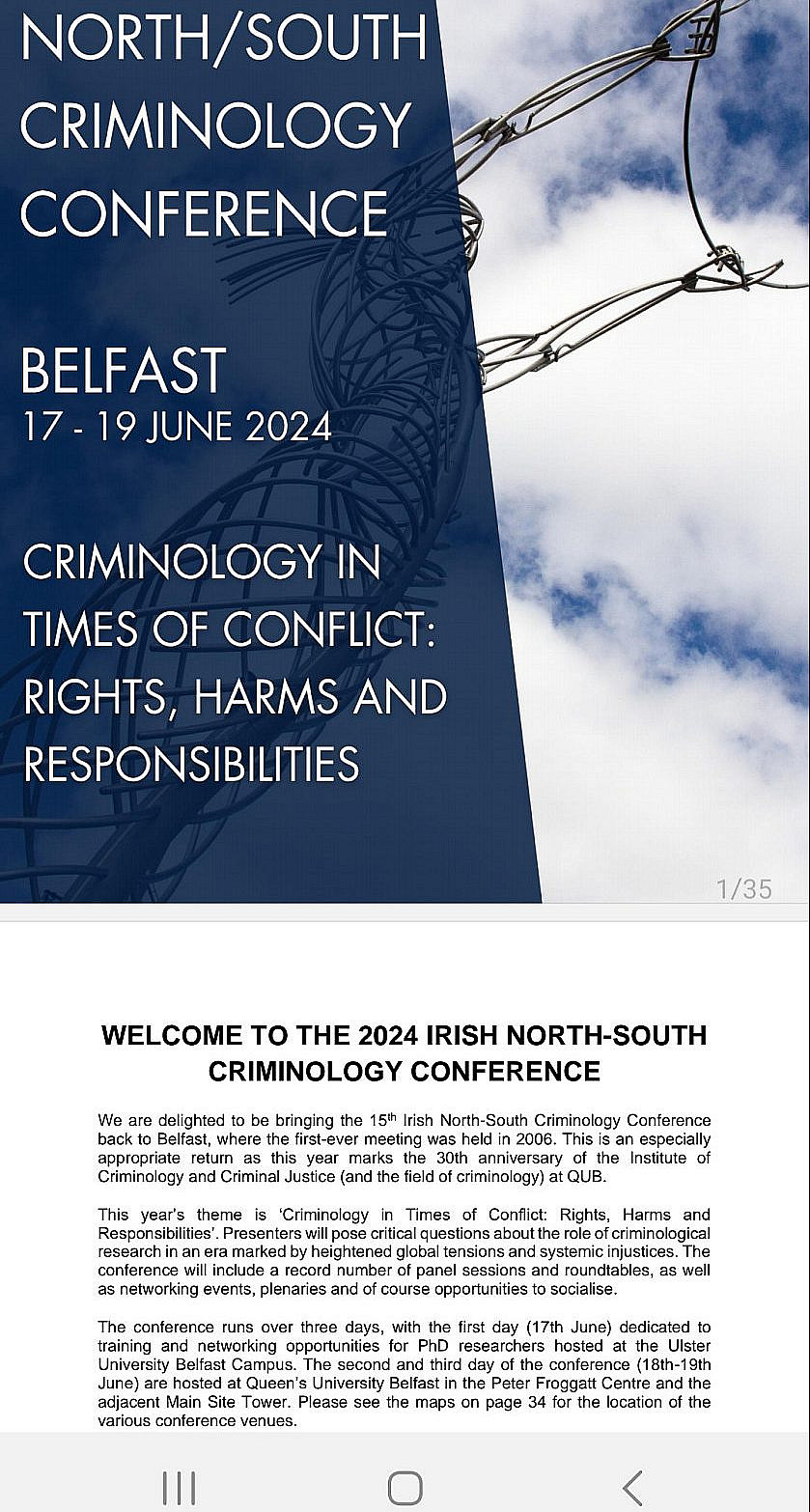
In June 2024, I travelled to Belfast to speak at the Irish North–South Criminology Conference. My subject was familiar — returning to faith and community, and the ways in which belief can anchor rehabilitation.
The conference theme, Criminology in Times of War, was framed as a study of justice under conflict, yet what unfolded was less dialogue than declaration. Gaza dominated the programme, and somewhere between empathy and politics, something darker began to surface.
I have no quarrel with the right of any people to tell their story, least of all those whose suffering continues. But there is a line between human-rights discourse and the vilification of another people’s existence. In Belfast, that line dissolved.
During one session, a Palestinian academic insisted that I attend her talk to “educate myself.” When I declined, explaining that I had chosen another session, she followed me from the corridor, shouting that October 7th was “nothing” — that what happened that day “had been happening every day since 1948.” The aggression was not abstract; it was physical. I was pushed, cornered, and made to feel that my identity itself was an offence.
Following the organisers’ guidance, I reported the incident to the Community Security Trust. It was not the only antisemitic episode that summer, and it was not the last. But it was the most visible — a moment that crystallised how little space there was for a Jewish voice in certain academic rooms. Months passed. Nothing more was heard.
Later that year, a report on antisemitism on campus caught the attention of a BBC journalist based in Belfast. She noticed that an incident had been logged there and contacted the CST for details. When I was asked whether I was willing to be identified, I agreed. It seemed important to speak — to say, gently but firmly, that antisemitism does not always arrive as graffiti or hate mail. Sometimes it appears as professional disdain, disguised as political virtue.
I spoke with the journalist several times. She was courteous, even sympathetic. But when the story reached editorial level, the BBC’s position became clear: they would only publish it if they could also include the fact that I had a criminal record — one long since spent — complete with the nature of the offence and the sentence.
In the United Kingdom, a spent conviction means that a person has completed their sentence and, by law, that conviction should no longer define or restrict their future. The principle is enshrined in the UK’s Rehabilitation of Offenders Act 1974, which applies in England, Wales, and Scotland, with related provisions in Northern Ireland. It allows most convictions to become “spent” after a set period, meaning they no longer need to be disclosed in most areas of life. It recognises that justice must end as well as begin. Yet in the public imagination, no conviction is ever truly spent.
Not only does this mean that I am not required to discuss it with anyone, but it also means that others should not be using Google searches to find or weaponise old information. I had never mentioned my past to this journalist — she had found it herself and chose to use it. As it happens, for reasons of transparency in my criminological research, I do often share aspects of my story where they illuminate questions of rehabilitation and desistance. I may do so again in this series, but it must always be my choice to disclose — not someone else’s decision to expose.
After all, no one introduces “Former shepherd, Rabbi Akiva” every time his name is mentioned. At some point, a person’s story has to move forward.
I had gone to Belfast to talk about rehabilitation and belonging. Yet in order to speak about being attacked, I was told I must first be exposed again — re-tried, re-labelled, re-shamed. I wondered whether this was bias against people with convictions or something else. At first, I thought the former. Then I noticed that when the BBC ran a story about the Reverend Jonathan Aitken — a man with a serious conviction of his own — they described him simply as “a former Cabinet Minister and prison chaplain.” No mention of the past. No resurrection of headlines. Just a story about a man of faith.
The contrast was impossible to ignore. When a Christian man speaks about redemption, his past is treated as context. When a Jewish woman speaks about faith, her past becomes evidence. The BBC did not want a story about antisemitism; they wanted a story that confirmed their comfort — that Jews who are attacked can still be treated as suspect.
I spoke to the Campaign Against Antisemitism, who were immediately supportive, and they connected me with a journalist from The Jewish Chronicle. But before the story could move forward, Iran attacked Israel and hostages were being released; the news cycle was overwhelmed. My experience — a small, local act of hatred — disappeared into the noise of global crisis.
Perhaps it was fitting that it happened in Belfast — a city whose skyline is still defined by the yellow cranes of Harland & Wolff, those towering reminders of an age when identity, labour, and loyalty were welded into one story of belonging. Between 1861 and 1963, Harland & Wolff built more than four hundred ships — yet most people can name only one – The Titanic. The city’s pride rests on a vessel that also became its grief. In that way, Belfast has never stopped trying to reconcile two instincts: to build, and to deny. There is a kind of Harland & Wolff syndrome that persists in parts of its civic and academic life — a desire to appear industrious and enlightened while quietly overlooking the rivets that hold prejudice in place.
The conference that set out to discuss Criminology in Times of War ended up exposing something far more domestic: how fragile the right to speak remains for those who carry both a faith and a record.
If rehabilitation is the promise that a person can begin again, then prejudice — religious or institutional — is the mechanism that denies it. What happened in Belfast was not an isolated failure of civility; it was a mirror. It showed that even in universities, even in the media, even among those who believe themselves enlightened, the myth endures: that some people are never quite entitled to be heard unless they first apologise for existing.
And yet, I did speak. I will go on speaking — in halls and prisons, in synagogues and universities, in places where belief is still permitted to mean something more than identity. Because the truest act of rehabilitation is not being forgiven by others, but refusing to collude in their amnesia.