The Royal House of Kanaani Est. 2026
Why a Jerusalem-born cat breed is being recognized as the Heirs to King Solomon’s Feline Throne
In 2026, I established the Royal House of Kanaani, a cultural, ceremonial and preservation institution dedicated to the future of the rare Jerusalem-born Kanaani cat.
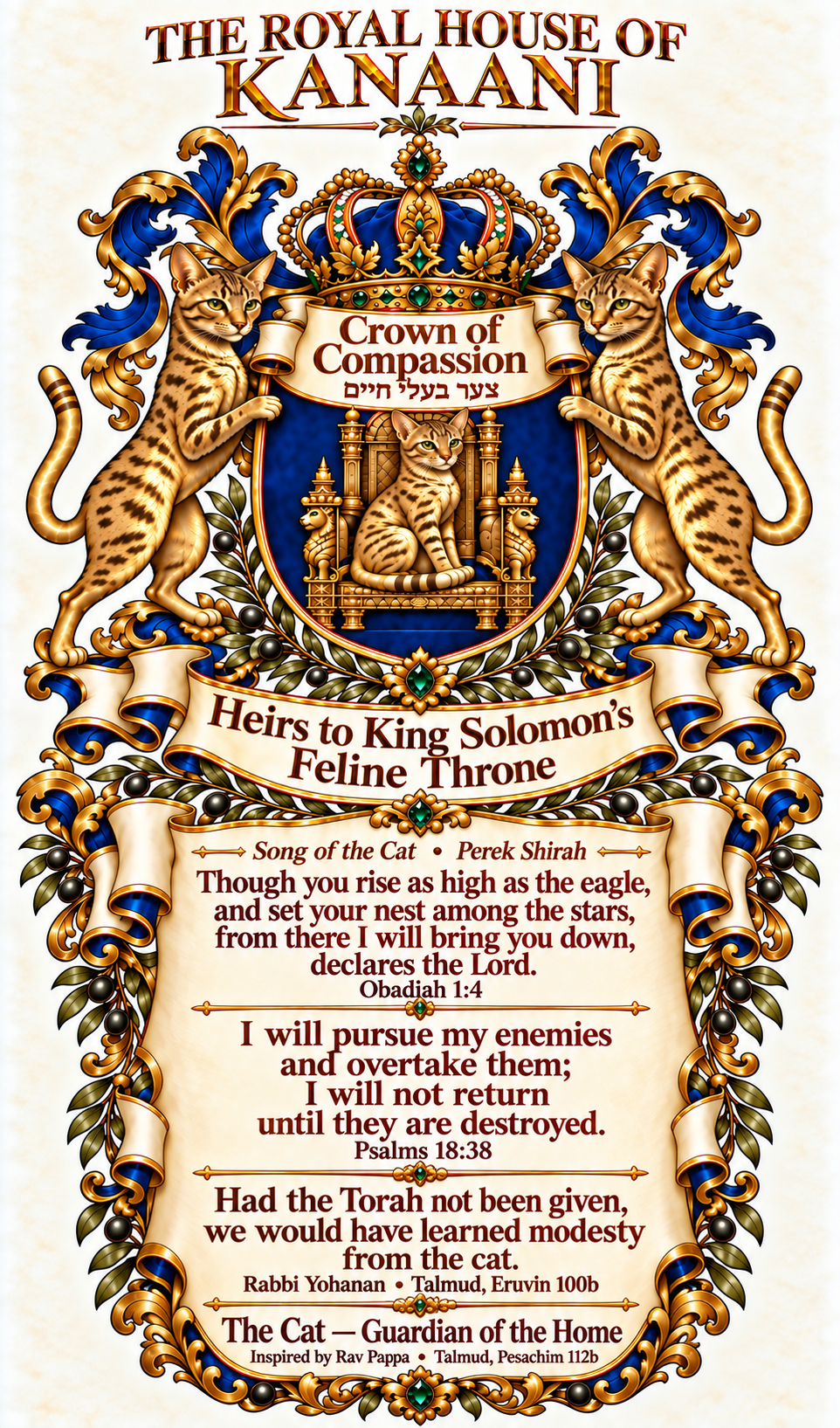
At the center of the House is a designation that I have used deliberately: Heirs to King Solomon’s Feline Throne.
The idea did not begin with a desire simply to place crowns on cats or to create decorative titles. It began with King Solomon himself, with Jewish tradition, with Jerusalem, and with a question that has stayed with me for a long time: Why did a king remembered throughout history for extraordinary wisdom choose a cat as part of the imagery of his throne?
Jewish tradition preserves a remarkable description of Solomon’s magnificent throne that includes a golden cat facing a golden rooster. We cannot know every reason behind that symbolism, and I do not claim that we can prove today whether the golden figure represented a particular living palace cat. But the choice itself matters.
Solomon did not place the cat outside the throne. He placed the cat upon it.
For me, that creates the beginning of a distinct Royal feline tradition associated with King Solomon.
The modern Royal House of Kanaani does not claim to crown a cat for the first time. It recognizes that Solomon had already given the cat a place of Royal honor. What we are doing now is carrying that symbolic tradition forward.
The Wise King and the Wise Cat
King Solomon remains one of the greatest kings in the history of Israel and one of humanity’s most enduring symbols of wisdom. His reputation crossed the boundaries of one nation and entered the religious and cultural memory of much of the world.
Jewish traditions surrounding Solomon also associate him with an exceptional understanding of the living world and with the language of animals.
That gives the feline presence on his throne an additional meaning.
Cats themselves have long invited associations with a quieter kind of intelligence: observation, patience, restraint, independence and the ability to watch before acting. Within the philosophy of the Royal House of Kanaani, these two images meet — the Wise King and the Wise Cat.
The Kanaani do not inherit Solomon’s human kingship. They do not rule over other cats, nor does the Royal House claim authority over other breeds.
What they inherit, in the cultural tradition of the House, is something different: a Royal feline tradition of dignity, wisdom, memory and responsibility.
That is what I mean when I call them Heirs to King Solomon’s Feline Throne.
From Jerusalem to the modern Kanaani
The second part of this story is the Land of Israel itself.
For generations, Israel has had its own local feline populations. In the 1990s, the modern Kanaani breed was developed in Jerusalem through the work of Doris Pollatschek, drawing inspiration from the appearance and character of local cats of Israel.
The Kanaani became a modern pedigreed expression of an Israeli feline identity rooted in the land.
That geographical continuity is important to the philosophy of the Royal House. King Solomon belongs to the history of Jerusalem and Israel. The golden cat belongs to the Royal imagery associated with his throne. The modern Kanaani was created in Jerusalem as a breed representing the feline character of the land.
This is the bridge.
King Solomon gave the cat a place upon his throne. Jerusalem gave rise to the modern Kanaani. The Royal House of Kanaani carries that feline Crown forward.
I do not claim a scientifically documented biological pedigree stretching three thousand years from one individual ancient cat to a modern Kanaani. That would be impossible to demonstrate.
What I do claim is a cultural dynastic succession: from the Royal feline symbolism of Solomon, through Jerusalem and the feline heritage of Israel, to the modern Kanaani and the living cats through whom the breed is being preserved today.
The continuity rests on four elements: the Crown, the Land, the Memory and the Living Lineage.
The Founding Royal Family
The Founding Royal Family of the modern House consists of His Majesty King Arbuz, Her Majesty Queen Haifa, Her Royal Highness Crown Princess Laila Yom Tov, His Royal Highness Crown Prince Sky, Her Royal Highness Princess Sasha, Her Royal Highness Princess Haya, and Her Royal Highness Princess Neshama.
Crown Princess Laila Yom Tov is the daughter of King Arbuz and Queen Haifa.
Together, these cats form the founding living nucleus of the Royal House of Kanaani. Their pedigrees, titles, descendants and future generations are intended to be preserved through the Royal Register of the House.
The titles are ceremonial and cultural, but the responsibility behind them is very real.
The Kanaani remained extraordinarily rare for many years. Its documented population became dangerously small, and its revival requires deliberate preservation, responsible breeding, veterinary care, pedigree documentation, genetic planning, international registration and public awareness.
That is one of the principal reasons I established the Royal House now.
A rare breed can disappear quietly. To prevent that, it needs more than reproduction. It needs identity. It needs memory. It needs cultural meaning. And it needs a reason for people outside a small circle of breeders to care whether it survives.
The Royal House is my answer to that problem.
The Crown of Compassion
I am an ordained rabbi and an ordained Animal Chaplain, and my animal-chaplaincy formation included study through the Compassion Consortium.
For me, the preservation of the Kanaani is inseparable from Jewish teachings concerning our responsibility toward living creatures.
The Jewish principle of tza’ar ba’alei chayim addresses the suffering of animals, while chesed teaches loving-kindness expressed through action.
Those ideas have become part of the moral philosophy of the Royal House.
I call that philosophy The Crown of Compassion.
The Crown is not bestowed for vanity. It represents obligation: to feed, protect, heal, preserve, notice suffering and act.
I sometimes express the idea in one sentence: We gave them a Crown so that the world would remember to protect them.
The Crown does not make an animal more valuable. It asks human beings to recognize the value that was already there.
My own role within the House reflects the same principle. I do not assume the title of king or prince. I serve as Royal Custodian of the Heirs to King Solomon’s Feline Throne.
My place is beside them, not above them.
They have the Crown. I have the responsibility.
Kanaani and a second Jewish cultural name
I also recognize that the word Kanaani can carry difficult associations for some religious Jewish readers because of the ancient Canaanite peoples described in Jewish scripture.
The modern breed name, however, functions as a geographical designation rather than an identification with those ancient peoples. Animal breeds are frequently named for lands or historical regions. Israel’s own Canaan Dog provides a close example, while names such as Persian and Siamese preserve older geographical terminology within breed nomenclature.
The established breed name therefore remains Kanaani. It is not my intention to erase or change the name of the breed.
At the same time, out of respect for Jewish religious sensitivities and because of the Royal tradition associated with the House, I am introducing a second Jewish cultural name: Chatul HaMelakhim — חתול המלכים — “The Cat of the Kings.”
The House may also use Chatul Yerushalayim — חתול ירושלים — “The Cat of Jerusalem” when emphasizing the breed’s connection to Jerusalem.
The distinctions are simple. Kanaani is the established breed name. Chatul Yerushalayim expresses the Jerusalem heritage. Chatul HaMelakhim expresses the Royal Jewish cultural meaning. Heirs to King Solomon’s Feline Throne is the dynastic designation.
Why establish a Royal House for cats?
Because preservation sometimes requires an extraordinary response.
The purpose of the Royal House is not to keep the Kanaani artificially rare. It is the opposite.
The goal is not to keep the Kanaani rare. The goal is to make sure it survives.
The House will work toward responsible preservation of pedigrees, healthy breeding, genetic diversity, animal welfare, historical research, cultural storytelling, education and international cooperation.
For me, this is also a larger cultural idea.
Humanity has spent thousands of years creating crowns, titles, monuments and ceremonies to express what we consider worthy of dignity and remembrance. I believe some of those same cultural tools can also be used to deepen our responsibility toward animals.
Giving Royal dignity to an animal does not diminish human dignity.
It can enlarge our understanding of it.
The Royal House of Kanaani therefore begins with Solomon, continues through Jerusalem, lives today through the Kanaani and looks toward generations that have not yet been born.
Its historical inspiration is King Solomon. Its geographical heart is Jerusalem and the Land of Israel. Its living bearer is the Kanaani. Its moral foundation is compassion. Its modern mission is preservation.
Solomon gave the cat a place of Royal honor.
Our generation gives that tradition a living future.
The Royal House of Kanaani — Heirs to King Solomon’s Feline Throne.
Established 2026.
Rabbi & Animal Chaplain Mikhail Salita
Founder, The World Kanaani Organization
Royal Custodian of the Heirs to King Solomon’s Feline Throne