The Ten Camels That Changed Jewish History
Parashat Chayei Sarah reveals how Rebecca’s compassion for animals became part of the divine providence guiding the future of Israel.
Why does the Torah call this portion Chayei Sarah, “The Life of Sarah,” when it begins with her death? I would like to offer my own interpretation. When we reflect upon the life of a remarkable person, we often do so after that person’s earthly journey has ended. Only then can we consider the meaning of an entire lifetime, its accomplishments, and the legacy left to future generations. In this sense, I see Chayei Sarah as a spiritual biography. Sarah’s death does not contradict the title of the portion; rather, it invites us to understand the meaning of her life through what continues after her departure.
Abraham was promised that he would become the father of many nations. His spiritual legacy extends across Judaism, Christianity, and Islam. Sarah, however, occupies a distinctive place in Jewish history. Through her son Isaac, and subsequently Jacob, the covenantal lineage of Israel continues. She is the first matriarch of the Jewish people, and her legacy lives on through the generations that follow.
According to a well-known Midrash, Sarah’s death was connected to the overwhelming news of the binding of Isaac, the Akedah. Although the Torah does not explicitly establish this connection, the tradition emphasizes the depth of Sarah’s maternal love and the emotional weight of the possibility of losing her son. Yet the story does not end with her death. The Torah introduces Rebecca, the woman destined to continue Sarah’s maternal and spiritual legacy. Remarkably, one of the first demonstrations of Rebecca’s extraordinary character is her compassion toward animals.
As a rabbi and Animal Chaplain, I find this detail particularly meaningful. While traditional commentaries rightly emphasize Rebecca’s kindness, hospitality, and generosity, I believe the animals themselves deserve closer theological attention. They are not incidental figures in the narrative. Their presence helps reveal something profound about the moral character of the future matriarch of Israel.
Abraham sends his servant, traditionally identified as Eliezer, to find a wife for Isaac. Upon arriving at a well, Eliezer prays to God for guidance and proposes a specific sign: the young woman who offers him water and voluntarily offers to water his camels will be the one destined for Isaac (Bereshit 24:14). He does not ask for a demonstration of wealth, beauty, or social status. He seeks an act of chesed, loving-kindness, that extends beyond human beings.
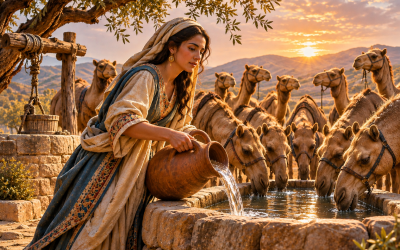
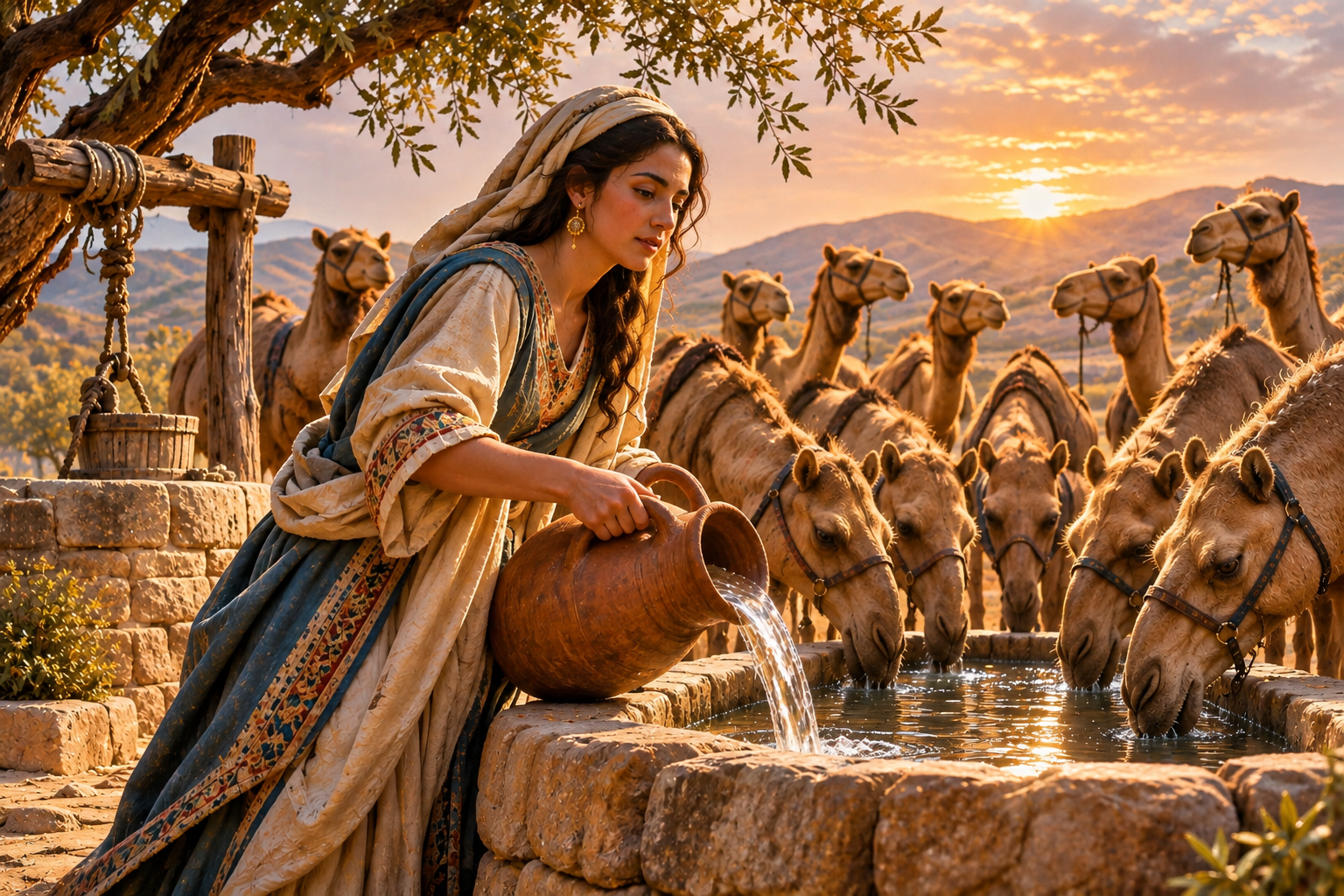
Before Eliezer has even finished his prayer, Rebecca appears. When he asks for water, she responds: “Drink, and I will also draw water for your camels, until they have finished drinking” (Bereshit 24:19). The Torah then describes how she hurries to empty her pitcher into the trough, runs back to the well, and continues drawing water for all ten camels.
We should not underestimate the physical effort involved. Ten thirsty camels, especially after a long journey, could require an enormous quantity of water. Depending on their condition, watering them could involve drawing hundreds of liters from the well. There were no mechanical pumps or modern conveniences. The Torah describes Rebecca herself repeatedly returning to the well and carrying out the work.
This is what makes Rebecca’s compassion so extraordinary. She does not merely express sympathy for animals or speak beautifully about kindness. She recognizes their needs and responds through sustained physical effort. Her compassion demands time, energy, and personal sacrifice. She does not know that Eliezer is searching for a wife for Isaac, nor does she realize that her actions will help determine her place in the history of Israel. She simply sees living creatures in need and chooses to help them.
This is what makes Rebecca Rebecca.
But the story raises an even deeper theological question. Why does this particular act become the sign through which Eliezer recognizes the future matriarch? Was Rebecca’s compassion part of divine providence? Did her kindness toward the animals find favor in the eyes of God?
The Torah does not explicitly say that God was impressed by Rebecca’s actions, nor does it describe God personally choosing the sign. Eliezer himself proposes it in prayer. Yet the narrative presents Rebecca’s arrival and fulfillment of the sign as an answer to that prayer. Eliezer subsequently blesses God for guiding him on his journey. In my theological reading, this sequence is profoundly significant: an act of compassion toward animals becomes part of the providential unfolding of the Jewish people’s future.
We often read the Torah primarily through the lens of human relationships, overlooking the spiritual significance of animals within its narratives. Yet animals are an essential part of God’s creation, not merely instruments of human convenience. In Bereshit, they are described as nefesh chayah, living creatures. After the Flood, God’s covenant with Noah explicitly includes every living creature (Bereshit 9:9–10). And in Tehillim 145:9, we read: “The Lord is good to all, and His compassion is over all His works.”
These words are fundamental to my understanding of Jewish Animal Chaplaincy. Divine compassion is not limited to humanity. It extends to the entirety of creation. If we seek to imitate God’s attributes of mercy and loving-kindness, our own compassion should not end at the boundaries of the human species.
Generations after Rebecca, King Solomon expressed a principle that captures this responsibility with remarkable precision: “Yodea tzaddik nefesh behemto” — “The righteous person knows the soul of his animal” (Mishlei 12:10).
The Hebrew word nefesh deserves particular attention. While Jewish theology distinguishes between different dimensions of human and animal life, the verse unmistakably calls upon the righteous person to recognize the needs and living nature of the animal under their care. Righteousness is not measured solely by how we treat other human beings, but also by how attentively and compassionately we respond to creatures who depend upon us.
Rebecca embodied this principle long before Solomon articulated it. She recognized the thirst of the camels without being asked to help them. She understood their needs and acted upon that understanding. In doing so, she demonstrated that true compassion is not passive sentiment but active responsibility.
Judaism does not prohibit every form of human use of animals. However, the Jewish tradition recognizes moral obligations toward them, including the prohibition against causing unnecessary suffering, known as tza’ar ba’alei chayim. Animals may participate in human life and labor, but they are never morally insignificant. Their hunger, thirst, exhaustion, fear, and suffering matter.
As an Animal Chaplain, I believe this distinction is essential. Animals are not simply resources placed at humanity’s disposal. They are living creations of God, possessing their own needs and their own place within the divine order. When we care for a thirsty animal, comfort a frightened creature, or protect an animal from unnecessary suffering, we are not merely performing an act of kindness. We are acknowledging the sacred responsibility entrusted to humanity within creation.
Rebecca’s story also invites us to consider the relationship between compassion and blessing. After her encounter with Eliezer, the events leading to her marriage with Isaac unfold, and her family blesses her: “Our sister, may you become thousands of myriads” (Bereshit 24:60). Her kindness toward the camels should not be understood as a transaction that automatically earns divine reward. Rather, it reveals the qualities that make her an appropriate successor to Sarah’s spiritual legacy.
The distinction is important. Genuine compassion does not calculate rewards. Rebecca did not water the camels because she expected a blessing, marriage, or recognition. She acted because she recognized a need. Her kindness was sincere precisely because it was freely given.
At the conclusion of the narrative, Isaac brings Rebecca into the tent of Sarah, his mother. The Torah tells us that he loves Rebecca and finds comfort after his mother’s death (Bereshit 24:67). Rashi, drawing upon the Midrash, describes the return of the blessings associated with Sarah’s tent upon Rebecca’s arrival. The spiritual continuity between the two matriarchs becomes unmistakable.
We can now return to the question with which we began: Why is the portion called The Life of Sarah when Sarah dies at its beginning?
Because Sarah’s life must be understood not only through the years she lived, but through the spiritual legacy she left behind. Her covenantal lineage continues through Isaac, and her maternal legacy finds a new expression in Rebecca. And before Rebecca enters Sarah’s tent, the Torah reveals her character through an extraordinary act of compassion toward ten thirsty animals.
For me, this is one of the most beautiful and often overlooked dimensions of Chayei Sarah. The continuation of the Jewish people’s maternal lineage is accompanied by a demonstration of mercy toward living creatures who cannot speak for themselves.
Perhaps we should ask ourselves how often we overlook similar opportunities in our own lives. How often do we notice an animal’s suffering but fail to respond? How often do we regard animals primarily in terms of their usefulness rather than recognizing their intrinsic place in God’s creation?
Rebecca teaches us that compassion must be more than an admirable idea. It must become action, even when that action is difficult, inconvenient, or physically demanding.
The ten camels remind us that the way we treat animals is not separate from our spiritual lives. It is one of the ways in which our spiritual character becomes visible.
Sarah’s life ended, but her legacy continued. And the woman who carried that legacy forward was someone who understood that the thirst of an animal was worthy of her attention, her labor, and her compassion.
Perhaps the most enduring lesson of Chayei Sarah is that Rebecca did not become extraordinary because she spoke about kindness. She became extraordinary because, when ten thirsty animals needed water, she returned to the well again and again until every one of them had enough to drink.
That is the compassion I believe God calls us to practice.
Shabbat Shalom.
Rabbi Mikhail Salita is an Animal Chaplain and Jewish theologian whose work explores the spiritual and ethical relationship between human beings and animals within Jewish tradition.