
The Sacred and the Light Up Dance Floor
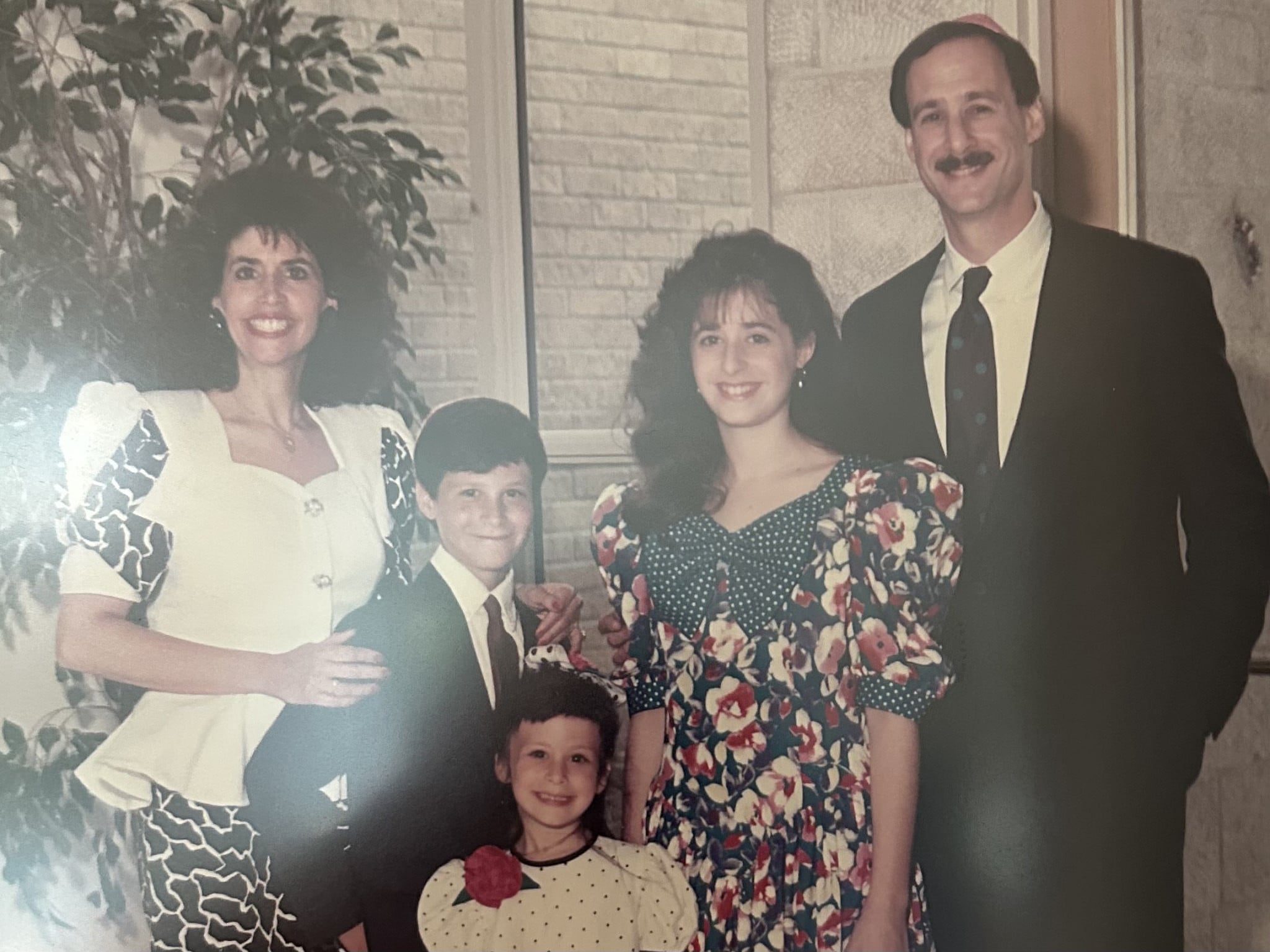
My family and I just celebrated our middle daughter’s bat mitzvah, and throughout all the moments–the ceremonious, the silly, the profound–I couldn’t help but to ponder this millenia-old tradition.
Growing up in suburban Houston in the late 80s, I was blessed to have had my seventh grade social calendar overflowing with bar and bat mitzvahs. Saturday mornings were spent chitchatting in synagogue pews and Saturday nights filled with parties with all of my friends in hotel ballrooms. All the boys and girls dancing amidst the ice sculptures, our taffeta balloon sleeves rivaled in height only by our hair-sprayed permed hair. We were living out our dreams on the dance floor, sharing our secret crushes underneath the din of the DJ. As I slow-danced to Whitney Houston with Josh Schwartz, a space the size of a redwood tree trunk between us, I remember thinking this was bliss. And now, looking back, it absolutely was. But viewing this time-honored ritual through mature, maternal eyes, I see it a bit differently.
A solid thirty years after seventh grade, I went back to a bat mitzvah service as preparation for my daughter’s upcoming mitzvah. As a mother about to embark on this journey for my eldest daughter, my first thought was, “Were our ancestors sadists? Requiring pimply-faced thirteen year olds, at the precise moment that the boys’ voices are cracking and the girls are testing out training bras and high heels, to get up on the bimah in front of everyone and sing?! In Hebrew!! At the apex of teenage insecurity, they thought, let’s force a microphone into these kids’ hands. Sink or swim, suckers.
But after I recalibrated to the bat mitzvah girl’s nervous energy in the spotlight she so desperately wanted to flee, I realized that the Talmudic scholars who created this tradition were not just sadists; they were geniuses. This ceremony, and all of the hard work and preparation leading up to it, is the connection to our past, the bridge to our future, and the thing that brings meaning to three generations all in one fell swoop. Plus it promises a killer party in the end (more on that later).
This tradition grounds our children, connecting them through time to their ancestors, who learned to recite the same prayers in the same tunes and read the same arcane Torah portions sung to the same trope. How comforting it is to know that in this topsy turvy, constantly changing world, our sacred texts are constant. They are the inexorable source of our wisdom and values no matter what changes around us. Through this journey, our children begin to see themselves as a singular dot on a connect-the-dots puzzle, an essential piece of the greater picture. They matter beyond their success at baseball or piano or how popular they are this week. They are an indispensable part of our people-past, present, and future-for whom the sum of its parts is greater than the whole.
Also, our children push themselves vigorously over the course of several years to study, learn, and then teach the community their findings. This is not perfunctory preparation. This is an enormous, oftentimes daunting lift. Our kids attend Hebrew classes and Sunday school; they meet with their rabbis and their cantors. How do they make time for this amidst their overscheduled days shuttling between school and sports and music lessons? They just do, because we make it a priority.
And throughout this process, or maybe even years later, but eventually, they internalize one of our greatest Jewish values: learning. From an early age they are taught to question, debate, analyze and reason. They learn to read text with a discerning eye, considering many interpretations to then deduce their own. Rashi says this, but Maimonides says that, and modern day rabbis disagree with both of them. They then have to reconcile these diverse ideas to understand the lessons from the Torah and apply them to their own lives. And yes, they are distilled into their simplest forms: “when my mom asks me to clean my room, I should follow the ten commandments and clean my room,” “when my friend asks me to go to a party, but I’ve already made plans with someone else I should honor my commitments.” And sometimes relating a parsha about animal sacrifices and communal diseases to the bar mitzvah kid’s ability to live without the latest pair of Air Jordans is a real stretch. But it’s a start. This application of law and morality to our children’s lives teaches them reason, introspection, and ultimately an understanding of our values.
They also learn how to give a D’var Torah in front of tens and hundreds of people. It is public speaking 101. They learn how to work with adults and how to publicly thank those who have guided them, honoring their parents and teachers. In return, the parents honor the child, showering her with praise for her commitment and character, celebrating the special person she is, and planting the seeds for her self-confidence and self-reliance as she grows into an adult. Every child should get this gift at least once in her life, a moment in the sun, honored by the parents who brought her into the world before the entire community. This holistic process sets our children on a path towards educational attainment and leadership. It is the bridge to their future, Jewish and otherwise.
The bat mitzvah ceremony is also strikingly brilliant at convening and honoring three generations at once. The parents, grandparents and the whole community pass down a tradition while at the same time raising up a child to meet the responsibilities of that tradition. And the ceremony occurs at a uniquely finite moment in time, when the child is old enough to remember and when her grandparents are hopefully young enough to remember. It is a spectacular blip in the arc of a family’s life, the convergence of three generations who each appreciate the moment from uniquely different perspectives. The grandparents look back at their lives with a bittersweet nostalgia, the child looks to the future with excitement for what is to come, and the parents focus on their child in the present, sharing in the emotions that she is feeling. And all of them are bursting with pride and love. Every time I witness the three generations standing on the bimah and passing the Torah down one by one, it makes me think both how big and small our lives are, how short a time we have, and yet how long we’ve been telling our story. L’dor v’dor.
And all of this beauty and wisdom and connection culminates under the strobe lights and the giant balloon installations at the bar mitzvah party. The word “party” is really insufficient to describe what these events have become in our culture. They are more like the Met Gala, just customized to thirteen year olds’ tastes. The ice sculptures and chocolate fountains of yesteryear have been replaced with pyrotechnics and prizes. There are swag bars where you can take home an item of clothing for every day of the week with a kitchy embroidered logo in the bar mitzvah kid’s colors, candy bars the length of a football field, and an LED dance floor causing vertigo in the over 60 crowd. As the DJ starts playing Pitbull, half a dozen dancers come out doing moves like it’s a Superbowl half time show. Our forefathers had no idea of the incentivizing value of jelly cats and lululemon gift cards to get the dance floor going.
The cultural depictions of excess and materialism from Adam Sandler movies to Philip Roth novels are not unfounded and also not surprising. Somehow humans have an amazingly consistent ability to take things too far. In a post-war America that enabled Jewish ascension in society, we savored our newfound material success and were not afraid to display it. And we deserve to enjoy the fruits of the labor that immigrant-minded striving bestowed upon us. But in all of this achievement, sometimes it can be hard to remember the sacred purpose of it all, the meaning behind the glittery dresses and custom Nikes. But I saw it with my own daughters, and I see it every time I attend a friend’s bar or bat mitzvah; this hallowed custom is a beautiful reminder of everything we stand for. It might even be part of the reason why we are still here.