
The Sanctions Paradox
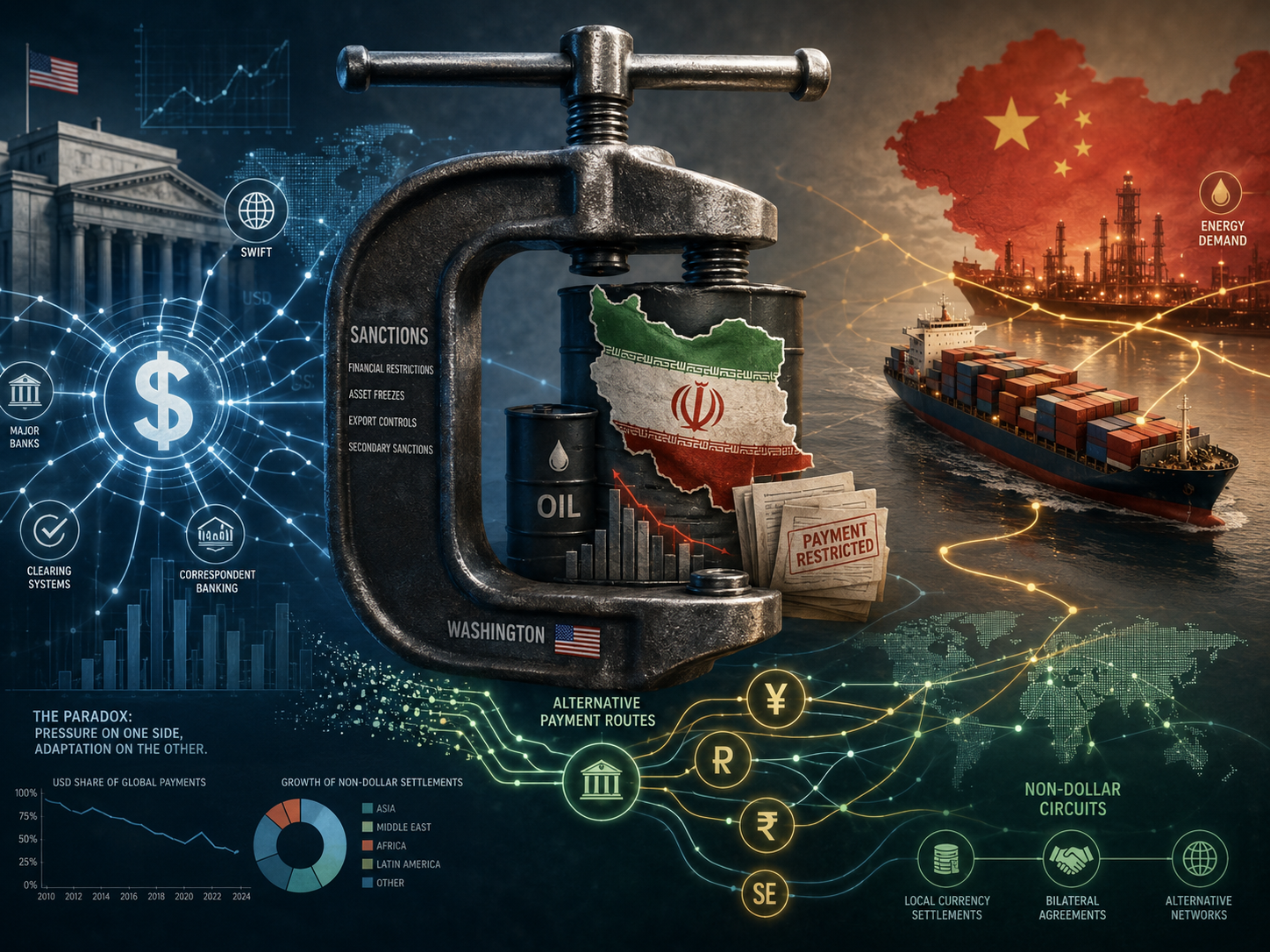
To understand the power of American sanctions against Iran, one must look beyond Iran itself.
Washington does not only possess considerable military power. The United States also has a much more discreet lever: the role of the dollar in the global economy.
A large part of international trade and financial transactions still passes, directly or indirectly, through the American system. This gives Washington a particular capability: to sanction Iran, but also to threaten those who continue to trade with it.
This is the principle of secondary sanctions.
The message sent to a foreign bank or company is simple: you can continue to work with Iran, but you then risk losing access to the American market, to American banks, or to the dollar.
This is where what one might call “Washington’s vise” closes.
The strategy is strikingly effective when it forces a company to choose between a relatively limited Iranian market and access to the American financial system.
But the more Washington seeks to isolate Tehran completely, the more difficult it becomes.
Because it is no longer enough to sanction Iran, one must also convince or compel the countries that continue to trade with it.
And the main problem is called China.
Beijing remains the largest buyer of Iranian oil and refuses the principle of unilateral American sanctions. Washington can sanction small Chinese companies without triggering a major crisis. The situation becomes much more complicated if it must target large banks, major energy groups, or strategic Chinese institutions.
At that point, pressure on Iran risks turning into an economic confrontation with China.
This is the paradox of the American strategy.
To make the sanctions truly effective, Washington must gradually threaten increasingly important players. But the more important these players are, the higher the economic and diplomatic cost for the United States.
The power of the dollar then meets its real limit: ”interdependence”.
It is relatively easy to ask a small bank to choose between Iran and the United States. It is much more difficult to ask the same question of China, India, or other major economies without causing much broader consequences.
Finally, there is another risk, much slower.
Each time Washington uses access to the dollar as an instrument of coercion, it gives countries that fear this weapon one more reason to develop alternative payment systems, to use their national currencies more, or to seek financial circuits less dependent on the United States.
This obviously does not mean that the dollar will lose its central place tomorrow. We are very far from that.
But this may be the paradox of any effective geopolitical weapon: the more it is used, the more those it threatens seek to protect themselves from it.
Washington’s vise can therefore continue to tighten around Iran. But its real test will probably come when the United States must choose between two objectives: isolating Tehran or preserving its relations with the major powers that refuse to participate fully in this isolation.
The question will then no longer be just how long Iran can resist.
It will also be how far Washington can turn the dollar into a weapon without gradually giving others a strategic reason to try to escape it.