Exploring Memory, War, and Survival
The Scream That Followed Me Home
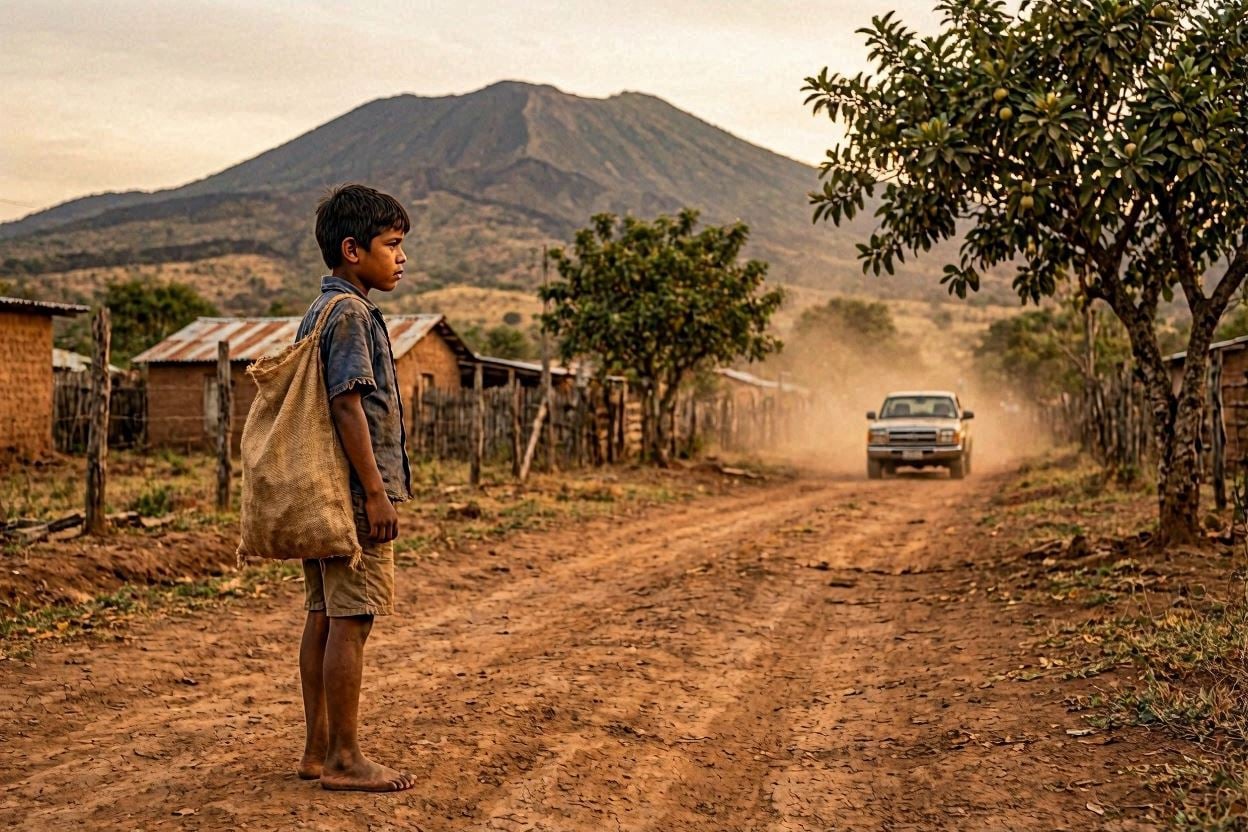
Illustration created with AI based on the author's memories.
There are sounds that never completely leave the body. They fade for years, hide beneath work, distance, language, and adulthood. Then one afternoon, without warning, they return exactly as they first arrived—raw, immediate, and alive. For me, it was the scream of a mother beside her dying child.
I was still a boy during the Salvadoran civil war when I began working in the hills outside San Jorge. Poverty and war often forced children into adulthood long before they understood what adulthood meant. By the time I should have still been worrying about school or games, I was already walking long distances carrying sacks through dry creek beds and orchards, helping harvest fruit to put food on our table.
I remember those mornings clearly: the dust rising beneath my bare feet, the heat beginning before noon, and the smell of guavas ripening in the trees. The long paths wound through Jocote Dulce and the hills beyond town. Sometimes a torogoz—El Salvador’s national bird—would land briefly on a branch nearby, its colors startling against the dryness of the landscape. Even during war, beauty continued appearing in small places.
That morning had begun like any other. A woman from town had taken me along to help gather fruit from neglected trees in the countryside. I carried an empty sack over my shoulder while the sun climbed slowly behind the Chaparrastique volcano. At first, the day felt ordinary. Then we heard the explosion. It came from somewhere farther up the creek bed—a deep sound that rolled through the hills and silenced the birds all at once. I remember stopping in the middle of the path while dust drifted through the heat. The woman beside me looked frightened, but after several moments of silence, we continued walking. War teaches people to continue moving even after hearing things that should make them run.
A few minutes later, a pickup truck raced past us at terrifying speed, throwing dust into the air. Inside, a woman screamed so violently that even now I struggle to describe it. It was not simply panic; it was the sound of someone already understanding that her entire world had ended. We followed the truck to a small farmhouse farther up the creek bed. I did not know then that I was walking toward the moment that would divide my childhood into a definitive before and after.
The yard was full of confusion. Men moved frantically searching for water and cloths, while the woman kept crying out her son’s name. And there, lying on the dry earth beneath the heat, was a boy. He could not have been much older than I was, his body torn apart by the explosion. Someone was pouring water over him as if water could still repair what war had already destroyed.
I froze completely. The world seemed to narrow into details my mind never released afterward: the dust sticking to the blood, the unbearable sound of the mother screaming, and a small red bracelet hanging loosely from the boy’s wrist. For years, I wondered why I remembered the bracelet so clearly. Now I think memory sometimes chooses small things because the larger reality is simply too terrible to hold directly.
The woman who had taken me there finally touched my shoulder and told me we needed to leave. I followed her back down the creek bed in silence, carrying the empty sack that suddenly felt heavier than anything I had ever carried before. When I returned home, my mother immediately understood something had changed in me. She did not force questions; she simply held me for a long moment at the doorway. That night I could not eat. I lay awake listening to every sound outside the house while the mother’s scream repeated itself endlessly inside my head.
Until then, war had existed around me. After that day, it existed inside me.
For weeks afterward I barely slept, waking suddenly in the darkness hearing the scream again as clearly as if I were still standing in that yard. During the day, I continued helping my mother—carrying water, gathering wood, doing whatever children in poor towns learn to do early. But something fundamental had shifted. I had seen another child lying dead on the ground, and I understood, perhaps for the first time, that childhood itself offered no protection.
What haunts me now is not only the violence of that day, but the unbearable normality surrounding it. We still had to eat afterward. The sun still rose the next morning. People still sold fruit in the market, chickens still crossed the roads, and somewhere, a torogoz still sang from the trees. War does not stop the world completely; that may be part of its cruelty. Life continues beside horror until both begin to exist together.
Decades have passed since that afternoon in the creek bed outside San Jorge. I have lived in another country longer than I lived in the town where those memories were born. Yet some part of me still walks those dusty paths carrying a sack over my shoulder beneath the heat. And sometimes, unexpectedly, I still hear her. Not the explosion, nor the voices of the men—only the mother, calling for the child who would never answer again. Some sounds do not fade with time. They become part of the person who survives them.
Related Topics
Related Posts