Falling in Love with a Dead Writer
When I was a literature student at the University of Haifa in the mid-1970s, I came across a story in the wonderful literary magazine Siman Kri’ah (Exclamation Point). That magazine was our window to literature in Israel and abroad. It carefully selected original and translated works, all brought together in a thick, book-like volume.
In the earlier issues of Siman Kri’ah, I read two stories by the late young writer Naftali Yavin 1936–1972, who had died in London a few years earlier. Yavin was the same age as the magazine’s editors and many of its contributors, who must have known him and been familiar with the circumstances of his life in London and his tragic death.
Yavin, a writer, director, and actor, had gone to Manchester to pursue an advanced degree in theater, hoping to become part of London’s vibrant and experimental theater scene. Indeed, he succeeded. A play he wrote in English while studying at the University of Manchester was produced there and received very positive reviews. He was subsequently invited to join a group of experimental theater artists who lived and worked together. The group, “Interaction,” introduced British audiences to new and daring plays by contemporary artists.
At the time when the group was active, I was still in high school. I only learned about its work several years later, after reading Yavin’s stories in Siman Kri’ah.
The long story, “Continuous Childhood and Summer and Winter in Another City,” depicts ordinary childhood scenes in Israel in the 1940s: children growing up during the sunny summers in Tel Aviv, wandering around in groups and simply being themselves. This is contrasted with the dreary winters abroad, in a foreign city where the depressed adult narrator exists.
The second story, published in another issue of the magazine, was the very short “Maybe Poland.” It describes in detail how a person becomes increasingly paralyzed as a result of loneliness and depression. Shortly afterward, a collection of Naftali Yavin’s stories was published by Siman Kri’ah.
I had never read stories quite like these. As a literature student, I had read Kafka, Dostoevsky, and the French existentialists, yet I felt that Yavin had the potential to become a great writer. I had not encountered anything in contemporary Israeli literature that moved me as deeply as his genuine and sensitive writing.
I wrote to his brother in Tel Aviv and asked whether I could see his unpublished material. His brother was very kind, and we met at his mother’s house, where numerous notebooks were stuffed into a drawer. I suggested that I type up the material and return the notebooks to him together with the typed pages. He agreed.
I sat down and typed the material. The following summer, my husband and I traveled to London to visit the Interaction commune, which had moved to a new location. There, we met Ed Berman, who had invited Yavin to join him in London several years earlier, and Robin, a friend of Yavin’s who had been there at the time of his death.
That was the year we went abroad to study. I enrolled at the Drama Centre at the University of Toronto, hoping to write a dissertation about Naftali Yavin. Unfortunately, that never happened. My material about him remained in a file that moved with me wherever we went. Finally, just recently, I donated it to Gnazim, the wonderful institution where our literary heritage is safely preserved.
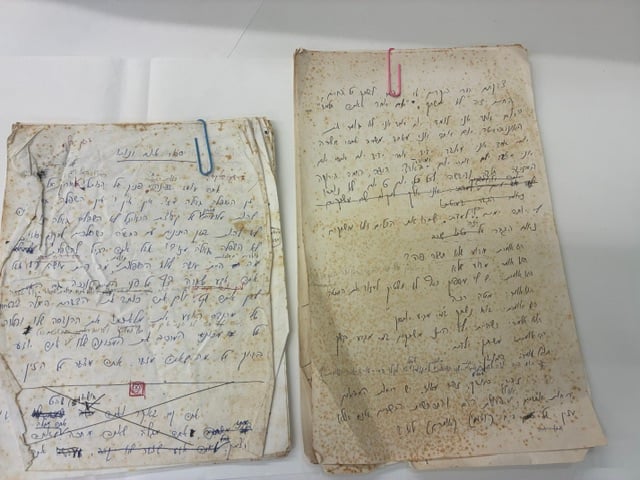
Then, a few days ago, Adiva Gefen, the head of Gnazim, who had known Yavin personally and was very fond of him, called me. She told me that they had discovered some of his writings and wanted to know whether I could confirm that they were in his handwriting. Indeed, they were. I was deeply moved to see that familiar handwriting, in notebooks of the same kind as those I had typed almost 50 years ago.
I am waiting for the PhD student who will research his work in the context of his time and sit in Gnazim, studying his notebooks. It would be a great thrill.