
Russian-American-Israeli Palestinian. Palestine is Israel.
The Selective Fluidity of Identity
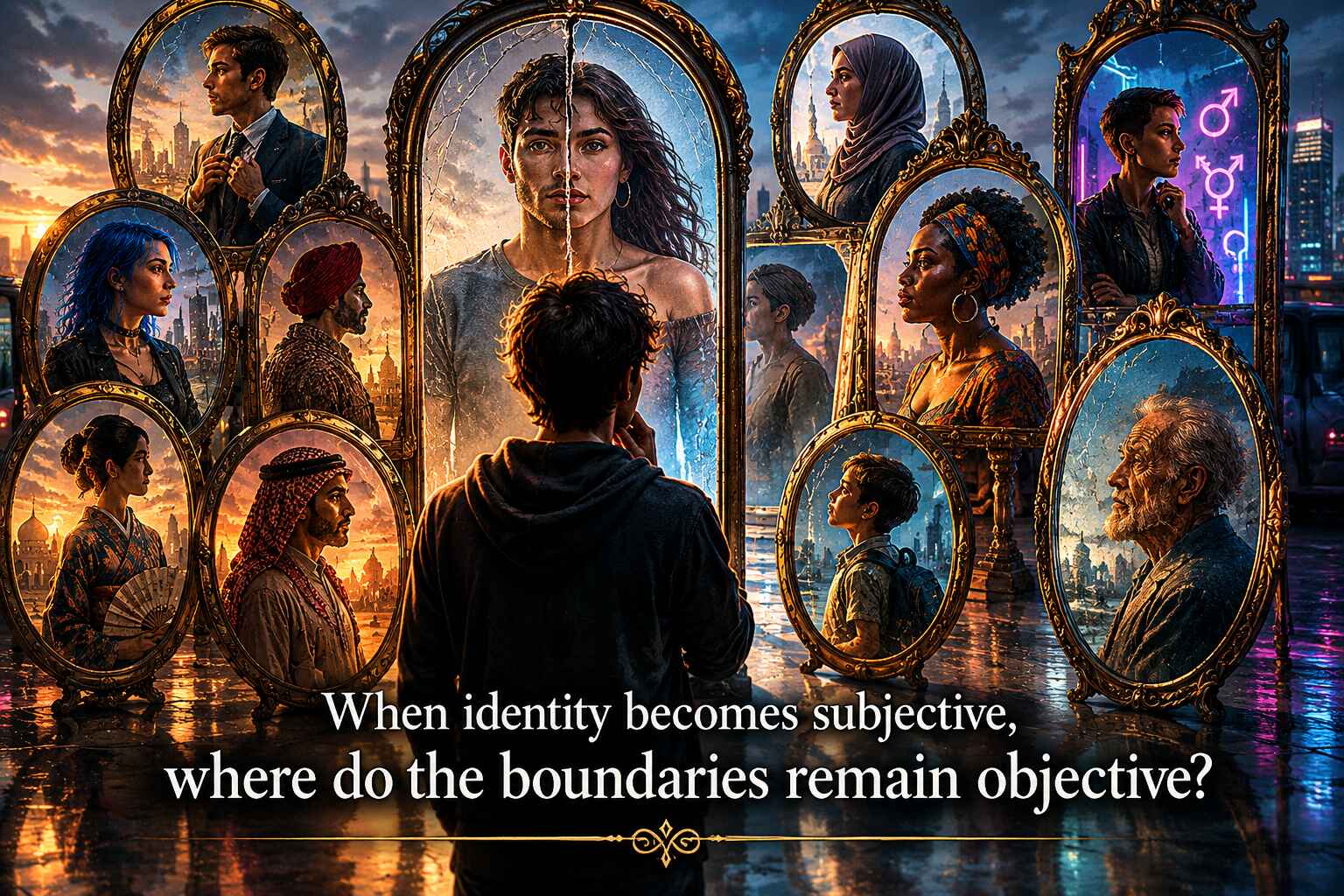
Some identities are liberated. Others remain externally policed. Image © Ivan Bassov, 2026. Licensed under CC BY 4.0.
Why Some Identities Become Subjective While Others Remain Objective
In my previous essay, Demystifying Gender, I explored how the word gender gradually evolved from a grammatical category into something far larger and more abstract.
Originally, gender referred primarily to classification in language. Many languages assign masculine, feminine, or neuter forms to nouns. A table may be feminine in one language, masculine in another, and neuter in a third. Nobody assumed the object itself possessed some hidden metaphysical gender essence. Grammatical gender was largely a matter of convention, structure, and linguistic agreement.
Later, the word gender became a polite synonym for biological sex.
Then the two concepts gradually split apart.
Sex remained tied primarily to biology:
- reproductive function,
- anatomy,
- chromosomes,
- hormonal development,
- and sexual dimorphism, despite occasional biological variation and edge cases.
Gender increasingly became psychological and subjective:
- internal identity,
- social experience,
- self-perception,
- and personal affiliation with sex categories.
This transformation created enormous conceptual confusion because people continued using the same word while referring to entirely different layers of reality.
Some hear:
- biology.
Others hear:
- identity,
- expression,
- social role,
- aesthetics,
- psychology,
- or metaphysical selfhood.
In Demystifying Gender, I suggested that much of the confusion disappears once gender is understood not as a mystical standalone essence, but as a qualifier:
Sex-gender
In other words:
Sex-gender refers to a person’s subjective psychological relationship to biological sex categories.
Once viewed this way, the conceptual structure suddenly becomes easier to analyze logically.
But this realization immediately raises a much larger philosophical question.
If subjective identity may detach from objective classification in the domain of sex-gender, why should this logic stop there?
Why not:
- race-gender,
- ethnicity-gender,
- religion-gender,
- nationality-gender,
- citizenship-gender,
- civilization-gender,
- or education-gender?
And here, I think, modern identity philosophy begins encountering its deepest unresolved tensions.
The Expansion of Subjective Identity
Modern society increasingly accepts that a person’s subjective sex-gender may differ from biological sex.
But humans possess subjective relationships to many categories besides sex.
A person may feel profound affinity toward:
- another nation,
- another ethnicity,
- another civilization,
- another religion,
- or another culture.
People already do this constantly.
Converts adopt religions they were not born into.
Immigrants adopt new national identities.
Individuals assimilate into new civilizations.
People develop emotional attachment to countries where they were not born.
Others feel alienated from identities assigned to them at birth.
Some people strongly identify with cultures or ethnicities different from their ancestry.
Historically, many individuals attempted to “pass” into different racial, ethnic, or cultural categories in order to escape assumptions associated with the category imposed upon them.
The phenomenon itself is not new.
The real question is why some forms of identity fluidity are increasingly considered morally legitimate while others remain socially guarded — or even taboo.
The Hidden Hierarchy of Identity
Modern society appears to treat identity categories according to very different philosophical rules.
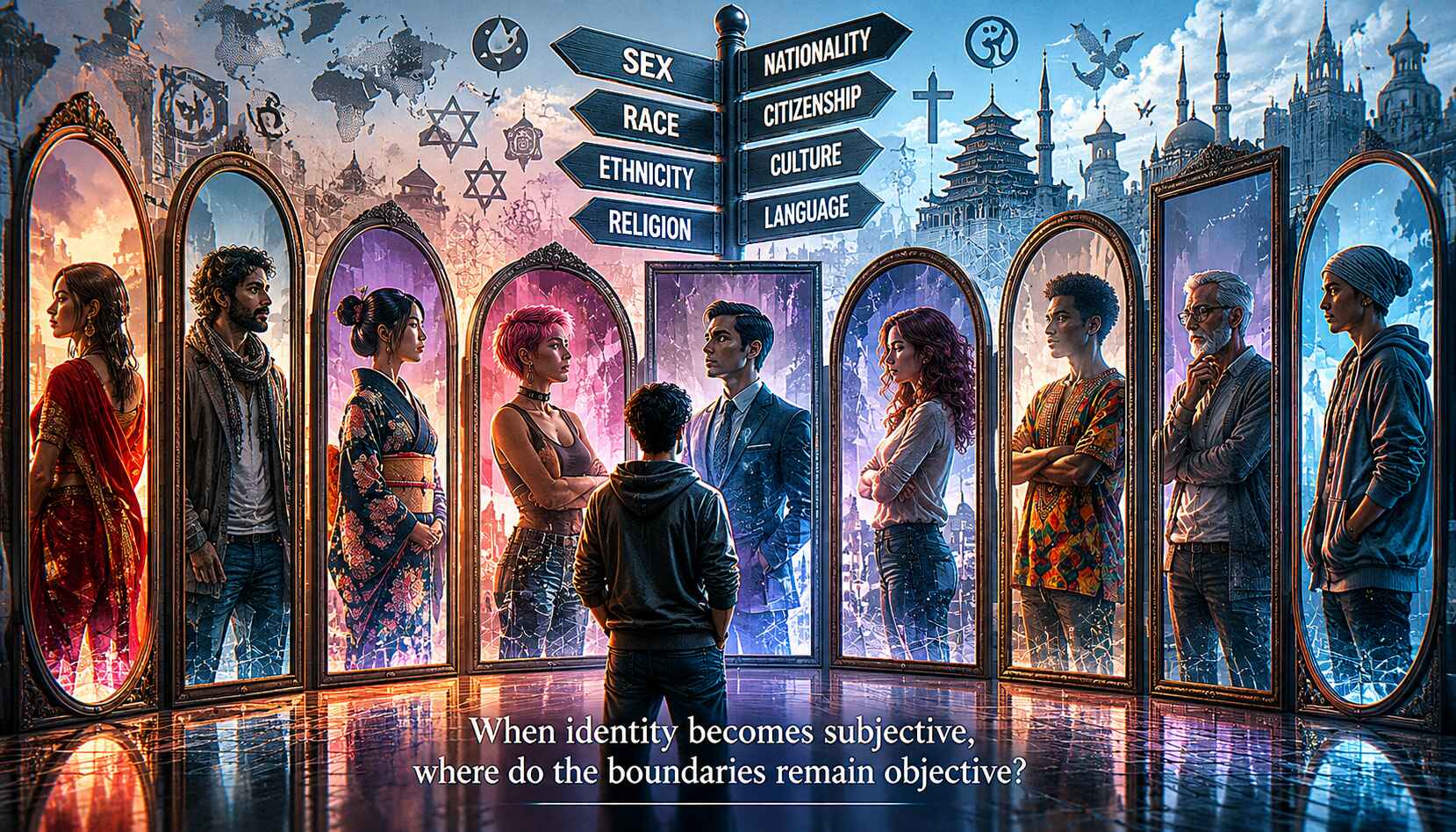
Some categories increasingly permit subjective self-definition, particularly the expanding framework of sex-gender identity, which now often encompasses:
- internal psychological identity,
- social role,
- linguistic self-identification through pronouns,
- and symbolic or aesthetic self-presentation.
Other categories remain far more externally grounded:
- race,
- ethnicity,
- ancestry,
- tribal affiliation,
- indigenous status,
- citizenship,
- and lineage.
Still others occupy unstable middle ground:
- religion,
- nationality,
- civilization identity,
- and cultural affiliation.
The asymmetry becomes difficult to ignore.
A biological male identifying as female may increasingly receive broad institutional recognition.
But a White person identifying as Black is often treated as fraudulent or offensive.
A non-Jew identifying as Jewish may be viewed with suspicion unless recognized by formal religious structures.
A person identifying culturally as Finnish, Japanese, Italian, or Native American despite lacking ancestry often risks ridicule.
Why?
If subjective identity is considered sufficient in one domain, why is it insufficient in another?
And if there truly is a meaningful distinction, what exactly is it?
- Biology?
- Social function?
- Historical oppression?
- Practical consequences?
- Collective continuity?
- Legal structure?
- Moral intuition?
The answer is rarely articulated clearly.
The Practical Consequences Argument
One common explanation is that sex-gender concerns internal psychological experience in ways other categories supposedly do not.
Another argument claims that race, ethnicity, or nationality depend more heavily upon ancestry and historical continuity.
But these explanations do not fully resolve the asymmetry.
In many situations, ethnicity-gender or nationality-gender fluidity would create fewer practical complications than sex-gender fluidity.
Sex categories sometimes affect:
- medicine,
- sports,
- prisons,
- reproduction,
- intimate relationships,
- and legal classifications.
Meanwhile, a person identifying culturally as Italian, Finnish, Jewish, or Japanese would often affect none of these systems at all.
Yet society increasingly normalizes fluidity in sex-gender while remaining far more resistant to fluidity in ethnicity-gender or race-gender.
The philosophical distinction remains surprisingly unclear.
Again, I am not arguing against transgender identity. I am asking why one category became philosophically fluid while others remain guarded.
Shared Spaces and Consistency
Debates surrounding bathrooms, locker rooms, and other sex-segregated spaces further expose the unresolved tensions within modern identity philosophy.
One common objection to sex-gender fluidity argues that biological males identifying as women may create safety concerns in female spaces.
But this raises additional questions.
If the concern is fundamentally about potential inappropriate behavior, then the issue is behavioral rather than identity-based. Criminal behavior remains criminal regardless of gender identity.
Moreover, modern society increasingly accepts that sexual orientation itself is fluid and diverse. Yet society generally does not argue that gay men should therefore be excluded from male spaces, or that lesbians should be excluded from female spaces, despite theoretical concerns based upon attraction.
This suggests that the issue may not be reducible to simple categories of attraction, identity, or biology alone.
The deeper difficulty is that modern societies continue attempting to balance:
- privacy,
- safety,
- equality,
- biological distinctions,
- subjective identity,
- and social practicality,
while lacking a fully coherent philosophical framework for reconciling them.
As a result, many debates surrounding shared spaces increasingly resemble collisions between partially incompatible principles rather than disagreements over simple facts.
These tensions reveal that modern identity debates are rarely only about personal self-expression. They also concern recognition, legitimacy, institutional authority, and the boundaries between subjective identity and externally validated categories.
Which leads to a deeper question:
Who ultimately determines whether an identity claim is socially recognized?
The Role of External Recognition
Part of the tension may lie in the relationship between internal identity and external validation.
Some identities increasingly prioritize subjective self-identification:
I am what I internally experience myself to be.
Other identities remain heavily dependent on recognition by external systems:
- ancestry,
- institutions,
- governments,
- communities,
- tribes,
- religions,
- or historical continuity.
Citizenship illustrates this especially well.
A person may deeply identify as American, Israeli, Finnish, or Japanese while possessing no legal citizenship whatsoever.
That subjective affiliation may feel psychologically authentic.
But governments continue treating citizenship as externally verifiable rather than internally experienced.
Similarly:
- universities determine degrees,
- tribes determine membership,
- religions often determine conversion,
- and states determine nationality.
Meanwhile, sex-gender increasingly moves toward subjective self-definition independent of biological assignment.
Again, the question is not whether this transition is right or wrong.
The question is why this particular category became uniquely fluid while others remain more guarded.
The Linguistic Layer
Part of the confusion may stem from language itself.
As discussed in Demystifying Gender, the word gender gradually accumulated multiple meanings simultaneously:
- grammatical,
- biological,
- psychological,
- social,
- and metaphysical.
Different languages also structure identity differently.
Some languages possess grammatical gender everywhere.
Others barely use it at all.
Some increasingly introduce neutral pronouns.
Others resist them.
The linguistic system itself influences how identity categories are mentally organized.
But language alone cannot fully explain the selective fluidity of modern identity politics.
The deeper issue concerns philosophy.
Which categories are objective?
Which are subjective?
Which may legitimately detach from biology, ancestry, law, or institutional recognition?
And who decides?
The Problem of Consistency
Perhaps there are good reasons why sex-gender differs philosophically from race-gender, ethnicity-gender, or citizenship-gender.
Perhaps sex identity possesses unique psychological depth.
Perhaps race and ethnicity remain too historically entangled with lineage and collective memory.
Perhaps citizenship depends inherently upon legal systems.
Perhaps different identity domains simply operate according to fundamentally different rules.
All of this is possible.
But modern society often behaves as though these distinctions are obvious and self-evident when they are not.
The underlying philosophy remains remarkably underdeveloped.
Instead, society increasingly appears to operate through a selective moral hierarchy of identities:
- some categories are liberated,
- some remain regulated,
- some become sacred,
- and others remain externally policed.
The result is not necessarily a coherent philosophy of identity, but rather a patchwork system evolving in real time.
The Fear of Asymmetry
One reader asked me directly whether this discussion was really about opposing transgender people.
No.
In fact, my difficulty is almost the opposite.
As I admitted in the original article, I seem to suffer from a kind of “gender deafness” — perhaps even “gender blindness.”
I can intellectually understand why someone may feel profound affinity toward another culture, nation, civilization, or ethnicity. That feels psychologically intuitive to me.
But I do not fully experience the same intuitive understanding regarding sex-gender identity.
Yet many others experience the exact reverse.
This suggests that our intuitions about identity are themselves highly uneven and subjective.
And perhaps that is precisely the problem.
Modern society increasingly treats some forms of subjective identity as sacred while continuing to mock or prohibit others. The result is not necessarily liberation from rigid identity systems, but rather the creation of a new asymmetry.
Perhaps even a new hierarchy.
The Empathy Asymmetry
During one discussion, I mentioned that I could genuinely imagine feeling deep identification with another nationality or civilization — for example, feeling internally Italian despite lacking Italian ancestry.
A reader jokingly replied:
I’m sorry. Perhaps you can go out to Italian restaurants.
The comment was likely intended humorously rather than maliciously.
But it revealed something philosophically interesting.
Imagine responding similarly to a transgender person:
I’m sorry. Perhaps you can use women’s restrooms.
Modern society would increasingly regard such a response as dismissive, invalidating, or offensive because subjective sex-gender identity is now treated as psychologically serious and morally protected.
But subjective nationality-gender, ethnicity-gender, or civilization-gender identities are still often treated as eccentric roleplay, aesthetic preference, or cultural consumption rather than authentic internal identity.
Why?
What exactly distinguishes one form of subjective identity from another?
Again, I am not claiming the categories are identical. I am asking why society increasingly extends moral empathy and institutional recognition toward some forms of identity fluidity while withholding them from others.
The asymmetry itself is philosophically revealing.
The Unanswered Question
Perhaps the real issue was never gender alone.
Perhaps gender merely became the first major category through which modern society began separating subjective identity from objective classification.
Once that separation occurred, the logic naturally began expanding outward into other domains of identity.
And once the principle of subjective self-identification is introduced, it becomes increasingly difficult to explain why it should apply absolutely in some categories while remaining restricted in others.
Perhaps future societies will eventually normalize far broader forms of identity fluidity:
- civilization-gender,
- ethnicity-gender,
- religion-gender,
- nationality-gender,
- or categories we have not yet imagined.
Or perhaps society will eventually reintroduce stronger objective boundaries after discovering that unlimited subjectivity creates conceptual instability.
I do not know.
But I suspect many people remain confused not because they are hateful, irrational, or malicious, but because the underlying philosophical framework itself remains incomplete.
And perhaps the real question is not merely what gender is, but what identity itself is — and who gets to decide.
—
See Also
Related Topics
Related Posts