
The Ship that Nearly Divided a Nation
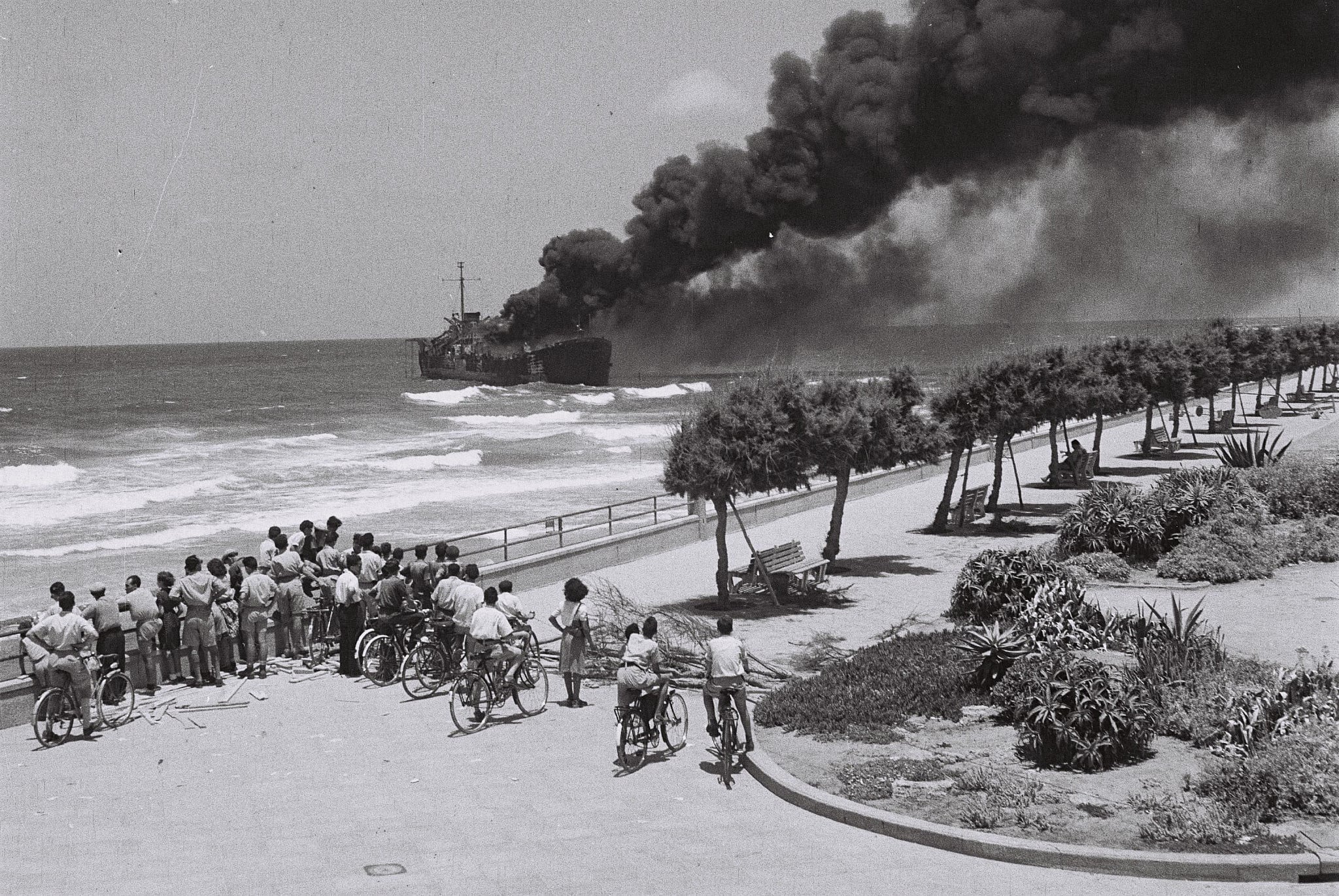
It was June of 1948. The State of Israel was barely five weeks old. Arab armies were attacking from every direction and the Jewish people were fighting for their very survival.
It was then, on a beach in Tel Aviv, that one of the saddest and most tragic events in the history of modern Israel took place. Jewish soldiers fired at a ship filled with other Jews, causing the ship to catch fire. Flames rose into the sky as men aboard leaped into the water while the gunfire of other Jewish soldiers continued around them.
The ship was called the Altalena.
Before Israel declared independence, several different Jewish organizations had fought to defend the Jewish population, including the Irgun, led by Menachem Begin.
Once the state was established, the new Prime Minister, David Ben-Gurion, insisted there could be only one government and one army. The separate fighting groups would have to dissolve and join the newly created Israel Defense Forces.
The Irgun had already arranged for the Altalena to sail from France carrying more than 900 Jewish immigrants and fighters, together with a desperately needed shipment of weapons and ammunition, valued at 153 million francs. By the time it reached Israel, the Irgun had already signed an agreement to join the national army.
However, the two leaders had a serious disagreement over who would control the weapons and where they would be distributed. Ben-Gurion insisted that every weapon had to come under exclusive government authority. The young country could not tolerate independent armies or private stockpiles of weapons.
While Begin agreed that most of the weapons should enter the national war effort, he also wanted some allocated specifically to his Irgun fighters defending Jerusalem.
Negotiations collapsed.
When the Altalena first came ashore near Kfar Vitkin, IDF soldiers surrounded the area and demanded that the weapons be surrendered. Shots were fired. Jews on one side fired at Jews on the other, and six Irgun members and two IDF soldiers were killed in that initial battle.
Seeing they were outnumbered, Begin boarded the ship under fire and the Altalena sailed toward Tel Aviv where more Irgun fighters were stationed. Around midnight it ran aground near Frishman Street, where a large IDF force was waiting with orders to take the ship by force.
Accounts differ over who shot first, and whether the shots were meant only as a warning. Regardless, artillery hit the ship, and it began to burn. Fearing that the fire would reach the explosives aboard, Captain Monroe Fein ordered everyone to abandon ship.
On shore, Begin’s followers were enraged. Fighting broke out in several places, and one command could have plunged the newborn Jewish state into civil war. Instead, Begin ordered his men not to fight back and not to allow the confrontation to spread.
By the time it was over, sixteen members of the Irgun and three IDF soldiers were dead. Nineteen Jews had been killed by other Jews at the very same time as enemy armies were trying to destroy the Jewish state.
The following year, the burned hull was pulled from the Tel Aviv beach, towed far out to sea and deliberately sunk. Its precise location was lost.
Until this week, when Israeli officials announced that the wreck of the Altalena had been identified twenty kilometers off Israel’s coast, 503 meters beneath the Mediterranean Sea.
In the very week that the Altalena returned to public attention, we read a striking verse in the Torah portion:
“Pay attention and listen, Israel. This day, you have become a people to the Lord, your G-d.” (Deut. 27:9)
But hadn’t the Jewish people already become G-d’s people at Mount Sinai almost forty years earlier? Hadn’t they already received the Torah and entered into a covenant with Him?
What changed on “this day”?
The people Moses was speaking to were the new generation of Jews, about to enter the Land of Israel. Most of the adults who had stood at Mount Sinai were gone.
This was not merely a repetition of the original covenant. In this verse, Moses is transforming the covenant from a single historical event into a living bond that would include every future generation.
Sinai could not remain merely the covenant of their parents. This new generation would have to receive it as its own, and every future generation would have to do the same.
Rashi focuses on the surprising word “today” to explain that every single day must feel as if it is “today” that we are entering the covenant with G-d.
Our bond is not merely an ancient agreement signed by our ancestors thousands of years ago that we are now stuck carrying. It is being renewed today. Every generation, every morning, and every time a Jew chooses to live as a Jew, we become G-d’s people anew.
And here is what I find so powerful. To become G-d’s people is also to become one people. The covenant does not only bind us to G-d. It binds us to one another.
We are not merely long-lost cousins whose ancestors once shared an experience at Mt. Sinai. We are being bound to each other again, right now.
“Today” your life is connected to mine. Your safety is my concern. Your pain is my pain. Your Jewish future is part of my responsibility.
And tomorrow, that covenant must be renewed again.
This is not easy. We each have our own ambitions, goals and convictions. We disagree about politics, religion, Israel and how our community should move forward.
Jewish unity does not mean that those differences disappear. It means that something deeper comes before them.
I can believe that you are wrong without believing that you no longer belong. I can argue passionately for my position without forgetting that the person across from me is my brother or sister. I can fight for what I believe while refusing to let my personal victory come at the cost of our shared survival.
Seventy-eight years after the Altalena was sunk, its wreck has been identified again. Perhaps its most important message is not found in the weapons it carried, but in the war that Menachem Begin refused to begin.
Imagine what it took at that moment to hold back.
Begin believed that these weapons were needed for the survival of Israel. He believed passionately in what he was doing, and I’m sure he believed that a terrible injustice was being committed. He did not suddenly agree with Ben-Gurion, and he did not abandon his convictions.
But he understood that the survival of the Jewish nation was more important than winning the battle. More important than having the weapons to fight, was ensuring that the Jewish people remain one people, fighting for each other.
Not against each other in civil war.
As we prepare for Rosh Hashanah, the Day of Judgement, we must remember that our greatest strength comes from standing together as one people. As we will read in next week’s Torah reading, when we “stand together”, we stand with greater merit before G-d.
We should not enter the new year by trying to prove that we were right. We should enter it by showing G-d that His children can still stand together.
Raising the entire Altalena from such a depth may be impossible. But its message can still be raised. Its warning of how close we once came to losing everything to fighting among ourselves can still reach us from the bottom of the sea.
Before Rosh Hashanah, let us make sure that no Jew has been thrown overboard from our heart. We can disagree. We can argue. We can hold firmly to our beliefs.
But beneath every disagreement must remain one unbreakable truth: Today, we became a people.
May G-d see His children standing together as one and bless our entire people with a happy, healthy and sweet new year.
Good Shabbos,
Rabbi Yankie & Chana Denburg