Lawyer & Law Professor
The Shoah happened within the law
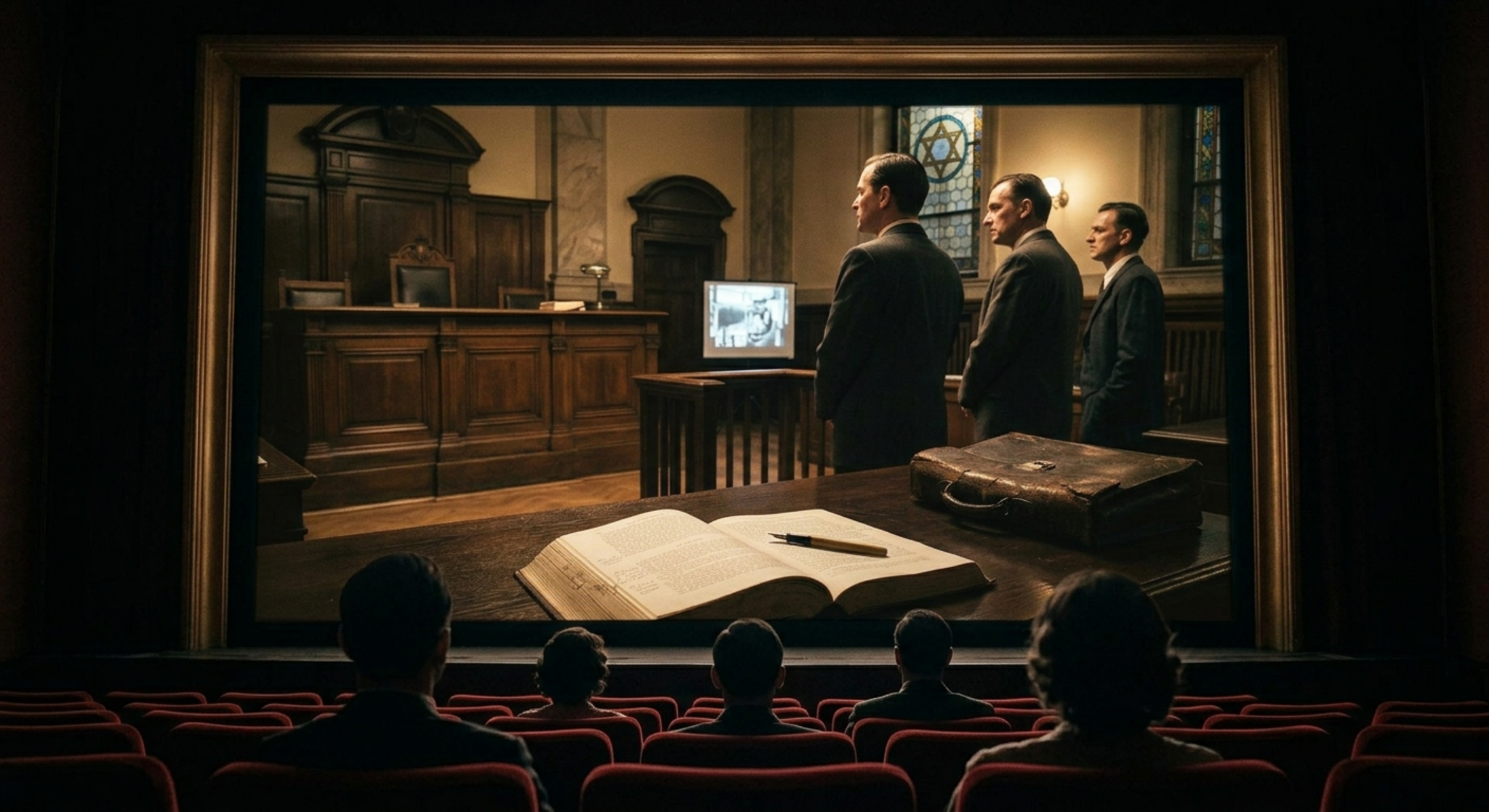
Image Created by Gemini with Nano Bana 2, Google, 2026.
Yesterday, I went to see the movie Nuremberg. I did not enter the theater as a naive spectator; Nuremberg has been a cornerstone of my professional development for years. First, as a student attempting to grasp the implications of a legal system utilized to uphold that which, in human terms, is indefensible, and today as a professor, constantly revisiting the judgments, the facts, and the arguments to ensure my students understand that those proceedings did not merely try responsible individuals, but rather an entire conception of Jurisprudence.
The experience ultimately unsettled me in a way far deeper than any academic text ever has. There is something about hearing the technical serenity with which the high-ranking officials of the national socialist regime attempted to justify their decisions, which, even in dramatization, shatters intellectual distance. It forces a confrontation with a stubborn reality: those in the dock were not abstract figures or creatures of pure myth, but thinking men who presented arguments, advised by well-trained jurists, acting under the conviction that they were in compliance with the Law. For lamentably, a significant portion of Nazi barbarity was perfectly legal.
While the film does not seek to develop a specific legal thesis, it inevitably pushes toward questions I have navigated for years. These are inquiries I have studied, debated, and taught, yet they retain their visceral cogency. I must admit that at this stage, they remain pending in a work that is still very much in progress.
For years, I have reviewed the Nuremberg cases, returning time and again to the verdicts, attempting to dissect that “breaking point” with my students. However, seeing it portrayed on screen, with faces, stories, and the raw nature of the testimony, transforms the experience. It becomes a direct confrontation with the real-world consequences of a legal dilemma, dissolving the safety of abstraction.
Ultimately, the takeaways are not confined to historical reconstruction. If that moment made anything clear, it is that legality, in and of itself, is an insufficient criterion for justification. There exists a point where the jurist, precisely because of their station, is obligated to draw a line, even against the very normative system in which they operate. Since Nuremberg, it is no longer tenable to argue that compliance with the law provides a shield from liability when that law radically violates human dignity.
The film leans heavily on the fact that Nuremberg was the first time the world heard the truth spoken openly, though, tragically, not from the mouths of the survivors themselves. The horror of the Shoah was exposed to the world, voiced aloud, leaving no room for evasion. Once that occurred, the plea of ignorance vanished; there was no longer a refuge in distance or abstraction. That dimension carries a different weight when one assumes its consequences.
Today, on Yom HaShoah, this reflection ceases to be exclusively academic, as it does every year. It takes on a personal dimension that cannot be ignored. What is analyzed in the classroom or studied in textbooks is also the history of the People to whom I belong. That connection, ever-present, becomes undeniable when one stares directly into the harshness of the data.
A search in Yad Vashem yields 497 matches for the surname “Eichner” and 441 for “Wolowelski”—the names I carry, the first and most vital inheritance given to me by my parents. While I cannot say with certainty who those 938 individuals were, I cannot ignore what they represent. In that moment, they cease to be statistics and become evidence of a magnitude that precludes the comfortable distance of dispassionate analysis.
In that same spirit, a line from the Tefillah for Yom HaShoah, attributed to Rabbi Jonathan Sacks, resonates powerfully: we remember
what happens when humanity fails to recognize that those who are not in our image are, nevertheless, in the image of G-d.
In that phrase, the exact point where Law, society, and human conscience collapse simultaneously is condensed with uncomfortable clarity. That is where the possibility of barbarism begins.
My conscience does not dwell solely in the past, nor is it exhausted by historical memory. It exists in a context where Israel is at war and where antisemitism persists, intensifying, adapting, and finding new forms of expression that, while different in appearance, reproduce logics that are hauntingly familiar. This compels our reflection to take a definitive stand against dynamics that have already shown how far they can escalate when not confronted in time.
Sometimes, going to the cinema is not merely watching a film, but finding oneself at the intersection of what one does, what one is, and what one inherits. It is understood that memory implies assuming a concrete responsibility, even when that responsibility demands holding uncomfortable positions against narratives that, while presented as legitimate, cross a line that history has shown cannot be ignored without consequence.
Today we remember. But remembrance, if it is genuine, is not enough. To remember is to accept that the memory of the Shoah cannot be reduced to a date or a ceremony. The Shoah must remain a living, constant, and demanding standard that forces us to draw clear limits on what we are willing to tolerate, even when doing so is inconvenient. We must be ready to act, even when it means confronting that which would be easier to let pass.
NEVER AGAIN (is now). Am Israel chai!
Related Topics
Related Posts