Exploring Memory, War, and Survival
The Shooting Lasted Ten Minutes
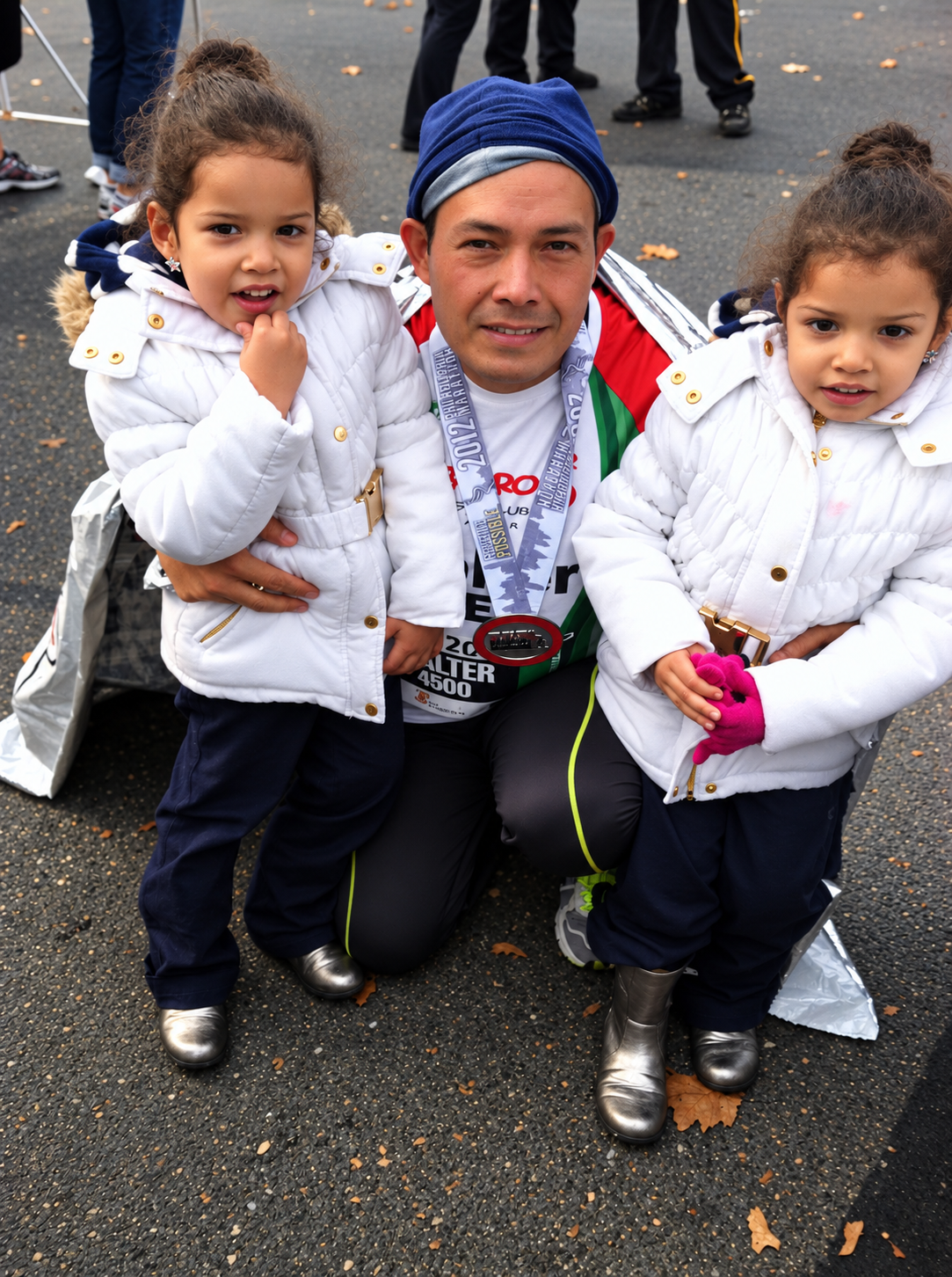
W. E. Gonzalez with his nieces Luna and Estrella at the Philadelphia Marathon in November 2012, during the years when distance running was a regular part of his life.
The shooting lasted about ten minutes. It took me seven to finish breakfast.
My wife, my mother-in-law, and my father-in-law were sheltering in the safest part of the house while gunfire echoed outside. I had found the spot for them within seconds. Then I returned to the kitchen and sat down to eat.
To anyone watching, it might have looked absurd. Perhaps it was. But there was a reason.
The shooting happened in Veracruz several years after I had left El Salvador. That morning, I had just returned from a run along the city’s coastal boulevard. At the time, I was training for the Mexico City Marathon, and running had become part of the rhythm of my life in Veracruz. I would go out early, put in the kilometers, return home tired and hungry, and eat.
That morning was supposed to be no different. My wife had prepared breakfast. The plates were already on the table when the first shots cracked through the neighborhood.
Everyone froze. I didn’t.
I did not know who was shooting or why. I did not know where the shots were coming from, how close they were, or whether whoever was firing was moving toward us. None of those questions could be answered from inside the house. But another question could: Where was the safest place to wait?
I began looking at the house differently—not as a home, not as rooms where people slept, ate, or kept their belongings. For those few seconds, walls became barriers. Doorways became openings. Windows became things to avoid.
The stairwell seemed to offer the best protection. A bathroom stood in front of it. Bedrooms bordered the sides. From where I stood, it appeared that any bullet reaching that part of the house would first have to pass through several concrete walls.
I told my wife and her parents to stay there until everything ended. They did not argue. Then I walked back to the kitchen. I was hungry.
The strange thing is that I never thought of myself as brave. Fear was not absent; it simply arrived differently.
When you grow up during a war, certain calculations become automatic. You learn that the first seconds matter. You learn that standing in the wrong place can be more dangerous than not knowing what is happening. You learn to look at walls, windows, doors, and open spaces differently. You learn that panic rarely improves a situation.
Most importantly, you learn that daily life does not always stop simply because danger appears.
As a child in El Salvador during the civil war, I learned these lessons before I understood that they were lessons. There was no class for them. No adult sat me down and explained how a child should behave when gunfire came close. Knowledge accumulated another way: by watching what people did, by noticing when voices changed, by understanding that sometimes an ordinary moment could become dangerous without asking permission.
Children are remarkably good at learning the rules of the world they are given. They do not first decide whether those rules are reasonable; they simply learn them. And one of the rules I learned was that fear and routine could occupy the same place.
Life did not wait for danger to disappear. People still ate. They still worked. They still swept floors, prepared meals, talked to neighbors, went to sleep, and woke the next morning. Danger was not always an interruption—sometimes it was simply there.
That may be difficult to understand if danger has always meant an emergency—something exceptional that arrives, disrupts ordinary life, and eventually leaves. For many children who grow up around violence, the order can be reversed: danger becomes ordinary, and safety is the thing that feels temporary.
Years later, in Veracruz, I discovered that those lessons had never left me. The people around me were experiencing a crisis. I was following a procedure: Find shelter. Protect the family. Wait.
The only unusual detail was that breakfast happened to be sitting on the table. So I ate.
I remember sitting there while the shooting continued outside. The food was still warm. That detail has stayed with me. There was something almost offensive about its normality. Outside, someone was firing a weapon; inside, there was a plate in front of me, prepared only minutes earlier as part of an ordinary morning.
Those two realities should not have belonged together, but I had known realities like that before. Perhaps that is why I kept eating—not because I believed nothing could happen to me, not because the shooting did not matter, and certainly not because I was fearless.
There was simply nothing useful for me to do at that moment. My family was in the safest place I could find. Going outside would have been foolish. Standing at a window trying to understand what was happening would have made no sense.
So I remained where I was. And breakfast was there.
I sometimes think about how differently people inherit childhood. Some inherit recipes. Some inherit songs. Some inherit family businesses. Others inherit survival instincts they never asked for.
The shooting outside my in-laws’ house eventually ended. No one inside was harmed. The neighborhood slowly returned to normal.
The next day, I looked for the shooting in the newspapers.
I couldn’t find it.
I checked because I wanted to know what had happened—who had been shooting, why, whether anyone had been hurt. But there was nothing, at least nothing I could find. By then, shootings had become so common in Veracruz that finding nothing about this one in the next day’s news did not surprise me.
That absence stayed with me too. For ten minutes, gunfire had been important enough to send my family looking for shelter. By the next morning, it was as if those ten minutes had left no public trace at all.
Perhaps that was another thing I already understood from childhood: an event does not have to become history to change the people who lived through it.
What remained with me was not what happened when the shooting stopped. It was what I had done while it was happening.
For years, I had thought of the war in El Salvador as something that belonged to a particular country and a particular period of my childhood. It had a geography. It had dates. Eventually, I crossed a border and continued growing older somewhere else.
But sitting at that table in Veracruz forced me to understand something else: the war had followed me farther than I had imagined. Not across borders, not across years, but into habits, into reflexes, into the quiet calculations that occur before conscious thought begins.
It was there in the few seconds it took me to look at a house and stop seeing rooms. It was there in the instinct that told me where my family should wait. And, strangely, it was there in my decision to return to the kitchen once there was nothing more I could do.
The war was long over. I was married. I was living in another country. I was sitting at a breakfast table. And yet, when danger appeared, the child who had learned to survive during the Salvadoran Civil War was still there, calmly deciding where everyone should stand—then finishing his breakfast.
Because if ten minutes of gunfire could not interrupt childhood, it seemed unreasonable to let it interrupt breakfast.
Related Topics