
99.6% Ashkenazi + .4% Viking = 100% Zionist
The Shortcut Everyone Is Missing
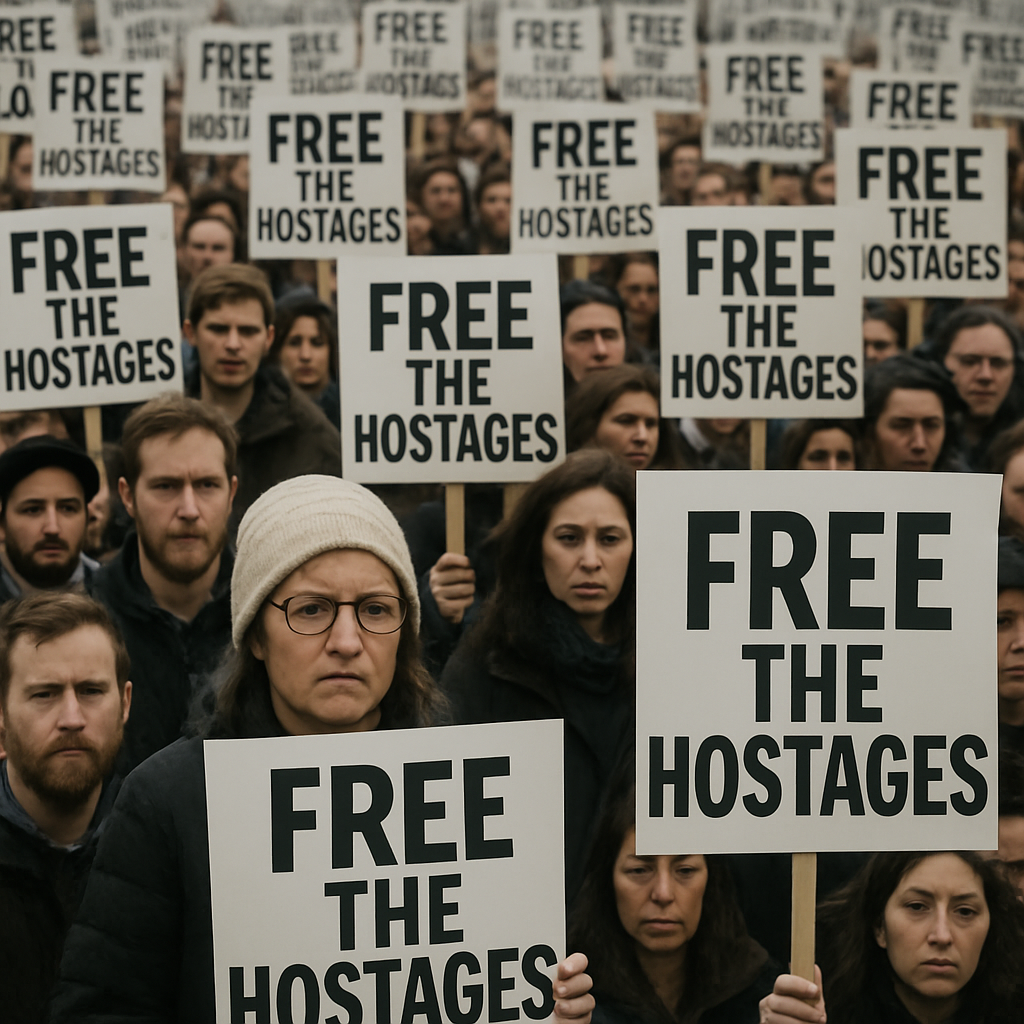
Free the Hostages
It’s time to reframe the outrage.
Everywhere you look—parliaments, universities, NGOs, celebrity petitions—the refrain is the same: Ceasefire now. The phrase is repeated with the cadence of a moral certainty, as though chanting it alone could halt the bombs and bring peace. But there’s a simpler, more direct demand that would actually end the war, open the aid trucks, and begin the rebuilding:
“Free the Hostages.”
Recent Examples: Ceasefire First, Clarity Last
In the past few weeks alone, the calls have been loud and repetitive:
- Germany’s foreign minister urged an immediate ceasefire in Gaza, linking it to reviving a two-state process—but treating the hostages as an afterthought.
- Egypt and Qatar, the main mediators, publicly pressed Israel to accept Hamas’s latest ceasefire-for-prisoners proposal, as though holding innocent civilians underground were a legitimate negotiating tactic.
- China called for an “immediate ceasefire” amid Israel’s military mobilization, never once putting the hostages front and center.
- University boards and faculty unions across North America passed resolutions demanding Israel cease fire. Some made no mention of the hostages at all.
- NGOs and advocacy groups have issued statement after statement with the same formula: ceasefire, humanitarian aid, a “path to two states.” Hostages, if mentioned, come after the bullet points.
- Celebrities and artists, from Hollywood to European pop stars, sign petitions urging “an end to the war”—their influence applied toward slogans, not the release of grandmothers, toddlers, and Holocaust survivors still trapped in Gaza’s tunnels.
- Even in Israel itself, where massive protests have filled the streets, many signs call for a “hostage deal”—but even there, the language too often falls back into the muddled framing of swaps and pauses instead of one uncompromising demand: bring them all home, now.
This is what needs reframing. Because the one demand that would truly change everything—the one lever that could halt the fighting overnight—is not “ceasefire”, it’s
“Free the Hostages.”
The False Equivalence of a “Swap”
One of the most corrosive habits in this conversation is the phrase “prisoner swap.” It suggests symmetry where none exists.
Hostages are innocent civilians—grandmothers abducted from their kitchens, children dragged from their beds, festivalgoers shot and then hauled into Gaza’s tunnels. Prisoners, by contrast, are individuals convicted or charged with violent crimes, many with blood on their hands – some serving multiple life sentences. To equate the two obscures the moral truth of October 7: a mass atrocity followed by the ongoing war crime of hostage-taking.
Hostages don’t “belong” in an exchange ledger. They belong at home. Period.
Hamas Has Never Wanted Two States
Many ceasefire appeals pair their plea with “a return to a two-state solution.” But Hamas has never sought two states. Its founding covenant is explicit about its goal: the elimination of Israel. Its 2017 “policy document” softened some rhetoric for Western ears but still rejected recognition of Israel and reaffirmed the struggle “from the river to the sea.”
And here lies a sharp irony: those words—from the river to the sea—are not just Hamas’s battle cry. A century ago, during the British Mandate for Palestine, the same geographical frame described the Jewish homeland promised in international law: a national home for the Jewish people from the Jordan River to the Mediterranean Sea. The identical phrase, inverted in purpose, now serves as a rallying cry for Israel’s erasure.
The next time you hear someone cry, “From the river to the sea” instead of quizzing them on which river and which sea (a quiz most would surely fail), share with them the origins of that phrase – the phrase used to denote “the national homeland for the Jewish people.”
The Myth of the Forever-Deferred State
The two-state framework is a Western diplomatic construct, later adopted in the Arab Peace Initiative of 2002. But historically, Arab leaders rejected partition outright in 1947. And when genuine opportunities arose, Palestinian leadership turned them down again and again:
- The UN Partition Plan of 1947—rejected.
- A chance for statehood after 1948—rejected.
- Successive offers through the 1970s and 80s—rejected.
- The Clinton Parameters in 2000, which offered a state on nearly all of Gaza and the West Bank—rejected.
- The Taba talks of 2001—collapsed.
- Ehud Olmert’s 2008 offer, later acknowledged by Mahmoud Abbas as extraordinarily generous—rejected.
And there were numerous other proposals between the 1940s and early 2000s—every one refused. These are inconvenient facts—but they’re facts.
The Shortcut Everyone Is Missing
“Ceasefire” is a bureaucratic word. It lives in communiqués and conference rooms. “Free the Hostages” is a human imperative.
Freeing the hostages—all of them, immediately—would in practice deliver the very outcomes ceasefire advocates claim to want: an end to fighting, humanitarian access, the beginning of rebuilding. Israel’s position is clear: the war ends when the hostages come home and Hamas can no longer wage war.
Why keep moral clarity hostage to diplomatic choreography?
What To Say Instead
If you are a university board drafting a resolution, an NGO releasing a statement, a politician on a podium, or a celebrity with millions of followers—shift your words.
“We call for the immediate and unconditional return of every hostage taken on October 7. Free the Hostages—now.”
Once the hostages are home, the rebuilding can begin. Until then, every cry for a “ceasefire now” that omits the hostages is incomplete at best; enabling at worst.
The Reframing
This isn’t complicated. You don’t need to be a historian of the Mandate or an analyst of the Oslo Accords to grasp it. A ceasefire is a process. Free the Hostages is a principle.
The choice is stark: keep chanting for a ceasefire and watch the suffering drag on, or raise your voice for the only act that can stop it.
Free. The. Hostages.
Related Topics
Related Posts