The Siddur Spectrum
For a school project, I did a ground-level evaluation of two Siddurim across the religious spectrum to find any interesting similarities or differences between them. Even though I am relatively knowledgeable about the subject, I learned a surprising number of new things when going through the weeds. Perhaps this will do something good to combat the chasm-like divide across the religious spectrum. So here it is
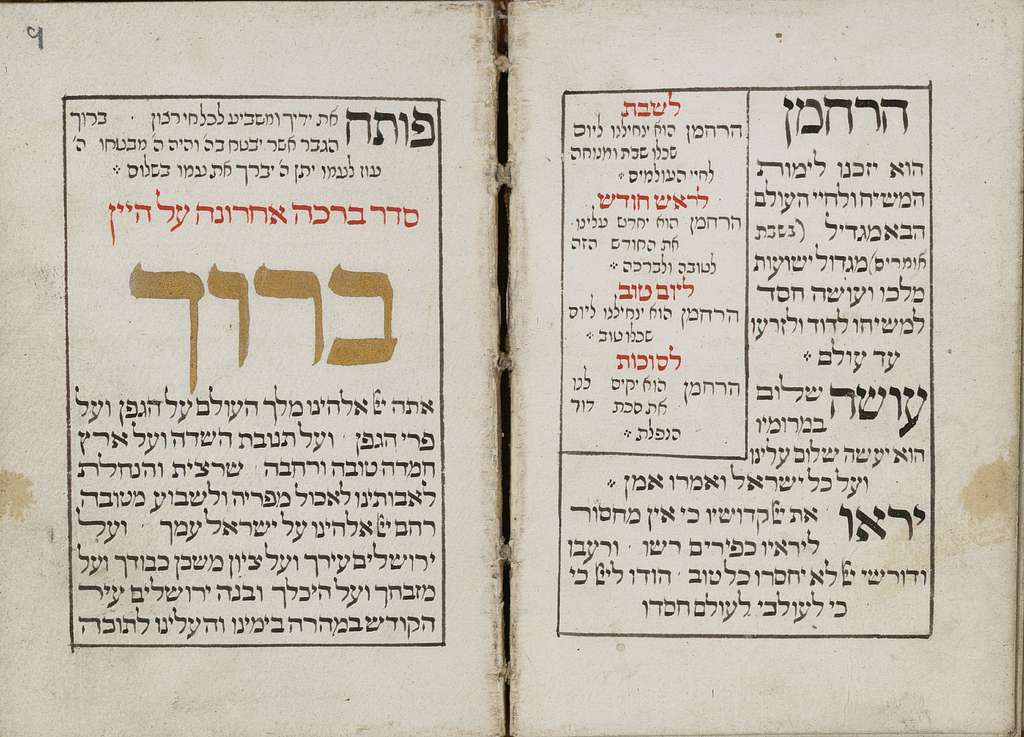
The Jewish people are known as the “People of the Book.” While this usually refers to either the Torah (the Five Books of Moses) or the Tanach (the whole Old Testament), the siddur, or the Jewish prayer book, is just as important. Rabbi Joseph Tabory rightly considers the siddur to be a “veritable museum of the Jewish people.” And of course, since the Jews have changed over time, so has the Siddur. Although all versions of the siddur came from the same forefathers and were standardized by the rabbis, the present American reality is that opposite sides of the religious spectrum now hold different values, creating siddurim with many disparities.
It All Started with Old Abe
Abraham canonically created the concept of Jewish prayer. He prayed during the day in a prayer called Shacharit. His son Isaac prayed in the afternoon — creating the concept of Minchah. Finally, not to be outdone, Jacob prayed at night — creating Mariv. From then on, everyone followed the example of the forefathers, praying very standardized prayers from their hearts three times a day. This continued until the time of the Talmud, where Halacha (Jewish law) was standardized. The rabbis ordained that prayer would center around the Shema and the Amidah, where the Amidah followed the original structure. In it, the Amidah had suggested topics to cover when praying, but nothing more. The Shema consisted of the verse: “Hear, O Israel, the L-rd is our G‑d, the L-rd is One” (Deuteronomy 6:4). As time went on, other prayers were introduced and standardized — usually about some crisis facing the Jewish people. Some examples are a blessing in the Amidah about Christian heretics, as well as additional blessings about the stories of Purim and Chanukah. This is the point of divergence, because different groups of Jews disagree on the most important things to include. So, many different types of siddurim were created reflecting these important events, leading to the branching paths that exist today.
Branches You Say?
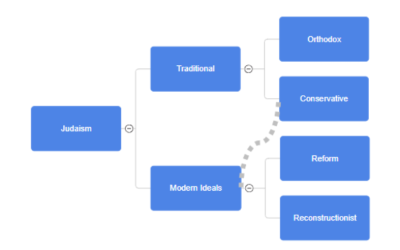
When considering the modern status quo for Judaism, a branch diagram would be the most fitting. In the United States, the three main branches are Orthodox, Conservative, and Reform. The way to pick your branch is to decide to what extent you want to respect traditional values. Currently, 33% of Jews consider themselves Reform, 8% as Orthodox, 15% as Conservative, and 29% as no denomination. All of these came about as different solutions on how to deal with changing morality, culture, and technology. As seen in the tree diagram (figure 1), the general ideologies have Orthodox Jews be more traditional, while Reform Jews are more prone to accepting modern ideals of secularism and skepticism.
No Vacuums For Me Please
Change doesn’t happen in a vacuum. Even if there are some ideological differences, there were no standardized differences in Siddurim until the late 19th Century. This came with the creation of the Conservative and Reform siddurim, alongside a reformation of the synagogue system within those branches. Historically, prayers were very top-down, but with declining numbers, these synagogues had no choice but to downsize and make things personal. Immigrants who were happy to use a synagogue as just a place of worship started moving to the suburbs. There, the synagogue became a place for socialization and community, more than just praying. The content shifted to using more English with simpler content. There is a reason that Reform Judaism centers around Tikkun Olam (repairing the world), and is centered around a person who makes folk music. The values Reform Judaism holds have become fundamentally transformed. Prayer is now a suggested exercise, and many people only attend Shul for important lifecycle events. This accelerated the drift between Reform and Orthodox Judaism until we can see the completely different prayer books and values we have today.
Prayer She Goes
Now that the background has settled, it is time to discuss the main focus: the Siddur. The Hebrew word סדור just means order, meaning that the main focus is on the order of prayers, and how they build up for each other. All forms of prayer have macroscopic rises and falls, and a lot of times, there are more small peaks and troughs along the way. Aside from these general similarities, Orthodox davening (prayer) and Reform davening is very different both in terms of sequencing and the prayers themselves. For the purpose of comparison, we will use the Central Reform Congregation’s (CRC) April 6, 2019, Shabbat morning siddur, and the Chabad Siddur Tehillat Hashem Nusach Ha-Ari Zal. These siddurim provide insight into the value these branches hold and the clergy’s expectations of the congregants’ knowledge of davening practices.
Pezuke Dizimra
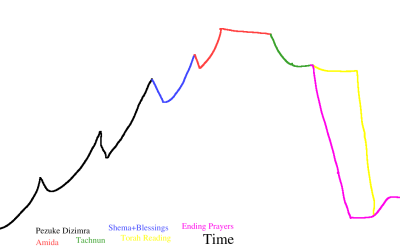
Literally meaning “verses of praise,” Pezuke Dizimra is the initial meditation preparing for the more “important” prayers later. Smaller peaks come with the more declarative prayers, and it all builds up to the next section of the Shema. The buildup is so important that there is a law banning any non-prayer utterances during this section (but most Synagogues unabashedly ignore this rule). Looking at the start, the CRC siddur opens with a verse about treating fellow Jews with respect, and then continues by praising God for giving us another day. The Chabad siddur reverses the order, putting the man-God relationship before the man-man. While a seemingly trivial difference, any change is an intentional act that says a lot about the congregation. Continuing on, most of the prayers in the CRC are a sentence or two, usually the first verse of a psalm. Meanwhile, the Chabad Siddur has full psalms. An important note is that the CRC skips the peaks within the Pezuke Dizimra section, choosing instead to go by quickly in favor of focusing on the Shema. Both end in a Hatzi Kaddish, ending the section.
Kaddish??
Between Pezuke Dizimara and the blessings of the Shema, Kaddish is recited. Kaddish is a prayer praising God. Kaddish is a mourning prayer for the recently deceased. Kaddish is used to separate sections of prayer. All three are true, and this mystical prayer managed to break into every branch of Judaism. There are multiple forms of kaddish: half kaddish, mourners’ kaddish, and rabbi’s kaddish. All of them have the same theme of praising God for his greatness. The cantor uses half kaddish as an intermission between sections, and mourners say the other kaddishes. I think the significance is how integrated Kaddish is to all branches of Judaism. The association between mourning and collective prayer represents a critical intertwinement between the synagogue and the life cycle. There is an almost palpable feeling of support present when Kaddish is being recited. This creates the give and take relationship, where people show up to synagogue, and in return, they are able to receive built-in support for ones they lost, while simultaneously being there to say amen when it is someone else’s turn.
Shema and Its Blessings
Now that the proverbial salad course is out of the way, it is time for the meat and potatoes. When asking Jews what is the most important prayer, many of them say the Shema. This historic declaration of faith in one God represents the core of Judaism. It is so important that there are supplementary prayers said beforehand. The prayers are a lot more intense compared to Pezuke Dizimra, ramping up until the actual Shema. A noticeable addition in the Chabad Siddur is a whole narrative about the angels and how they would pray to God. The meaning is clear. There is always a goal of Orthodox Jews to be a “light to all of the nations (Isaiah 42:6).” It is an ideal to act Godly at all times to inspire everyone else to do likewise — almost the Chabad version of Tikkun Olam. This follows the pattern of the way that both branches channel values. Once again, Reform Judaism values physically repairing the world, while Chabad focuses on using Godly channels to determine how to act. The rest of the Shema is the same for both siddurim, going through the three paragraphs and transitioning to the Amida. There is no kaddish here, because of the high intensity that both offer.
The Amida
If the Shema is considered to be the meat and potatoes of the meal, the Amida is the part where everyone gets up from the meal, goes into a different room, and starts a new, shorter meal with the same food, going quickly through the courses, including the dessert. While being the most intense part, where everyone physically gets up and spiritually enters a new plane by taking three steps back and three steps forward, the Amida presents a recursive-like structure reflecting the rest of the Amidah. Within its 19 blessings (it, of course is different for holidays but that’s beyond the scope of this paper), the Amidah has opening praise, moving into requests, and ending with thanks and declarations. Both the Reform and the Chabad Amidahs are strikingly similar, with only some minor differences, where Reform adds in the names of the foremothers when expressing how God is the God of our ancestors. It is another example of focusing on human interaction, but not one that takes away from the rest of the prayer. As a fun fact, the Amidah is the only prayer that is mandated to be said silently, with a loud cantor-led repetition following the silent Amidah.
A Quick Stopchnun for Tachnun
On regular weekdays, the Amidah is followed by Tachnun. Since the Reform siddur skips this completely, I will briefly mention its significance. Tachnun was created to be a daily reflection of the sins the Jews committed, like a smaller version of Yom Kippur (In fact, it may be more fitting to see Yom Kippur as a drawn-out Tachnun). Following the established theme, it checks out that the Reform Siddur doesn’t seem to have it. The Reform doctrine wouldn’t recommend anyone to pray to God when they sin instead of apologizing to the person who was hurt. Thus, the lack of Tachnun in the Reform siddur fits nicely into the thesis.
The Written Torah, Orally
The Torah service for Reform and Chabad davening is surprisingly similar. Both put the Torah service in the same section, reading the same sections of text during the same week, three times a week. The only difference is the triennial cycle of Torah reading. As the name suggests, the triennial service divides the Torah reading into three parts, completing the whole Torah after three years. The important part is that they skip around, reading ⅓ of the whole weekly section that Chabad and other Orthodox groups use. The striking similarity here suggests that both groups believe that they are following the spirit of the Torah. Reform is arguing that even though they have changed a lot, it is not random. Rather, it follows the values of the Torah, focusing on the human interaction morality lessons (but of course, all of this comes with a large grain of salt as Leviticus 18:22 is always a big adversary in the more liberal spaces).
And to Close
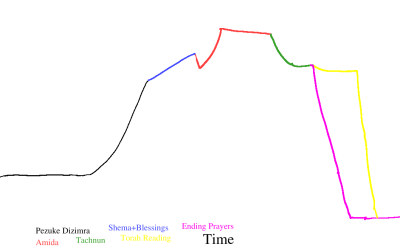
The closing segments of both Chabad and Reform davening are relatively short, perhaps because everyone just wants to go home and leave after the important prayer of the Amidah is over. The Reform siddur’s closing prayers are quite short, just being one psalm usually sung aloud. In compassion, the Chabad siddur has about 7 different prayers, mostly psalms and quotes from the Torah. It ends with a message of not fearing evil, because God is on your side. This once again follows the comparison, as the most important communal services are done, so there is not much of a point for Reform services to continue. But in the more spiritual Chabad world, there needs to be some time to unwind from the Godly presence and to transition back into regular life. Thus ends the service. Figure three gives a diagram of the level of intensity of Reform davening over time, notice that the sections are smoother, where the bumps are more pronounced between sections.
The Point
The fact of the matter is that Reform Davening fulfills different goals from Chabad, and has different frames when considering the means. Reform davening is shorter, is more focused on human connections and relationships, and has less nuance within sections. Chabad davening has more of an explicit connection with God, and roughly follows what someone would do when requesting something from a king. The isomorphism is quite fitting. Pezuke Dizimra is associated with the early pleasantries and greetings. The Shema is where the conversation starts getting to the point. The Amida is the pitch — where extra praise sandwiches the requests. Finally, the closing prayer is to end off with some relevant conversation, before respectfully leaving now that there is nothing left to inquire. Thus, there are many ideological differences between the branches of Judaism, but with some extra analysis, it is easy to see that the main point is the same: to pray to God as a community to bond with other congregates, and oneself. The beauty of the wonderfully complex branches of Judaism is that everyone has the same roots. Even if we have wildly different prayer structures, the book binding us together will forever remain the same.