
Advancing Women's Health, One Policy at a Time
The Sidewalk Is Never Just a Sidewalk
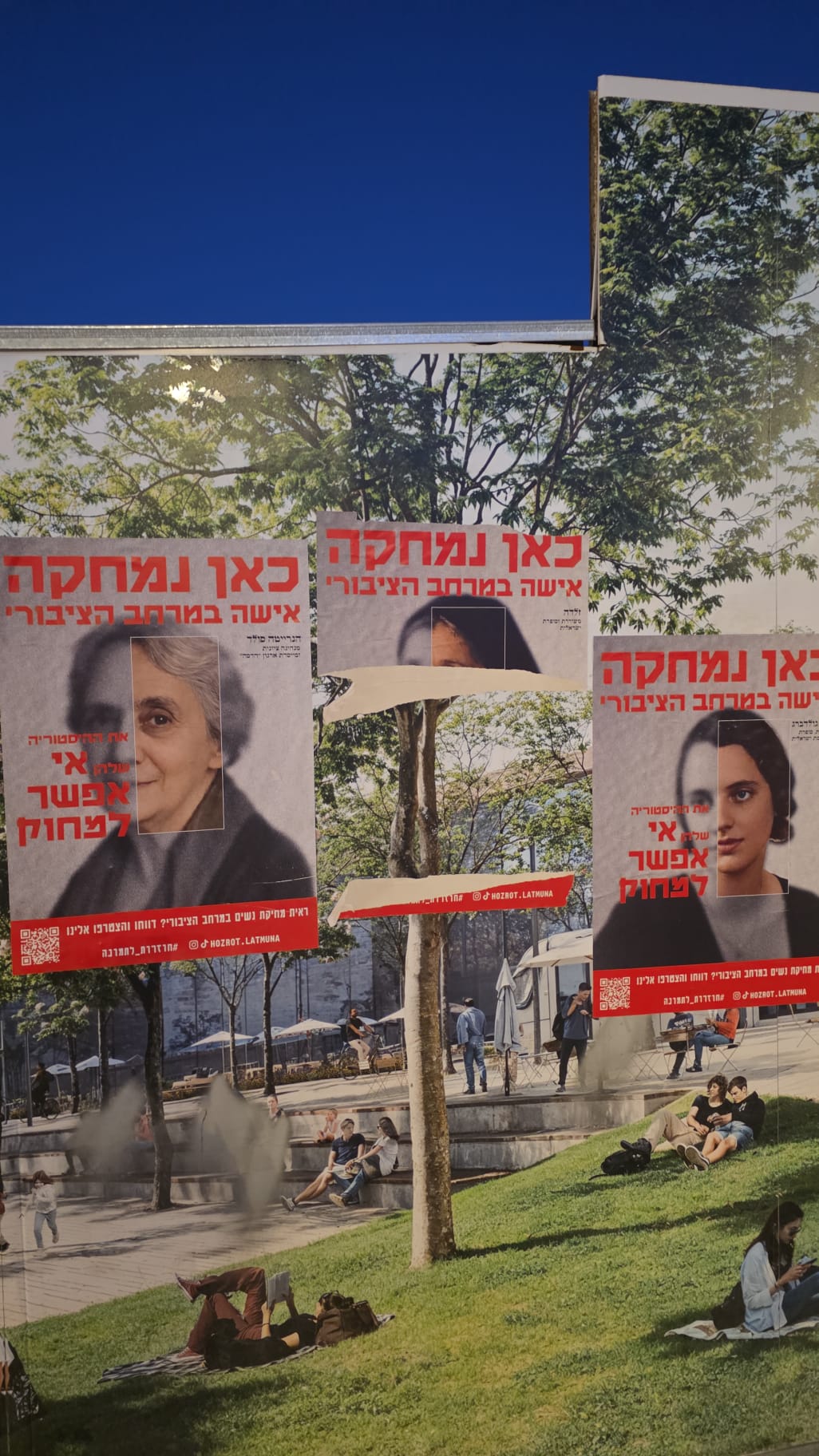
(courtesy)
Last week, reports emerged that men and women in Bnei Brak would be directed to use separate sidewalks in certain areas of the city. Signs were placed and then reportedly removed following public and legal opposition.
It would be easy to dismiss the episode as another short-lived Israeli controversy: a localized rabbinic instruction, a municipality claiming that it had merely assisted with logistics, a burst of public outrage, and signs that disappeared almost as quickly as they appeared.
But a sidewalk is never just a sidewalk.
On paper, the arrangement may appear symmetrical: one sidewalk for men and another for women. But giving each group a sidewalk does not make the arrangement equal.
When men and women are directed to different sides of a public street, a man walking down the street remains an individual going somewhere. A woman walking down the same street becomes a social and religious concern that must be managed. Her presence, which should be unremarkable, is transformed into a moral event.
Men are rarely taught that their bodies are inherently disruptive to public order or that the solution to another person’s religious struggle is for them to become less visible. They do not generally grow up learning that their voices, photographs, clothing, or physical proximity may constitute an imposition on those around them. Women, however, are asked to absorb that burden. Gender segregation turns one group’s discomfort into another group’s restriction. Rather than requiring men to navigate the ordinary presence of women with self-control, dignity, and respect, it reorganizes the environment so that women become responsible for male thoughts, feelings, and religious observance. They are asked to move, cover themselves, lower their voices, disappear from view, or accept reduced access to public space in order to preserve a standard of male morality.
This is often described as modesty, but modesty is an ethical discipline a person chooses for themselves. Regulating another person’s movement so that one does not have to encounter them is something fundamentally different. It is the imposition of one person’s religious obligations onto another person’s body. It transforms private conviction into public control and asks women to bear the cost of male virtue.
Segregation does not only reflect how a society sees women; it teaches girls how to see themselves. A girl who repeatedly watches women being moved aside, hidden, silenced, or told where they may stand learns that her place in public life is conditional. She begins to anticipate discomfort before anyone expresses it, calculating where she may stand, how loudly she may speak, and whether her presence will be considered disruptive. Over time, she becomes skilled at making herself smaller without ever needing to be told.
At the same time, a boy learns that the world should be reorganized around his reactions and that women are responsible for preventing his discomfort. Instead of being taught to meet women as full human beings and to conduct himself with maturity, he learns that male virtue depends on female absence.
Eventually, the sign on the street is no longer necessary. The girl carries the boundary within herself, and the boy comes to believe that it belongs there.
There will, of course, be women in Bnei Brak who support separation and see it as part of the life and values they have chosen. Their voices matter. Haredi women are not all the same, and they should not be spoken about as if they are helpless victims waiting to be rescued by outsiders. Many make thoughtful, meaningful choices within their communities, even when those choices are different from the ones others would make. But the fact that some women support segregation does not mean that every woman affected by it has freely chosen it. Choice is only real when saying no is also possible. Social pressure can be just as powerful as formal enforcement. It operates through glances, whispers, public correction, damaged reputations, family pressure, school consequences, marriage prospects, and the knowledge that refusing to comply will make a woman conspicuous. A woman may technically be free to walk on the “wrong” side of the street while knowing that doing so may mark her as immodest, provocative, or disloyal. When the cost of refusal is shame, exclusion, or social punishment, the absence of formal force does not amount to freedom.
And once women disappear from public life, they also disappear from the places where power is exercised. They are no longer sitting at the tables where decisions are made about their bodies, their healthcare, their education, their work, or their place in society. Their interests may still be discussed, but without their voices, their experience, or their authority in the room. Decisions about women become decisions made for women by people who do not live the consequences.
Leaving those spaces is far easier than returning to them. Once institutions become accustomed to functioning without women, their absence begins to look normal, and their return is perceived as disruptive. A woman entering a space from which women have long been excluded is no longer seen as simply taking her rightful place. She is treated as though she is demanding access to a space that was never hers to begin with.
Segregation does not merely remove women from a particular place. It erodes the expectation that women should have been there in the first place.
Women across Israel run companies, lead hospitals and universities, sit on courts, build technologies, conduct groundbreaking research, command military units, treat the wounded, deliver babies, shape public policy, create jobs, raise families, and hold entire communities together through war, terror, grief, and crisis. They are not standing at the margins of this country; they are building it, leading it, and keeping it alive. We cannot depend on women in every moment of national emergency and then ask them to become smaller, quieter, or less visible when they step into public space.
The signs in Bnei Brak may have come down, and that’s important. But the deeper question is whether we are willing to challenge the belief that made them seem reasonable in the first place: that when men are uncomfortable, women should move; that when religious expectations conflict with women’s freedom, women should bear the cost; and that public order can be preserved by making women less visible.
A healthy society does not teach half its children to occupy the world naturally while teaching the other half to calculate whether their presence is permissible. Women are not temptations, disruptions, or obstacles around which a city should be designed. They are human beings, and their presence should require neither permission nor explanation.
Segregation begins by assigning women a different sidewalk. It ends when society no longer notices that they are gone.
Related Topics