
The signal in the bottle

TL;DR: The Dutch government’s new prohibition on goods from Israeli settlements is built on precision: legal consequences attach to a specific territorial relationship. Yet the same measure is also intended to send a wider political signal. That matters in a country where judgments about Israel have already moved from representatives to Jewish institutions, family ties, Holocaust commemorations, Stolpersteine and Anne Frank. The pattern is consistent: as political agency recedes, connection gives way to category, until Jewishness itself can become enough to keep the judgment in motion. The government has already formally recognized that boundary. It nevertheless chose to make the signal travel.
*
On 22 September, a bottle of wine produced in a Jewish community in Judea or Samaria will acquire a new legal status in the Netherlands. Nothing about the bottle will have changed. What will matter is where it came from. Under a decree adopted in July by the Dutch government, goods originating wholly or partly in Israeli communities in Judea, Samaria and East Jerusalem, grouped by the decree within its “West Bank” category, as well as in the Golan Heights, may no longer be imported, bought, sold or commercially brokered in the Netherlands. The customs question is narrow because the consequence is narrow: the relationship specified by the Dutch government determines whether the rule applies.
The decision to proceed nationally was neither straightforward nor routine. The Dutch Council of State notes that trade policy is in principle an exclusive competence of the European Union. The government had sought further European measures, found insufficient support and chose to proceed nationally. Customs, the Fiscal Intelligence and Investigation Service (FIOD), and the Public Prosecution Service raised difficulties in establishing origin, while the normal internet consultation was omitted. Yet the Council recorded another consideration: “the signal that the government wishes to send with this step”. The legal consequence would stop at a carefully specified category of goods. The signal was intended to communicate beyond them.
The line
The decree invokes the International Court of Justice’s advisory opinion of 19 July 2024 alongside relevant United Nations resolutions. The Court concluded, among other things, that states must distinguish in their dealings with Israel between Israeli territory and the Palestinian territory occupied since 1967 and not provide aid or assistance in maintaining the situation it found unlawful. It did not direct the Netherlands to impose this national prohibition.
The trade rule provides the control case. A bottle produced in Netanya may be an Israeli product, produced by Jews and embedded in the same national economy as a prohibited bottle. None of those genuine connections is enough. The consequence follows from the territorial relationship specified by the decree. The bottle establishes a simple discipline: consequences do not follow from relatedness in general, but from the relationship relevant to them. Outside customs law, the consequences are different, but the relational problem remains.
At Loods 24 in Rotterdam, where Jews were assembled for deportation during the German occupation, Israeli representatives had participated in the annual Holocaust commemoration for years. In July 2026, ambassador Zvi Aviner Vapni prompted objections from political factions, municipal employees, neighborhood bodies and others. Sixty-three organizations and individuals asked Mayor Carola Schouten not to attend while he remained on the program; she attended, and protesters later interrupted his address. Opposition to an ambassador has an intelligible political object. He represents the state whose conduct is contested. The controversy changed character when opposition to him became a reason for others to condition their participation in the Jewish ceremony on whether its organizers continued to include him. The judgment had moved from the representative to those who invited him, and from their choice to the commemoration itself.
The organizers defended the longstanding place of Israeli representation there. Family and migration, religion and prayer, Zionism and peoplehood, attachment to the land, collective survival and Israel’s place in modern Jewish history all make that presence meaningful. The connections are real, but they are not the same relationship. Representation carries political agency. Invitation carries association. Jewish identification carries history, attachment, and peoplehood. As the judgment moves from one to the next, the connection remains genuine while the agency that gave it standing becomes progressively weaker.
The relationship could weaken further. In 2025, a gardening company cancelled agreed work for the Liberal Jewish congregation in The Hague because, it explained, employees did not wish to work for “a Jewish institution” given “the terrible situation in Gaza.” Representation had disappeared; Jewish institutional identity supplied the connection. The same movement could pass through kinship: protesters confronting Lenny Kuhr invoked her children and grandchildren in Israel while directing accusations of terrorism and genocide at the Dutch Jewish singer.
When the object changes
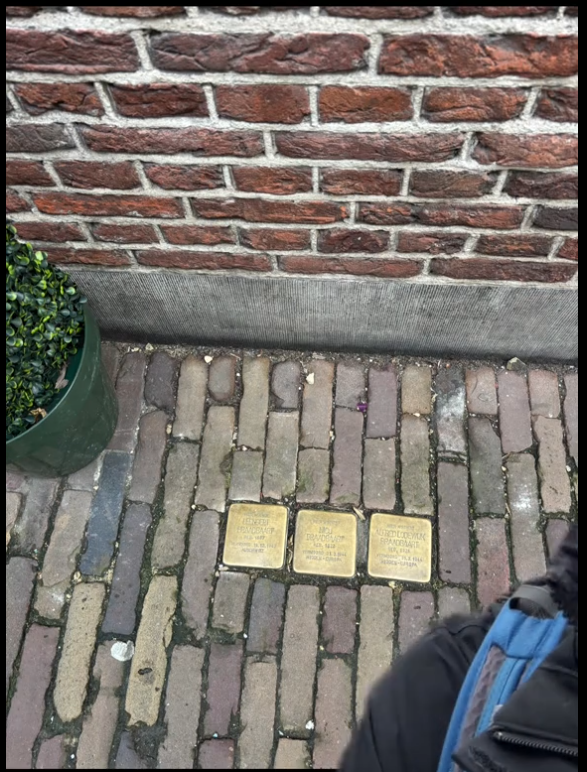
The movement becomes sharper at a Stolperstein. CIDI has documented stones marked with “Gaza” and, beside others, “Free Palestina” and “Fuck Zionism.” Pieter Rambags, a Dutch pro-Palestinian activist and social-media commentator who later participated in the Global Sumud Flotilla, made the movement unusually explicit in a February 2026 video recorded beside the Stolpersteine of Leendert Braadbaart and his sons Nico and Alfred Lodewijk at Groenmarkt 36 in Dordrecht. The stones stand outside what had been their home and family bakery. Leendert had taken over his father’s bakery there; he and his sons were arrested together in Dordrecht on 11 November 1942. Leendert was murdered in Auschwitz on 19 December. Nico and Alfred were deported through Westerbork, and their deaths are recorded in Central Europe on 31 March 1944, aged 21 and 18. Rambags holds no office and speaks for no institution or constituency, and his relevance lies in the clarity of the language. Standing beside the stones commemorating these three men, he said that they had acquired a “bad aftertaste” for him before moving from the individuals commemorated there to “a people” that had become a “genocidal kind.”
The endpoint is visible elsewhere. The Anne Frank statue on Amsterdam’s Merwedeplein was vandalized twice in 2024, first with “Gaza” and then with “Free Gaza.” Anne Frank died in 1945. She did not represent Israel, choose an Israeli policy or act through an Israeli institution; the state did not exist during her lifetime. Yet “Gaza” was written onto her memorial. At this point, the relationships that could supply contemporary political agency have disappeared. What remains is membership in the Jewish people. Jewishness is the remaining connection through which the judgment can travel.
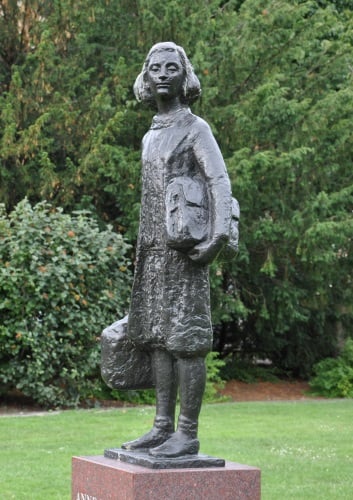
The direction matters most clearly at the level of Holocaust memory. A Stolperstein itself performs the opposite movement: persecution reduced an individual to “the Jews”. The memorial restores a person, a name, an address, a life. Anne Frank’s memorialization performs the same restoration at a different scale. She is not an anonymous representative of a category but one of the most individualized victims of the Holocaust: a named person with a face, a voice, a biography, and a fate. The contemporary accusation reverses that individuation. The person is returned to “a people,” the collective receives the political judgment, and the judgment can then return to the individual memorial. The memorial recovers a person from the category; the accusation restores the category in order to reach the person again. The category is therefore not merely where the movement ends. It is what allows the judgment to survive after the agency that originally sustained it has disappeared.
Frans Timmermans’s 25 July interview with Ilja Leonard Pfeijffer in De Morgen shows another form of the movement, inside the political subject itself. He begins with “the right and far right in Israel,” renders the position he attributes to that faction as “we Jews,” invokes “their grandparents and great-grandparents” destroyed in the Holocaust and concludes that “they” are now doing the same to another people. Whether “we Jews” reproduces the faction’s imagined voice or compresses it, the subject widens from a political faction to Jewish peoplehood and Holocaust ancestry. The politically specific actor becomes less important to the attribution. A claim about identifiable political actors acquires a collective subject through which culpability can travel across generations.
Taken together, the scenes reveal an attributional cline. At one end stands a politically specific actor whose conduct can ground judgment. Moving down it, representation gives way to association, association to affiliation, affiliation to peoplehood and ancestry. Relevant agency recedes while category does progressively more of the work. A judgment that began with what an actor did comes increasingly to depend on what another person, institution or memory is connected to, until what the object is supplies the relevance that conduct no longer can. No one needs to assert that Jews and Israel are identical. The transfer can occur cumulatively because each connection is real while different relationships are made to carry the same judgment.
Portable jurisdiction begins when the judgment survives that descent. Authority acquired through one relationship is carried into another until the judgment reaches an object that did not generate it and claims standing there. Once carried into the collective category, it can return toward particular people, institutions, memories or symbols. The object changes while the claim to govern it survives. The mechanism does not depend on the merits of the originating charge
The accusations themselves are historically unstable. The relational logic is less so. Across the history of anti-Judaism and modern antisemitism, Jews have repeatedly been made to personify problems whose causes lay elsewhere: capitalism and socialism, cosmopolitanism and separatism, revolution and reaction, rootless modernity and tribal particularism. The contradictions are not incidental. They show that the content of the accusation is less durable than the categorical object to which it is attached. Once “the Jews” are made to carry a political or social crisis, the charge can change while the object remains available.
One historical instance makes the mechanism concrete. During the Russian Revolution of 1905, Black Hundred and other loyalist forces associated Jews with revolution and opposition to the old order. A retrospective Chelm account preserves the pogromist cry “Beat the Jews and save Russia.” Once “the Jews” had become an explanation for Russia’s crisis, particular Jews no longer needed to have caused it to become its objects.
The state enters
The boundary had already been formally recognized by the Dutch government. In September 2025, Justice Minister Foort van Oosten was asked whether he recognized that Jewish Dutch citizens and Jewish institutions were being addressed over the war in Gaza, including when they held different views. He answered yes and called the development very concerning. In February 2026, the government’s antisemitism taskforce stated that Jews may not be held individually or collectively responsible for the actions of the State of Israel. In April, Vice-Premier Dilan Yeşilgöz described attacks on a synagogue, a Jewish school and the premises of Christians for Israel and observed that “every aspect of being Jewish” appeared capable of becoming an occasion for threat, aggression or violence. Government policy had already identified the boundary between judgment of Israel and attribution to Jews.
The decree was signed on 13 July and published on 21 July. Timmermans’s interview and the Loods 24 dispute followed within days. By the time the measure enters into force on 22 September, its signal is entering a public field in which the movement from political agency toward Jewish category has appeared in very different settings. Its significance here is that the government deliberately chose to signal into that field.
As law, the decree attaches consequence to a narrowly specified territorial-economic relationship. As signal, its political meaning is intended to extend beyond the transaction in which the rule is applied. The law is bounded by design. The signal travels by design. Customs regulates the bottle; signaling begins where the bottle ceases to be the only object that matters. The Council of State records the government’s intended signal among its considerations for proceeding.
That prior recognition changes the institutional question. Once communicative reach became one of the reasons for proceeding, preserving the distinction already drawn in government policy became part of the act of signaling itself.
Jewish attachment to Israel may be familial, religious, spiritual, historical, national or political. None of those connections turns a Jew into an Israeli government, policy or representative. A politics that required Jews to escape the judgment by severing those connections would merely make distance from Israel the condition of exemption. Equal treatment would depend upon Jews demonstrating that Israel matters sufficiently little to them. Jewish attachment may remain as consequential as Jews themselves understand it to be. The discipline belongs to the judgment. Its authority ends where the relationship capable of giving it standing ends.
The contradiction is now visible in the government’s own positions. Its legal rule insists that consequences attach to specified relationships rather than to relatedness in general. Its antisemitism policy has already identified the boundary between judgment of Israel and attribution to Jews. And in this decree it deliberately counts a political signal among the reasons for proceeding, a signal whose meaning necessarily extends beyond the legal transaction. These positions meet where the government itself has chosen to make political meaning travel.
That danger was already documented. The government cannot plausibly claim that it lacked notice that judgments concerning Israel were already reaching Jews and Jewish institutions. Nor can it claim that the wider meaning of the decree is an unintended by-product. The signal was part of the point.
On 22 September, customs will ask where the bottle came from. Being Israeli will not be enough. Being produced by Jews will not be enough. Belonging to the same economy will not be enough. The law moves toward distinction: it strips away relationships that are real but irrelevant until it reaches the one capable of giving the consequence standing. The signal moves in the other direction. It takes political meaning generated by that bounded relationship and sends it outward into the public field.
That is why precision cannot end at customs. When political judgment reaches a synagogue, a Jewish singer, a Holocaust commemoration, Anne Frank or a murdered Jew beneath a Stolperstein, the relevant question is again the one the government knows perfectly well how to ask of the bottle: what relationship gives this judgment standing here? If the answer is merely Jewishness, Jewish attachment or Jewish memory, the boundary has already been crossed.
The Dutch government cannot claim precision for the law and ambiguity for the signal. It cannot acknowledge that boundary in antisemitism policy and then treat it as someone else’s problem once political meaning begins to travel. And it cannot value the reach of the signal while disclaiming responsibility for preserving the distinction its own institutions had already identified as necessary.
The bottle was never the difficult case. By the time the Dutch government chose its signal, it already knew where the difficult case began.