Author l Columnist | Public Policy | Life Management Coach
The Silence on Hindu Rights in South Asia
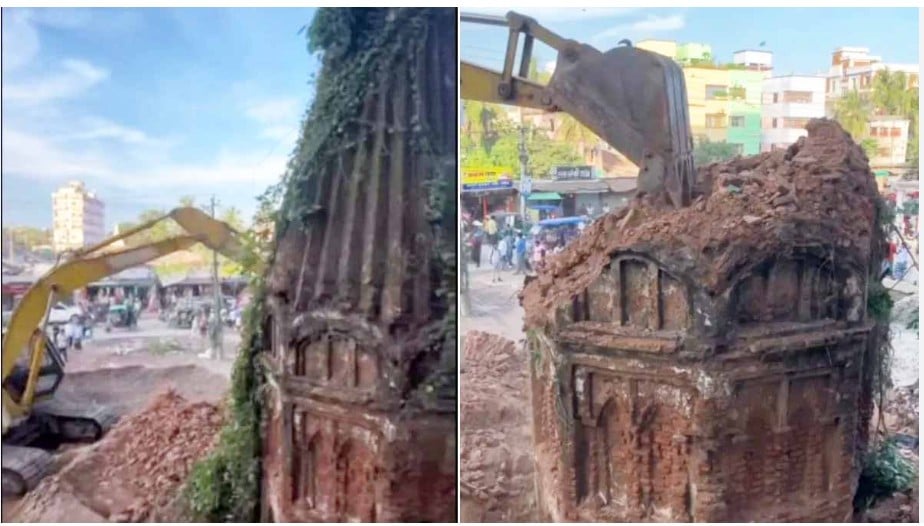
500-year-old Hindu temple demolished in Bangladesh ‘on Tarique Rahman’s orders’, Picture courtesy -www.thestatesman.com
Incident of demolition of a 500-year-old Hindu temple in Noakhali, Bangladesh has come to light. The action was allegedly taken on the “orders” of Bangladesh Prime Minister Tariq Rahman. If this incident had happened at a mosque in India, it would have probably drawn a barrage of reactions from the international media, human rights organizations and social media criticizing it as a Muslim atrocity. It is natural in a democratic society to raise questions on the rights of any community and make governments accountable. But an important question is relatively rarely asked, is the situation of Hindus, Sikhs and other religious minorities in Pakistan, Bangladesh and Afghanistan formed after the partition of India, discussed with equal seriousness and sensitivity? If human rights are universal, then they should also be evaluated on the same criteria for all countries and all communities.
To find the answer to this question, it is enough to look towards Rawalpindi. Before partition, Rawalpindi was counted among the major temple cities of North-West India (present-day Pakistan), where many temples, dharamshalas and religious institutions were the center of cultural and social life of Hindu society. The Lal Kurti Valmiki Temple is still in existence with limited religious activities, while the Maharishi Valmiki Swami Temple, Gracey Line, which was the center of faith especially for the Dalit Hindu community, has long been in a dilapidated state. The Kalyan Das Temple at Kothari Bazaar, which was constructed in the nineteenth century, is now being used as a government school for visually impaired children. The historic Raghunath temple complex of Bagh Sardaran, which comprised three temples and two gurudwaras, has been closed for a long time. The Mahadev temple of Sarafa Bazaar has been partially converted into shops. The Ramlila temple at Kanak Mandi was used for other purposes after Partition, while the Mohan temple at Lunda Bazaar and the Ganesh temple at Urdu Bazaar are today abandoned or in ruins. In contrast, the Sri Krishna Temple at Sadar, built in 1897, is still in limited use today and is considered a symbol of the remaining continuity of Hindu religious life in Pakistan. The present condition of Rawalpindi’s Hindu temples is not just a question of their renovation, but it is also a silent testimony to the gradual erosion of Hindu faith, religious symbols and cultural-social heritage of this country after the partition of Pakistan.
There is no difference in the situation of Bangladesh. An example of the challenges related to religious freedom in Bangladesh is that the construction of the 81-feet high Lord Shri Ram statue, built with the donations of devotees in the Sri Sri Radha Govind and Kali temple complex located in Palashbari of Gaibandha (district), had to be stopped after almost 80 percent completion due to threats from fundamentalist groups. The government is citing law and order issue to stop its construction and discussions are on to demolish the statue. Since the ouster of Sheikh Hasina, there have been attacks on the Hindu community. In the name of communal tension, there were continuous attacks on temples, houses and business establishments. Minority youth Deepto Rai (Prince Rai) of Sunamganj district was accused of blasphemy through social media. Eyewitnesses termed the allegation as untrue or unproven, but as soon as the allegation became public, the police took action and the family’s house, livelihood and local temple were attacked. According to the report of the local human rights organization, 17 cases related to blasphemy were registered between January and June 2026, while 73 minority youth were arrested on such charges in 2025. In many cases, arrests and mob violence begin even before digital forensic verification.
That is to say, Article 20 of Pakistan gives right to every citizen to practice religion, Article 22 gives right to a person to receive religious education, Article 26 and 27 prohibit discrimination and Article 36 deals with the rights of religious minorities. But on the other hand, some provisions of the Constitution clearly give Islamic character to the constitutional structure of Pakistan. Article 2 declares Islam as the state religion. Article 2A Objectives The resolution provides the constitutional basis for Islamic principles. According to Article 41(2) only a Muslim can become the President of Pakistan. According to Article 91(3) it is mandatory for the Prime Minister to be a Muslim. Article 227 dictates that all laws shall be in accordance with the Quran and Sunnah. Within the same constitutional framework, punitive laws related to blasphemy also apply, which have been used against religious minorities, particularly Hindus, Christians and the Ahmadiyya community. Similarly, in Bangladesh, Article 2A declares Islam as the state religion, while also stating that followers of other religions will be able to practice their own religion. That is, the Constitution of Bangladesh, on the one hand, guarantees equal civil rights and religious freedom, and on the other hand, it also recognizes Islam as the state religion. This constitutional duality gives rise to debate on practical challenges.
In contrast, India’s constitutional model is different. The Constitution of India does not declare any religion as the state religion, but Articles 25 to 30 provide freedom to all citizens to practice, propagate and manage religion, Articles 29 and 30 give special constitutional protection to religious and linguistic minorities to establish and operate their culture, language and educational institutions. Religious freedom in India is not only a constitutional but also a part of an institutional system. A provision of about ₹3,350 crore was made in the Union Budget for the financial year 2025–26. Apart from this, the National Minority Commission, State Minority Commission and Minority Welfare Departments of various states provide the institutional basis to this constitutional framework. The Waqf Board in India has a total of more than 8 lakh 72 thousand immovable properties spread over about 9.4 lakh acres of land, there are 7 lakh mosques and 3.5 lakh madrassas for about 19% Muslim population, about 75 thousand churches for 1.5% Christian population and the number of churches affiliated educational institutions is about 50,000.
In contrast, Pakistan and Bangladesh do not appear to have separate constitutional protection for the Hindu community, comprehensive institutional framework or dedicated ministries for education, cultural preservation and development of religious heritage, and comparable budgetary arrangements as in India. This is why while discussing minority rights in South Asia, a comparative assessment of their actual implementation, institutional support and state commitment rather than just constitutional declarations is also necessary.
The future of South Asia requires that religious freedom be elevated from political discourse to a universal human right. Be it temple, mosque, gurudwara or church, the security of every place of worship is equally important. Violence against any religious community, forced conversion, occupation of religious places, or social media-based mob justice must be equally opposed. The real test of human rights is not that we protect the rights of our own community, but that we protect the rights of every community with equal commitment. The path to lasting peace and social trust in South Asia also passes through this principle. The credibility of human rights is proved when justice is done not on the basis of the identity of the victim, but on the basis of principles. If religious freedom in South Asia is truly a universal value, then it must be evaluated with the same sensitivity, the same ethics and the same standards for all countries and all communities.
Related Topics
Related Posts