DISCLAIMER: This essay is not an opinion piece about Gaza. After all, my goal is to attract readership. Besides, my expertise is not in politics. This essay is an exercise in “absurdism”. I have always been enthralled with the “Theatre of the Absurd” and wanted to use that artform in writing this piece. This piece contains many nuanced subtleties. It is for the reader to locate them.
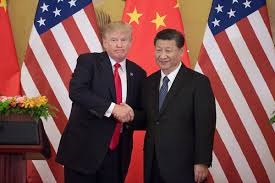
Washington, D.C., February 30, 2025 (Appointed Press)- The United States and China achieved an unprecedented landmark decision with regards to Gaza. Standing with General Secretary Xi Jinping of China on the East Lawn of the White House, the President declared, “this is a remarkable day in the world and our two countries. This is tremendous.”
The President and Xi (1)
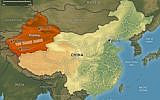
In lifting the tariffs placed on China, China has agreed to relocate all of the Gazans to Urho City in Xinjiang, China. The Xinjiang province, or the Xinjiang Uygur Autonomous Region, is located in the northwest sector of China. What makes this region unique is that fifty percent of the population are Muslim.
Map of XInjiang, China (in the orange) (2)
Urho City is one of dozens of ghost cities in China. During the last thirty years China has built fully developed cities that can accommodate up to 1-2million people. These cities are complete, with a whole infrastructure of schools, mass transit, luxury high rises, municipal buildings, art centers, and store fronts. These projects allowed average Chinese, who benefitted from the country’s boom, to invest in real estate since they were not allowed to invest their money overseas. It was a seemingly win-win situation.
These cities turned out to be a bust. They are almost totally empty; hence they are referred to as “Ghost Cities.”
Picture of Two Ghost Cities (3)Note the Empty Streets (Mandarin Blueprint 2024) (4)
China now has the opportunity to populate one of these ghost cities with Gazans. Urho City can accommodate two million people in luxury apartments, which is equal to the current population of Gaza.
Through international cooperation, China arranged that countries will partially subsidize the rents of these new immigrants. Thus, the owners of these properties will not lose their investment. The terms will be “lease to buy” to incentivize the Gazans to permanently live in this Moslem Region.
It was also arranged that China will be involved in the rebuilding of Gaza. The first priority will be for China to rehabilitate the international airport in Gaza which was destroyed due to Hamas’s aggressiveness towards Israel over the years. After that, there will be a major airlift of Gazans to Urho, a city which already has an international airport.
“This is a major victory for the Xinjiang Autonomous Region,” declared General Secretary Xi Jinping, “since there has been a significant major population decline in this region during the last twenty years.” Xi also added that the Gazans will begin their new lives by attending special schools that will teach them about Chinese culture, thus assisting them in acclimating to their new environment. Xi asserted that Xinjiang already has built “Reeducation Camps” throughout the province for this very reason.
Surprisingly, the Arab countries like Egypt, Saudi Arabia, and the Gulf States fully endorse this plan. These countries will also be involved in the rebuilding of Gaza. Plus, there has been quietude in the Palestinian areas in Judea/Samaria, Jordan and Lebanon.
“Never before”, shouted the President, “has every country in the world been unanimous about endorsing this plan. I believe it is peace for our time.”
Time will only tell.
–
(1) China Morning Post Oct 2018
(2) RANE Worldview 2013
(3) Mandarin Blueprint 2024
(4) Mandarin Blueprint 2024
About the Author
Saul Chapnick was raised in an Orthodox home with deep familial Hasidic roots. Educated in yeshiva and later earning a Master of Social Work degree from Yeshiva University's Wurzweiler School of Social Work, Saul has continued throughout his life to embrace Jewish learning in many settings—from studying at Hebrew Union College–Jewish Institute of Religion to maintaining a weekly chavruta for ongoing Torah study. His lifelong journey has given him a deep appreciation for richness of Jewish tradition across the spectrum of Jewish life.
For more than thirty-five years, Saul has devoted himself to the study of Jewish history, with a particular focus on Jewish life in interwar Eastern Europe. Inspired by the mitzvah of Zachor (to remember), he has explored both the extraordinary vibrancy of the Jewish world that was destroyed in the Shoah and the enduring questions of Jewish memory, continuity, and identity. Through extensive travel, archival research, and conversations with survivors, scholars, communal leaders, and public figures, he has sought to understand not only what was lost, but also what those vanished communities continue to teach us today.
His writing explores the intersection of Jewish history, personal memory, Israel, and contemporary Jewish life, seeking to connect the voices of the past with the challenges of the present.
A gifted storyteller and engaging speaker, Saul has lectured throughout the United States and abroad on Jewish history, Yiddish language and culture, modern Poland, Israel, and post-Holocaust Jewish identity. His presentations blend scholarship with personal experience, inviting audiences to explore the enduring relevance of Jewish history to contemporary Jewish life. He has also prepared adult participants of the March of the Living by providing historical and cultural context that deepens their understanding of both Poland's Jewish past and its emerging Jewish present.
Saul is the author of a widely read weekly Substack newsletter and a contributor to The Times of Israel, where he reflects on Jewish life, history, Israel, memory, and current events. His essays weave together personal experience, historical research, and contemporary issues, encouraging readers to reflect on the challenges and opportunities facing the Jewish people today.
For the past thirteen years, Saul has served as the Substitute Chaplain through the Greater Miami Jewish Federation Chaplaincy Program at Miami Jewish Health. During rabbinic transitions, he has served as the community's interim spiritual leader, leading Shabbat and holiday services, reading Torah, delivering Divrei Torah, teaching adult education classes and study groups, and providing pastoral care to residents and their families.
Professionally, Saul brings more than two decades of executive leadership in healthcare and human services. He specialized in turning around distressed assisted living and memory care communities by rebuilding staff morale, restoring occupancy, improving quality of care, ensuring regulatory compliance, and returning organizations to financial stability. Today, he draws upon that experience as an expert witness in legal matters involving senior care, assisted living, and long-term care communities.
Whether teaching Torah, leading prayer, writing, or speaking, Saul believes that Judaism is best experienced through learning, storytelling, meaningful relationships, and a deep respect for every individual's Jewish journey.
At the same time, Chapnick has witnessed a limited reawakening of Jewish life in his family’s ancestral homeland of Poland. He has spoken at numerous venues on the contemporary relevance of Yiddish and Yiddish culture, the significance of the 19th- and 20th-century Jewish world to modern life, and the shaping of post-Holocaust Jewish identity. He also prepares adult participants of the March of the Living to engage meaningfully with modern-day Jewish Poland.
Chapnick shares his insights and reflections in weekly blogs on https://saulchapnick.substack.com, where readers are welcome to subscribe.