
Investor, entrepreneur, author of Amplianism: The Economics of Error
The Slow Chip From Haifa That Changed Intel
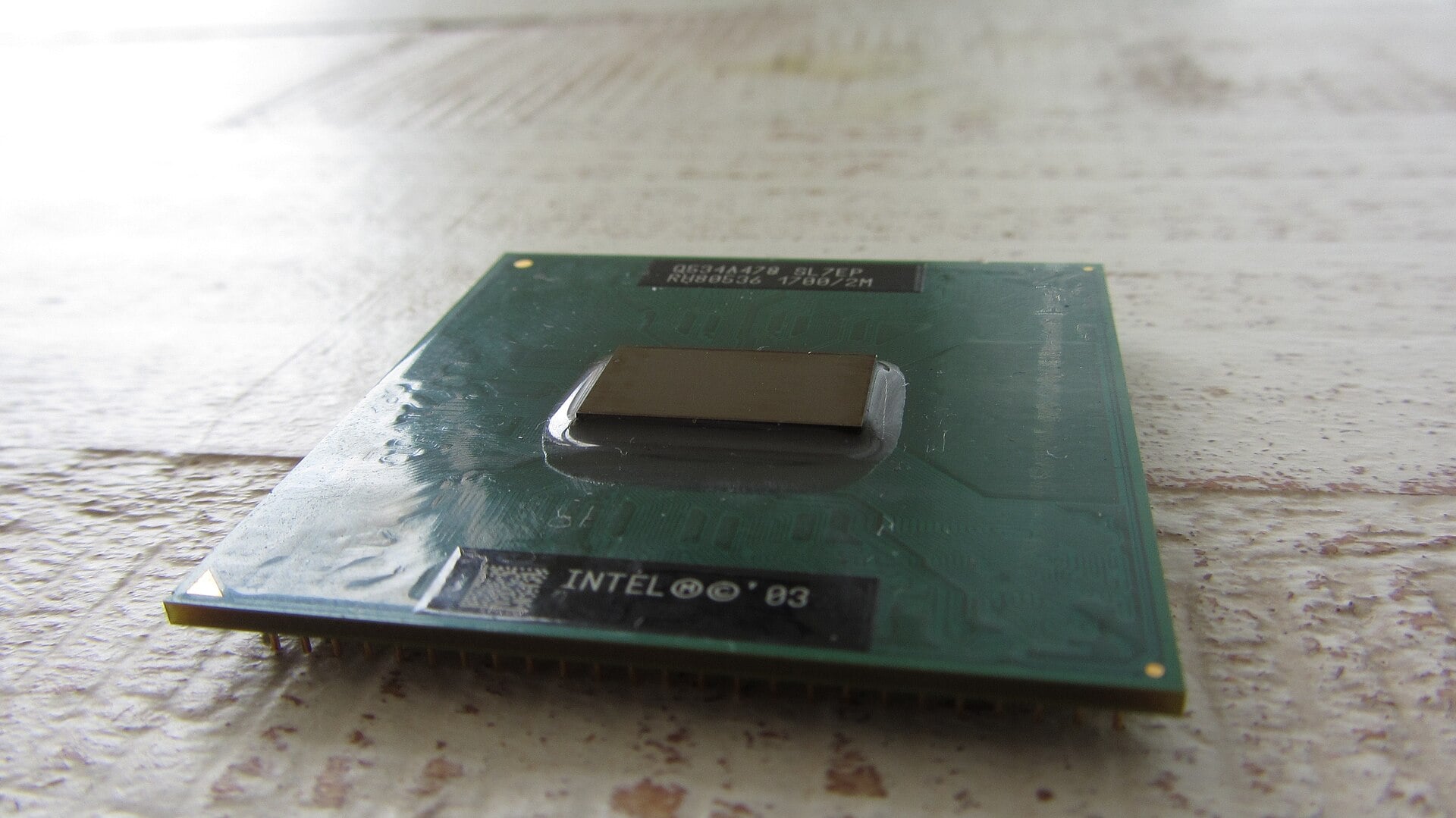
Intel Pentium M processor. Photo: Christiaan Colen, CC BY-SA 2.0, via Wikimedia Commons
Intel let a team in Israel sell a slower processor years before its desktop roadmap ran out. Kodak, with a head start in digital, never found an equivalent.
In December 1975, a young engineer at Eastman Kodak named Steven Sasson took a photograph with a camera that used no film. It was the size of a toaster and took 23 seconds to write one black-and-white image onto a cassette tape [1]. Decades later he told The New York Times what management said about filmless photography: “that’s cute, but don’t tell anyone about it” [2]. Kodak filed for bankruptcy protection in January 2012 [3].
People like to say Kodak buried its own future, which leaves out most of what happened. The company spent heavily on digital, and in 2005 it sold more digital cameras in the United States than anyone else [4]. Cameras just never made the kind of money film did, and the business kept shrinking around a product that was selling well.
Intel ran into a version of the same problem twenty-odd years later, and a team in Haifa is a large part of why it came out differently.
On October 26, Intel agreed to buy Classiq, a Tel Aviv quantum software company founded in 2020. Israeli media put the price at about $2.3 billion, the largest acquisition so far in quantum computing [5][6]. Most coverage read it as a hiring deal for quantum engineers. I keep thinking about Intel’s much older bet in Haifa, which worked for reasons that had little to do with hiring.
When I look at a company before investing, I use a test that comes out of an idea I have been working on since 2015 and call Amplianism. One of its laws is that whoever pays decides who tries. So I want to know whether a company has spent actual money developing an alternative to its main strategy, with a product it can sell. I also watch what happens when the people working on that alternative disagree with management. Those conversations get uncomfortable fast, and how the top handles them tells me a lot.
Frequency was king
In the early 2000s Intel sold its desktop processors mostly on clock speed. On August 28, 2001, Paul Otellini, then head of the Intel Architecture Group, told the Intel Developer Forum that the Pentium 4 design would scale to 10 gigahertz over its lifetime [7].
That line gets quoted a lot, usually as proof of a headquarters that could not see past one number. The transcript of the same keynote is more interesting. Otellini also said gigahertz were necessary but not sufficient, and he previewed a laptop processor built for high performance at very low power, code-named Banias, which was being designed in Haifa [7][8].
Haifa was Intel’s first design center outside the United States, opened in 1974 with five people, as I described in an earlier post [9]. Rony Friedman, one of its lead engineers, had watched Otellini cancel a low-cost chip of his. He later told Bloomberg that frequency was king in those years and his group was on the outside [8].
Haifa still had a product to build, though, and a market of its own: laptops, where battery life counted as much as raw speed. Banias shipped in March 2003 as part of Centrino, topping out at 1.6 gigahertz while desktop Pentiums were already at 2.8 and above [8][10]. Getting the rest of Intel to sell a slower chip took some doing. Mooly Eden, who had run the Israeli center, put it this way: “We did it the Israeli way; we argued our case to death” [8].
The main roadmap then ran into heat. In May 2004 Intel cancelled Tejas and Jayhawk, the next generation of its fastest chips, and moved toward cooler dual-core designs [11]. In July 2006 Otellini, by then chief executive, launched the Core 2 Duo, which grew out of the Israeli team’s design work. Intel claimed up to 40 percent more performance and more than 40 percent better energy efficiency than its previous best desktop chip [8][12].
Haifa had a budget
Last week I wrote here about a lieutenant whose warning before the Yom Kippur War never got past the officer above him, and about Ipcha Mistabra, the unit Israeli intelligence set up so that someone would always be paid to argue the other side [13]. At Intel, the engineers in Haifa had something a warning alone never gives anyone: a budget to build their own design.
By the time Intel dropped its fastest-chip roadmap in 2004, Centrino had been selling for more than a year. Nobody had to go back and find the engineer who saw the problem coming. The company already had customers, sales figures and a working design to build on. I have watched companies invite disagreement in meetings and then decline to fund any of it, and in my experience dissent without a budget is only an opinion.
Kodak complicates this, since it spent heavily on digital and still led the American digital camera market in 2005. The Haifa team had Centrino making money before the desktop roadmap collapsed, which Kodak’s digital business never managed against film.
James March, the organizational theorist, wrote in 1991 that organizations get better at what they already do faster than they learn anything new, which pays in the short run and can be self-destructive in the long run [14]. I think of March whenever I see a company spend money on programs that encourage employees to challenge management. I would rather see part of that money financing a product that competes with the main one. Haifa had one, and Intel ended up needing it.
Brazil’s version
Most Brazilians drive a version of this story. On March 24, 2003, Volkswagen presented the Gol Total Flex, the first car sold in Brazil that runs on gasoline, ethanol or any mix of the two [15]. Brazilian engineers at two European suppliers, Bosch and Magneti Marelli, developed separate flex systems with backing from their head offices. Bosch’s team in Brazil had a prototype running in 1994, and the Gol used Magneti Marelli’s [15][16].
Nor was the Brazilian project a skunkworks. Ethanol had been sold at the pump since the 1970s, which gave the local engineers a problem their colleagues in Europe had little reason to solve, and drivers wanted a car that could take either fuel. About 40 million flex vehicles were sold in Brazil over the next twenty years [17].
What Israel should ask of its buyers
Israel hosted 511 multinational companies at the end of 2025, 35 of them new that year, according to the Israel Innovation Authority [18]. With every acquisition the same worry comes back, that the Israeli team will end up as an execution arm for decisions made somewhere else.
Classiq’s co-founder Nir Minerbi told Calcalist that the company will lead Intel’s quantum strategy from Israel and keep operating like a startup inside Intel [6]. That is easy to say before a deal closes, and this one is expected to close in the first half of 2027, subject to regulatory approval [5]. Two or three years after that, I would look first at Classiq’s budget and its customer relationships. If those decisions move to Santa Clara, the promise of independence will not mean much. The harder test comes later, if the team in Tel Aviv wants to go in a direction headquarters has already turned down.
I ask the founders I back the same things, and I ask them of my own companies. I like the first question least. Paying a team inside my own company to show that my main plan is wrong is not a comfortable line in a budget.
Amplianism has a line for this, that nobody is above error and nobody is below a fresh start. Otellini had to walk away from his 10-gigahertz promise, and the Haifa engineers had to regroup after their low-cost chip was killed. In 2001 Intel was paying for both roads. When it cancelled Tejas and Jayhawk in 2004, laptops running the Israeli design had been in stores for more than a year.
Sources
[1] Joanna Goodrich, “The First Digital Camera Was the Size of a Toaster”, IEEE Spectrum, April 6, 2022. https://spectrum.ieee.org/first-digital-camera-history ; U.S. Patent 4,131,919, “Electronic Still Camera” (1978).
[2] Claudia H. Deutsch, “At Kodak, Some Old Things Are New Again”, The New York Times, May 2, 2008.
[3] Eastman Kodak Company, voluntary Chapter 11 petition, U.S. Bankruptcy Court for the Southern District of New York, January 19, 2012.
[4] Associated Press, “Kodak tops U.S. digital-camera market”, February 9, 2006 (IDC data). https://www.nbcnews.com/id/wbna11258928
[5] Intel Corporation, “Intel to Acquire Classiq to Create a Full-stack Quantum Computing Platform”, press release, October 26, 2026. https://www.intc.com/news-events/press-releases/detail/1784/intel-to-acquire-classiq-to-create-a-full-stack-quantum
[6] CTech, “Intel to acquire Israeli quantum startup Classiq for $2.3 billion”. https://www.calcalistech.com/ctechnews/article/rygzvmpngg ; Ynet, “‘Nobody knew how to communicate with a quantum computer’: How Classiq landed Intel’s $2.3B deal”. https://www.ynetnews.com/tech-and-digital/article/rjumxqg6zg
[7] Intel Corporation, Paul Otellini keynote transcript, Intel Developer Forum, August 28, 2001. https://www.intel.com/pressroom/archive/speeches/otellini20010828.htm
[8] Bloomberg News, “How Israel Saved Intel”, 2007, reprinted with permission by ISRAEL21c, April 11, 2007. https://archive.israel21c.org/intels-israelis-make-chip-to-rescue-company-from-profit-plunge/
[9] Heitor Castro, “Can Layoffs Fuel Israel’s Next Startup Wave?”, The Times of Israel Blogs, November 3, 2026. https://blogs.timesofisrael.com/can-layoffs-fuel-israels-next-startup-wave/
[10] Intel Corporation, press release on the launch of Intel Centrino mobile technology, March 12, 2003. https://www.intel.com/pressroom/archive/releases/2003/20030312comp.htm
[11] Reuters, “Intel scraps new desktop, server chips”, May 7, 2004. https://www.nbcnews.com/id/wbna4923373
[12] Intel Corporation, “Intel Unveils World’s Best Processor”, press release, July 27, 2006. https://www.intel.com/pressroom/archive/releases/2006/20060727comp.htm
[13] Heitor Castro, “The Lieutenant Who Saw the War Coming”, The Times of Israel Blogs, November 9, 2026. https://blogs.timesofisrael.com/the-lieutenant-who-saw-the-war-coming/
[14] James G. March, “Exploration and Exploitation in Organizational Learning”, Organization Science 2(1), 1991, 71-87. https://doi.org/10.1287/orsc.2.1.71
[15] Government of Brazil, Secretariat of Social Communication, “20 anos de carros flex no Brasil”, March 24, 2023. https://www.gov.br/secom/pt-br/acompanhe-a-secom/noticias/2023/03/20-anos-de-carros-flex-no-brasil
[16] Pesquisa FAPESP, “Multinational partnerships”, issue 201, November 2012. https://revistapesquisa.fapesp.br/en/multinational-partnerships/
[17] AutoData, “Flex fuel: 40 milhões em 20 anos”, March 3, 2023. https://www.autodata.com.br/curtas-e-algo-mais/2023/03/03/flex-fuel-40-milhoes-em-20-anos/52297/
[18] Israel Innovation Authority, “The State of High-Tech 2026”. https://innovationisrael.org.il/en/wp-content/uploads/sites/3/2026/05/The-State-of-High-Tech-2026Eng.pdf
Related Topics