
What Does Netanyahu’s Smile Reveal After the US Strike on Iran?
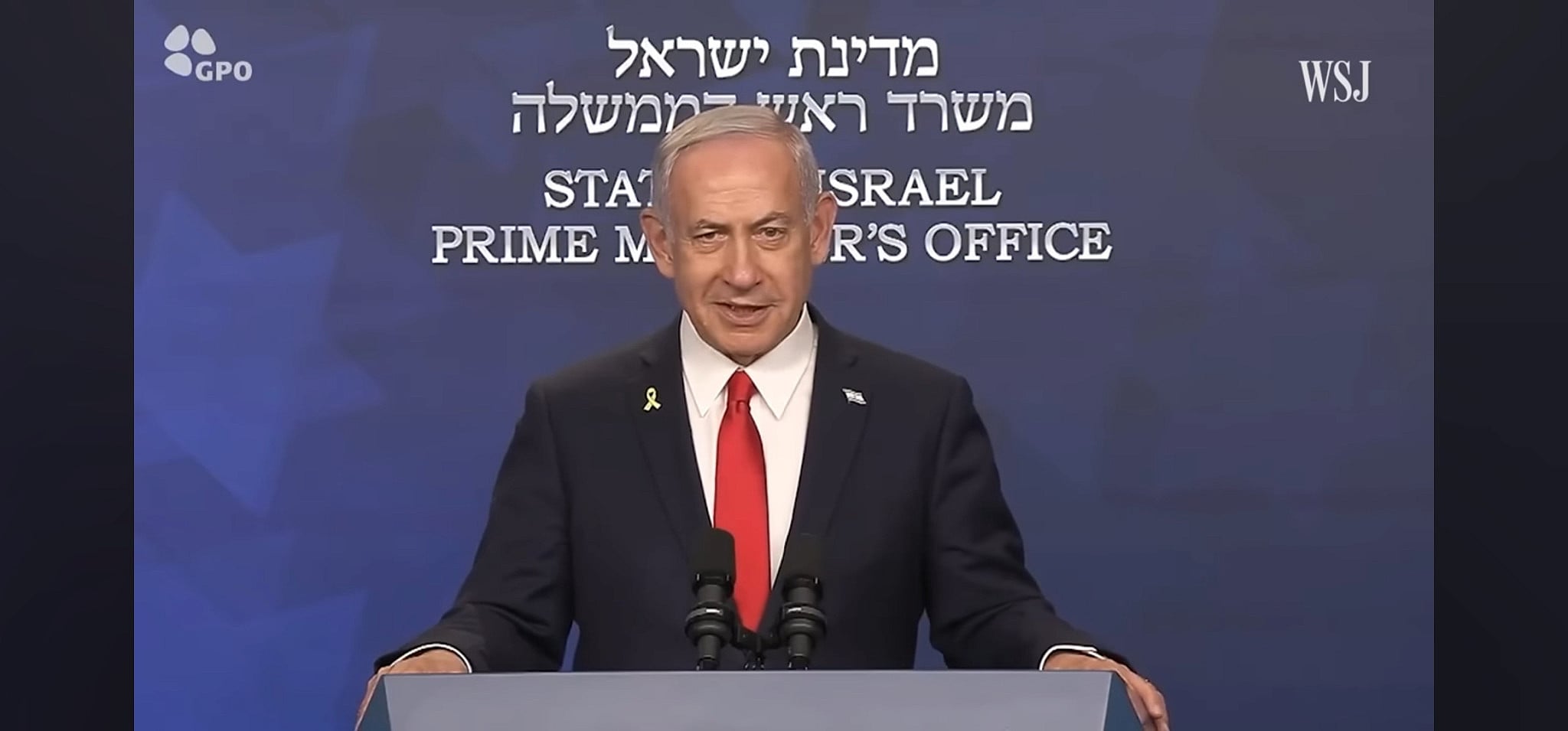
It was the kind of smile that says more than a thousand words — poised, deliberate, fleetingly satisfied. When Prime Minister Benjamin Netanyahu addressed the nation in the wake of the joint U.S.-Israeli strikes on Iran’s nuclear infrastructure, he spoke of Fordow, Natanz, and Isfahan being “flushed down the drain.” But it was the smile — not the words — that anchored the moment in history. Calm yet sharp, it signaled a confidence born not of rhetoric, but of knowledge. Knowledge of what six 14-ton GBU-57 Massive Ordnance Penetrators, delivered by U.S. Air Force B-2 Spirit stealth bombers, had just done to one of the most fortified nuclear sites in the world.
The Fordow Fuel Enrichment Plant, carved into a mountain near Qom and buried beneath over 80 meters of dense limestone, had long been considered untouchable — a fortified sanctuary of Iran’s nuclear ambitions, housing hundreds of IR-6 centrifuges enriching uranium to near weapons-grade levels. But deep-penetration weapons operate according to a logic far removed from visual spectacle. Their destruction unfolds not in fireballs or craters, but in silence. The GBU-57 is designed to detonate only once it has tunneled deep beneath the surface, creating subsurface shockwaves that collapse structures from within. The absence of surface devastation — no gaping sinkholes, no collapsed ridges — is not a sign of failure.
According to a technical assessment by the Institute for Science and International Security (ISIS), the sequential use of six GBU-57s likely triggered cumulative structural degradation in Fordow’s subterranean architecture. The physics of such an attack is cumulative: the first bomb fractures the bedrock, the second and third carve deeper channels of reduced resistance, and the final detonations exploit the weakened geology to inflict maximum internal collapse. At least one of Fordow’s two main enrichment halls is believed to have suffered catastrophic failure, with significant damage also likely in access tunnels, ventilation shafts, and cascade control systems. Satellite imagery shows terrain anomalies, dust ejections, and entry points that correlate with known MOP impact signatures — though the geology of compacted limestone may conceal even the most destructive outcomes.
Still, one critical detail has yet to come into focus: the fate of the enriched uranium stored at the site. Before the strike, Fordow was reportedly producing uranium enriched to 60% purity — dangerously close to weapons-grade — and possibly stockpiling hundreds of kilograms. Whether some of this material lies buried beneath the rubble or was successfully relocated before the attack remains uncertain. That ambiguity carries strategic weight. It keeps Tehran under scrutiny and leaves observers — and adversaries — cautious. In the end, it may be time, not imagery, that reveals whether Iran managed to shield the core of its program before the mountain swallowed it.
The fate of Natanz and Isfahan fared no better than Fordow. At Natanz, Israeli precision strikes — likely employing loitering munitions and standoff weapons — appear to have disabled surface nodes and targeted underground cascade halls. Structural deformation was observed in tunnel entrances, and auxiliary power systems were likely compromised. At Isfahan, both Israeli and American strikes reportedly hit uranium conversion and fuel fabrication units. High-resolution imagery suggests significant destruction in the UF6 production areas and related metallurgy labs.
By the end of the operation, the combined strikes by Israel and the United States left, with high confidence, the following outcomes: one of Fordow’s enrichment halls likely collapsed; Natanz’s underground centrifuge systems were disrupted or rendered inoperative; and Isfahan’s uranium conversion capacity was severely degraded. The attacks were not just coordinated — they were choreographed. Israeli munitions softened the defenses and neutralized critical electronics, while American deep-penetration bombs burrowed through stone to reach and shatter the heart of the infrastructure. Together, they delivered a strategic decapitation without ever needing to occupy a square meter of Iranian soil.
The physics tells the rest of the story. The GBU-57 doesn’t obliterate from above — it erodes from within. The mountain does not collapse; it exhales. And the aftermath, measured not in flames but in silence, leaves the world staring at an unbroken landscape — one that, in truth, may be hiding an irreparable void.
A void irreparable for the Iranian regime, and a temporary breath of relief for Israel. Netanyahu’s smile said it all. Though Iran will not abandon its nuclear ambitions, the path to building a bomb just became longer, harder, and costlier. For now, Israel has bought time — and reminded Tehran that even the deepest fortresses have limits.
Unlike Israel’s clear and confident public message, the Supreme Leader of Iran has remained notably silent, showing no visible reaction or statement in response to the strikes. This absence may reflect a deliberate strategy to avoid revealing weakness or uncertainty amid a serious blow to Iran’s nuclear program. In contrast, Netanyahu’s controlled smile confirmed his words — a restrained yet genuine expression of confidence and strength. It projected the steady leadership that his nation expects, sending a clear message of resolve and vigilance. That smile spoke volumes: Israel is ready, determined, and in control.
As Mossad Director David Barnea made clear, the Israeli public may rest — but the Mossad will not. “We will continue to keep a close watch on all the projects in Iran that we already know, in the most in-depth way,” he said. He emphasized that Israel’s intelligence operations will remain engaged, proactive, and unrelenting. Operation Rising Lion may not have killed the Persian Leopard, but its claws are now pressed against its throat — steady, patient, and ready to strike deep should it move again.