99.6% Ashkenazi + .4% Viking = 100% Zionist
The Socialist Surge Is a Warning for American Jews
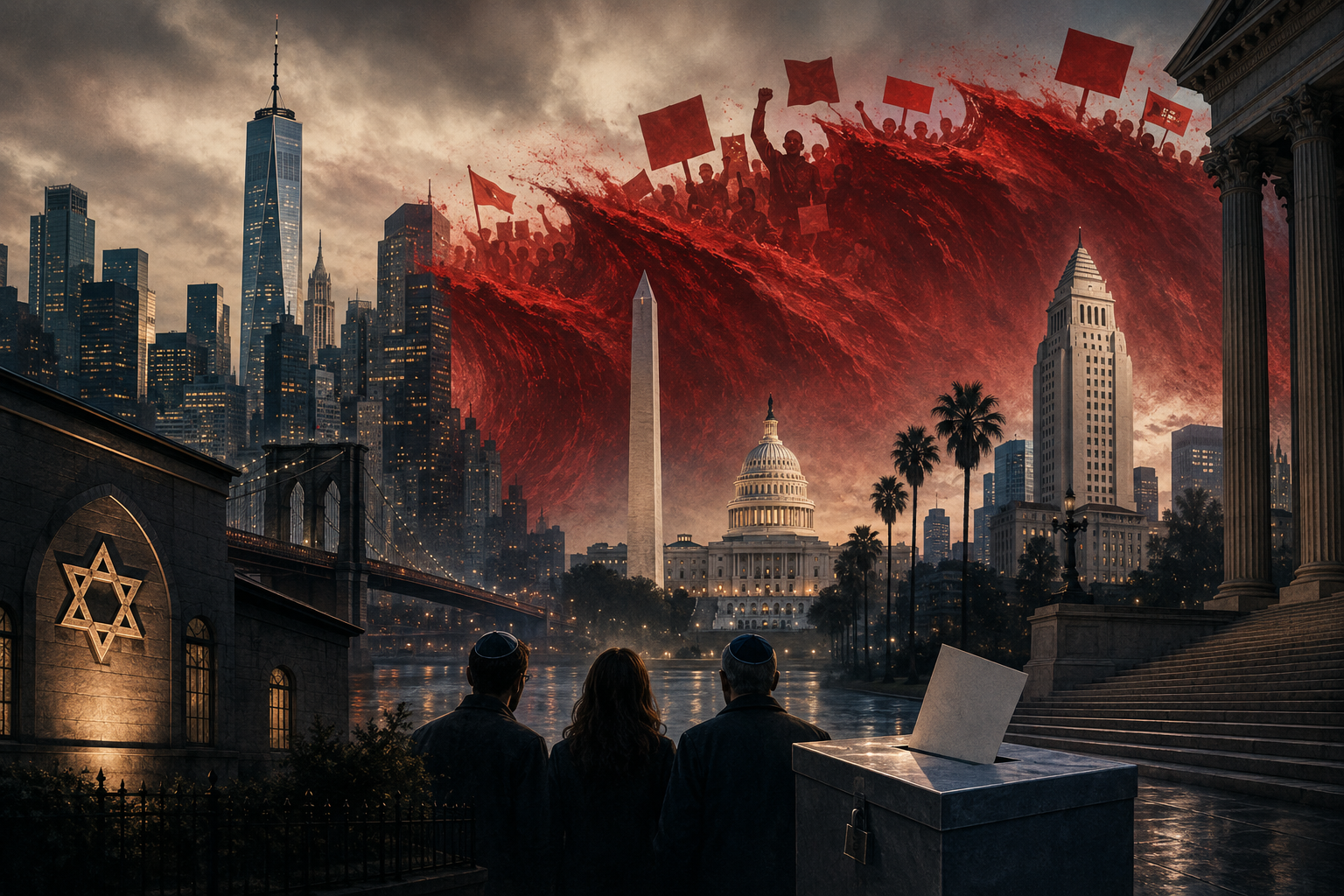
AI-generated image
For years, Americans have debated the dangers of executive power. Many warned that President Trump’s use of executive orders revealed how quickly government authority can be stretched when a political movement believes the normal limits no longer apply.
That concern was not wrong.
But American Jews should understand something else: illiberal politics does not only arrive from the right. It does not always wear a red hat. Sometimes it arrives through city councils, school boards, state legislatures, mayoral races, and congressional primaries. Sometimes it arrives speaking the language of justice, equality, liberation, and democracy.
And sometimes, it wins.
The recent rise of Democratic Socialists of America-aligned candidates should not be dismissed as a fringe curiosity. In New York, DSA-backed and Mamdani-backed candidates have made serious headway. In Washington, D.C., democratic socialist politics has moved closer to executive power. In Los Angeles, the same movement is no longer merely protesting from the outside; it is competing for control of major offices.
This is not a small development. New York, Washington, and Los Angeles are not symbolic towns on the edge of American politics. They are cultural, political, and institutional centers. What happens there does not stay there.
For American Jews, and especially for Zionist Jews, the warning signs are flashing.
The danger is not that democratic socialists are winning elections. In a democracy, movements are allowed to organize, campaign, persuade, and win. The danger is that some of the movement’s most energized factions appear increasingly comfortable using democratic legitimacy to advance deeply illiberal ideas. They defend democracy loudly, but too often only when democracy delivers the outcome they prefer. When voters, donors, organizations, institutions, or even fellow Democrats stand in their way, those opponents are not treated as citizens with competing views. They are treated as corrupt, bought, dangerous, or morally disqualified.
That is not pluralism. That is ideological permission to exclude.
The slogan may be democracy, but the operating principle often looks very different: rights for me, but not for thee. You are entitled to your own opinion, so long as it eventually aligns with ours. You may organize, donate, advocate, and vote, unless your cause is Zionism. Then your civic participation is recast as dark money, foreign influence, or moral contamination.
That is where American Jews need to pay attention.
New York Mayor Zohran Mamdani’s recent comments about AIPAC are a useful example. AIPAC is not above criticism. No political organization is. Americans can debate its influence, its endorsements, its spending, and its priorities. That is politics.
But there is a difference between opposing AIPAC’s policy positions and portraying AIPAC as a monstrous, anti-democratic force whose money corrupts the body politic.
Mamdani reportedly referred to “the monsters that we are up against” and then singled out AIPAC. He described the organization as one for whom “the only thing more frightening than democracy being allowed to run its course is an end to genocide and Netanyahu’s wars.”
That language walks a very dangerous line.
It does not need to say “Jews” for Jews to hear the echo. When a major pro-Israel organization is described as monstrous, when its political activity is framed as a threat to democracy, and when support for Israel is flattened into complicity with genocide, the line between criticizing lobbying and demonizing Jewish civic participation becomes dangerously thin.
Terms like “dark money” are not inherently antisemitic. They are part of the modern campaign-finance vocabulary and are used across the political spectrum. But context matters. When that language is aimed at AIPAC while pro-Israel political advocacy is simultaneously described as monstrous, anti-democratic, and complicit in genocide, the rhetoric begins to borrow from an old and familiar architecture: the accusation that organized Jews use hidden money and influence to bend nations to their will.
Again, AIPAC can be criticized. Israel can be criticized. Israeli governments can be criticized. But when Zionist Jews are no longer treated as citizens participating in democracy, but as contaminants within it, the issue is no longer only Israel. It is whether Jews are allowed to enter public life as Jews without first surrendering the parts of their identity that make the movement uncomfortable.
This is where Senator John Fetterman’s recent warning becomes useful.
Fetterman is not a conservative. He is not a MAGA messenger. He was once embraced by progressives, supported Bernie Sanders, and built his political identity around working-class Democratic politics. So when Fetterman warns that far-left candidates are “declaring war” on regular Democrats, his words should not be brushed aside as partisan theater.
He is pointing to a deeper rupture.
The concern is not that Democrats are debating policy too vigorously. Parties should debate. The concern is that one faction increasingly treats the rest of the party as illegitimate. Moderates are not merely cautious. They are sellouts. Pro-Israel Democrats are not merely wrong. They are complicit. Donors are not merely participants in politics. They are corrupting democracy. Law enforcement supporters, border hawks, institutionalists, Zionists, and skeptics of revolutionary rhetoric are not citizens to be persuaded. They are obstacles to be removed.
Authoritarian instincts do not become harmless because they arrive wearing the language of justice.
This is also why history matters.
The warning is not that every socialist is an antisemite. That would be historically false and morally lazy. Jews themselves helped build socialist movements. Many were drawn to socialist politics because they faced poverty, exclusion, pogroms, and fascism. The Jewish Bund, for example, was a socialist movement rooted in Jewish life, Yiddish culture, and the defense of Jewish workers.
So the argument is not “socialism equals antisemitism.” History is more complicated than that.
The warning is that universalist revolutionary movements have repeatedly made Jewish belonging conditional. Jews were often welcome as workers, comrades, dissidents, and victims. They were far less welcome as Jews with their own institutions, loyalties, memories, and national aspirations.
First, Jews are welcomed as long as they subordinate Jewish identity to the movement. Then Jewish particularism becomes suspect. Then Zionism is treated not as one political expression of Jewish peoplehood, but as a moral crime. Then Jewish institutions become targets. And eventually, Jews are told they may remain in the coalition only if they renounce the part of themselves the coalition finds inconvenient.
We have seen this pattern before.
In the Soviet Union, anti-Jewish campaigns were often dressed in ideological language. Jewish writers, doctors, intellectuals, religious leaders, and Zionists were not always attacked as Jews directly. They were attacked as cosmopolitans, imperialists, reactionaries, agents of foreign influence, or enemies of the people. The vocabulary changed. The suspicion remained.
That is what should alarm American Jews now.
When a movement says Zionism is racism, believe it. When it says Zionism is colonialism, believe it. When it says Zionism is incompatible with justice, believe it. These are not minor disagreements about a prime minister, a war, a settlement policy, or a military decision. They are statements about Jewish peoplehood, Jewish self-determination, and the moral legitimacy of the Jewish state itself.
Most American Jews are not being invited into a debate. They are being asked to renounce a central part of modern Jewish identity as the price of civic respectability.
That is the real issue.
The socialist surge is not only a left-wing economic story. It is not only about rent, wages, policing, immigration, or health care. For American Jews, it is a Jewish security story. Because once anti-Zionism moves from protest signs into city halls, public schools, cultural institutions, prosecutorial discretion, police policy, and congressional caucuses, it stops being symbolic. It becomes power.
And power matters.
A city government can decide which communities are protected and which are scolded. A school district can decide whether Jewish history is taught honestly or folded into a fashionable oppressor-oppressed narrative. A prosecutor can decide whether antisemitic harassment is treated as a crime or contextualized as activism. A mayor can decide whether Jewish fears are taken seriously or dismissed as political theater. A congressional bloc can decide whether support for Israel remains a legitimate Democratic position or becomes a stain to be explained away.
That is why American Jews should stop pretending this is merely another intramural fight among Democrats.
It is not.
The question is not whether Jews may vote for socialists, Democrats, Republicans, independents, or anyone else. Of course they may. The question is whether a growing political movement will allow Jews to participate fully in public life without demanding that they amputate Zionism from their identity first.
That is the line.
Criticize Israel? Yes. Criticize Netanyahu? Absolutely. Debate AIPAC? Of course. Argue over Gaza, settlements, aid, diplomacy, and war policy? That is democracy.
But when Jewish institutions are called monsters, when Jewish political advocacy is portrayed as dark money corrupting democracy, when Zionism is treated as racism, and when American Jews are told their place in progressive politics depends on rejecting Jewish self-determination, we are no longer dealing with a normal policy disagreement.
We are watching the terms of Jewish belonging being rewritten in real time.
And Jews should take them at their word.
Related Topics
Related Posts