
Published author, Jewish educator and scholar
The Song at the Sea and the Song of Our Day
Canva
At what point can we truly say that the Exodus came to an end? Was it on the night of Pesach, when our ancestors physically left Egypt? Was it when they crossed the Sea of Reeds on dry land, or when they saw the Egyptian army lying lifeless on the shore?
I would suggest that the Exodus reached its conclusion only when the Israelites lifted their voices in song at the sea.
First, God had taken the people out of Egypt—but Egypt had not yet been taken out of them. In the moments of terror as the Egyptians pursued them, the Israelites cried out to Moses: “Was it for want of graves in Egypt that you brought us to die in the wilderness? What have you done to us, taking us out of Egypt? Is this not the very thing we told you in Egypt, saying, ‘Let us be, and we will serve the Egyptians, for it is better for us to serve the Egyptians than to die in the wilderness’?” The repetition is striking. Five times in a few short verses, the word “Egypt” is invoked. The people were no longer physically enslaved, but Egypt still occupied their consciousness.
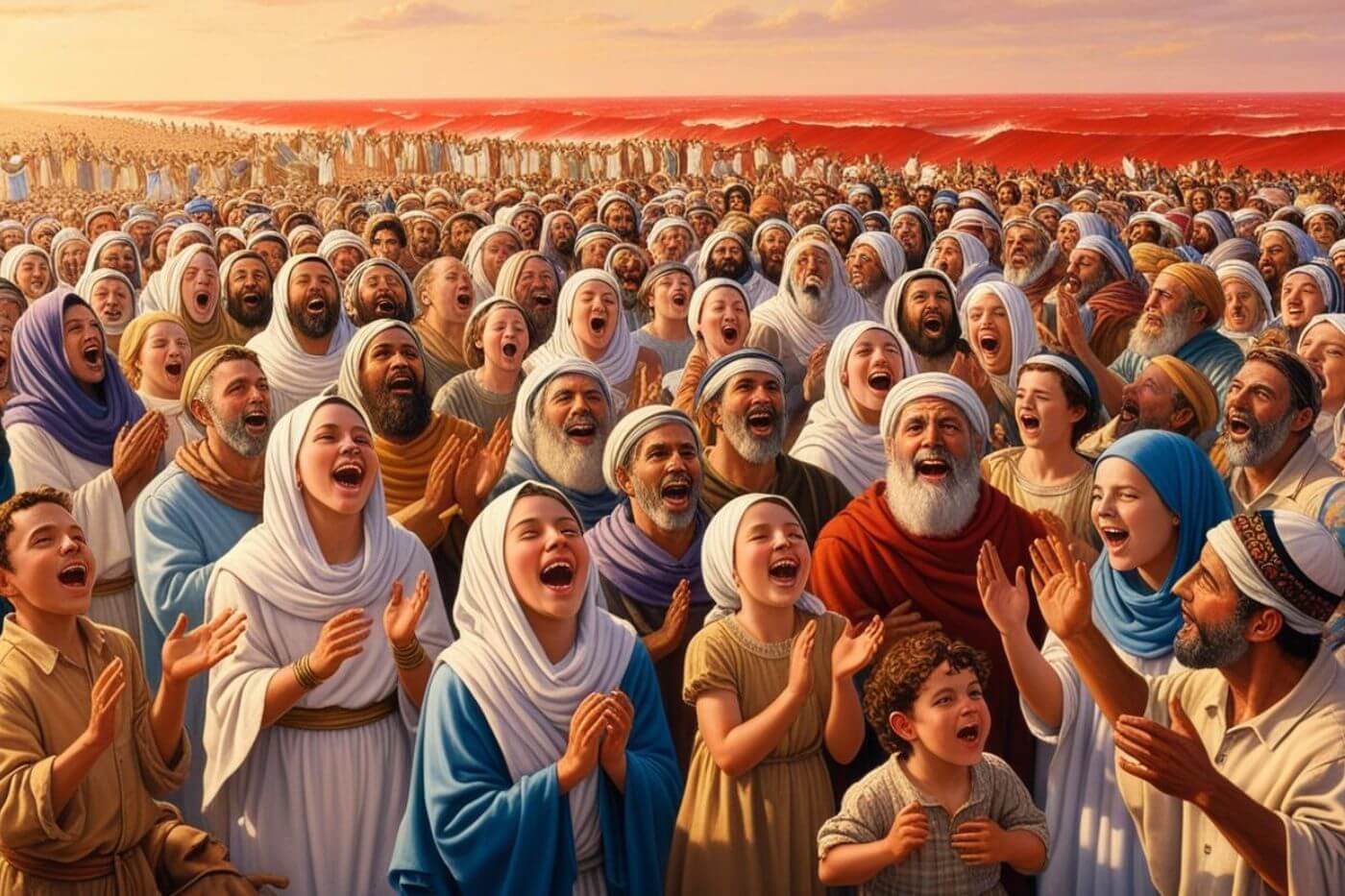
And then, something changed. When the Israelites stood safely on the far shore of the sea, they broke into song. Remarkably, in the entire Song at the Sea, the word “Egypt” does not appear even once. Instead, the song is filled with God’s might, God’s kingship, and God’s future dwelling among His people. Thus, in song, the Israelites demonstrated that they were finally able to release Egypt from their hearts and minds. Though its memory would continue to resurface in the years ahead, at that moment they were no longer defined by what they had fled, but by what they were becoming. In that sense, the Exodus was complete.
The song accomplishes something else as well. It transforms a moment of rescue into a shared memory and enduring faith. No longer merely a story of escape, the Exodus is reframed as the revelation of God’s sovereignty and Israel’s calling. Through song, a fleeting historical moment becomes a narrative that can be remembered, retold, and lived across generations.
Finally, the song looks forward. It speaks of the nations who will tremble, of entry into the land, and of a sanctuary yet to be built. The Exodus is, therefore, only complete when it points beyond itself—when it is understood not as an endpoint, but as the beginning of a larger journey toward destiny and responsibility.
Turning to our own day, one of the central goals of the war that began on October 7 was the return of all 251 hostages. For more than two harrowing years, amid war, loss, and uncertainty, Israelis and Jews around the world were united by a single cry: to bring them home. With the recent return of Ran Gvili, the final hostage, it might appear that this chapter has finally closed.
Yet I would like to suggest that, just as a song marked the conclusion of the Exodus, so too, it is a song that marked the conclusion to the hostage crisis. Immediately after the operation to rescue and return Ran Gvili’s, all those involved sang together the age-old song Ani Ma’amin. “I believe with perfect faith in the coming of the Messiah; though he may tarry, I will wait for him each day.”
Like the Song at the Sea, Ani Ma’amin is an act of interpretation. It places unbearable events within a larger framework of meaning—past, present, and future. It says that we have been here before and we are still here, and that although we have suffered unspeakable losses and pain since October 7, we never relinquished our faith in God and in our ability to bring every hostage home.
And it speaks to the future as well. It acknowledges that the enemy has not yet been fully defeated and that much work still lies ahead but it also insists on how we will face that future: by choosing hope over despair, life over death, and good over evil. And it affirms our determination to carry forward the faith expressed in the Ani Ma’amin—the faith that tomorrow will be better than today.
Shabbat Shalom.
—
For an abridged video version of these parasha thoughts: https://youtu.be/oVdHFwMvjis
For more articles on the parasha and current events, or to sign up for my newsletter, visit my website: https://davidharbater.com/
Related Topics
Related Posts