The Song of the Cat and the Protection of the Soul
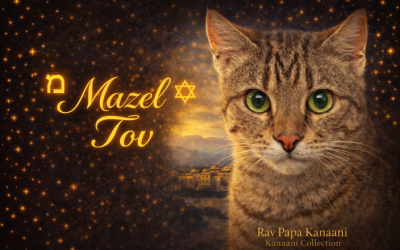 A personal Midrash on the Kanaani, compassion, and the quiet protection that comes from within
In Jewish tradition, there is a unique text known as Perek Shirah.It is an ancient composition, woven from verses of Tanakh — especially from the Psalms.
According to the teachings of our sages, this work is connected to King David, the King of Israel, and his son, King Solomon.
It is said that after King David completed the Book of Psalms, he came to realize that all of creation — each in its own way — praises the Creator. And then it became clear: man is not the only one who sings. The entire world sings.
The heavens.
The earth.
The sun.
The moon.
The stars.
The clouds.
The wind.
The rain.
Birds.
Animals.
Each has its own verse. Its own line. Its own way of serving the Creator. And among these voices, there is the voice of the cat.
In Perek Shirah, the cat says:
“I will pursue my enemies and overtake them…”
(Psalm 18:38)
At first glance, it seems to be about hunting. But if one pauses it is not about prey. It is about a quality. Persistence. Alertness. The refusal to let go. The cat does not speak. It acts. And this is its song. And a person who lives alongside it begins to feel this.
When you care for a cat, when you worry about it, when you pray for it — you are no longer simply caring. You are entering that song. It is not that the cat sings to you. You begin to sing with it. I say this not as a theory. I have come to this through experience. I am a rabbi. And I carry responsibility for the Kanaani.
Today, I have documented Kanaani cats registered within the World Cat Federation, The International Cat Association, the Feline Alliance of Ukraine, and the Association of Rare Breeds of Cats. Independent organizations — Official World Records and Record Holders Republic — have recognized the Kanaani as the rarest documented breed of cats in the world. I say this calmly. Not out of pride. Because this is not about me. It is about what was placed into my hands.
From the very beginning, I knew these cats had no documentation. I searched — and found nothing. But the cats themselves were there. Real. Strong.
I was in New York. I contacted experts, sent photographs and videos. And they confirmed: this is Kanaani. And then it became clear: this must be documented. Not because the breed does not exist. But because it can disappear without a trace. And that is how it began.
I am grateful to the Creator of the world —
Ribono shel Olam, blessed be His Name.
For the mission entrusted to me.
The Creator knows a person better than a person knows himself.
And if something is placed in your hands — there is meaning in it. And it is received with gratitude… and with reverence.
And here I recall the teaching attributed to the Maggid of Dubno — the great-grandfather of Ze’ev Jabotinsky. He taught: it is not enough to know Torah. It is not enough to master texts. One must speak to God as to one who is close. As to a friend. And perhaps this is what I am learning now.
I speak to the Creator of the world — Ribono shel Olam, blessed be His Name — and I tell Him that I love Him. And that I am grateful for the mission entrusted to me. And if it has begun now — then this is how it is meant to be.
When my cat Layla became ill… I worried. I prayed. And at a certain point, there is only you and prayer. Then the words came: “She has been healed.” And you understand… this is not just care. This is a relationship. In Judaism, we do not say that a cat is a mystical amulet. But we say something deeper: the Creator governs the world through natural means.
Every creature is a shaliach — a messenger. And the cat as well. And here it is important to say one more thing. This is not only my personal experience. Our sources speak about this too. Not only Perek Shirah. In the Talmud, in the words of Rav Papa, the role of the cat in the home is mentioned. There is a tradition that cats protected homes even in the time of Egypt — from snakes and scorpions.
This is not symbolic. This is real. The cat is a guardian of the home. But we must understand how. Not as an amulet. But as part of the order that the Creator established in the world. The cat senses. The cat acts. The cat responds before a person does. And in doing so, it fulfills its role. And then it becomes clear: The cat does not protect directly. But through it, the Creator changes the person. And a person who learns chesed — compassion — is already under protection.
Measure for measure. You give protection — and you are given protection.
And then I think of Israel. There are many cats there.They are fed. Simply. Quietly. And this — is chesed. And perhaps this is one of the hidden secrets. It is not only the army that protects a country. There is something else. When a person stops and feeds a cat. And in that moment, he becomes different. And then one can say: The lion guards Israel from the outside. And the cat — from within.
The lion is strength. The cat is the heart. And if this is so… then it works the same way in my home. The cats do not protect me directly. But they teach me to become someone worthy of protection. And perhaps… that is everything. Quietly. But truly.