The Song That United Two Traditions
A Journey Through Jewish-Muslim Spain
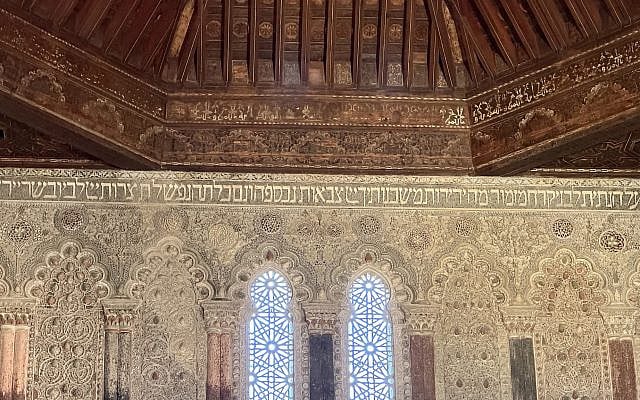
In early July, I traveled through Spain for two weeks with our team as part of our EU-funded project, “Bridges of Understanding.” We visited eleven cities where Muslims and Jews had lived side by side for centuries, among them Toledo, Córdoba, Seville, Granada, Ávila, and Segovia. We stood in synagogues that are now churches or museums, followed the traces of Maimonides in Córdoba, and were reminded again and again that the Sephardic Jews who had helped shape these cities for generations were forced to leave the country in 1492 under the Alhambra Decree. It was an overwhelming experience, one that has stayed with me ever since: where did all these people go, and what did they carry with them from their homeland?
One answer lies far to the east of Spain, in what is today the northwest of Turkey. Many of the exiles found refuge in the Ottoman Empire, and out of this new neighborliness grew one of the most striking, and least known, forms of Jewish-Muslim intertwining: the tradition known as the Maftirim.
In Edirne, a city on the border between Europe and Anatolia, Jewish cantors sang Hebrew prayers for centuries in the modes of Ottoman court music and the Mevlevi dervishes. The Maftirim are an echo of the very story I had seen with my own eyes in Spain — and today they have nearly fallen silent.
The Sound of Edirne
When the relationship between Judaism and Islam is discussed, the conversation usually turns to texts, theology, or politics. Music is rarely mentioned, even though for centuries it was one of the most intimate meeting points between the two. Anyone who wants to understand how deeply Ottoman Judaism and Ottoman Islam were interwoven cannot pass over a tradition that appears in almost no everyday history book: the Maftirim.
Edirne, at the time one of the most important cities of the Ottoman Empire, became a center of Jewish life after 1492. In the same city, influential Mevlevi Sufi lodges were active, renowned for their elaborate devotional music. Over generations, coexistence turned into collaboration: Jewish cantors began singing Hebrew piyyutim, liturgical poems, not to inherited synagogue melodies but in the makams of Ottoman art music, the same complex, microtonal tonal systems the dervishes used for their own dhikr chants.
Israel Najara and the Birth of a Tradition
A key figure in this development was Rabbi Israel Najara, born around 1555, probably in Damascus, and died in 1625 in Gaza. Najara was one of the most influential Hebrew poets of his time. In his major work, “Zemirot Yisrael,” first published in 1587, he arranged more than 200 piyyutim in a later 1599 edition explicitly according to the Ottoman makam system. He wrote religious poetry deliberately for melodies borrowed from the surrounding Muslim culture, not out of necessity, but out of artistic conviction. His work became the foundation of a tradition that spread from Edirne to Istanbul, Bulgaria, Bosnia, and as far as Egypt.
Golden Age, Spread, and Rupture
The Maftirim tradition reached its golden age in the 17th century, with a final flourishing as late as the 1920s. Cantors composed and passed down orally a repertoire that is said to have once numbered more than a thousand poems, sung in forms borrowed directly from secular Ottoman art music: pesrev, şarkı, beste. This music was never a marginal addition to Jewish worship; it stood at the very beginning of Shabbat morning, a kind of overture that attuned the congregation to prayer.
What followed in the 20th century was a double rupture: emigration, assimilation, and the Shoah decimated the Jewish communities of southeastern Europe and Anatolia, and with them the carriers of this knowledge disappeared. Only a small circle of master cantors kept the complex melodies alive orally, without any comprehensive written record. As recently as the early 2000s, musicians such as Karen Gerson Şarhon of the Ottoman-Turkish Sephardic Culture Research Center in Istanbul reported that only a handful of elderly cantors, among them the longtime chief cantor Yitzhak Macoro, still commanded the full repertoire, while younger community members increasingly found the unfamiliar-sounding music foreign to them.
What Remains of the Silence
This is exactly where the real relevance of this story lies. The Maftirim are not proof of some untroubled interfaith idyll; they are the result of neighborliness, curiosity, and centuries of cultural closeness that no one had ever decreed. While today we search laboriously for formats for Jewish-Muslim dialogue, here, for centuries, dialogue was simply part of daily life, not negotiated, but sung. That this music has nearly gone silent should be read less as nostalgia than as a warning: what grew together can also be lost together, if no one carries it forward.
Initiatives such as the multi-volume Maftirim collection produced by the Sephardic Center of Istanbul are working to preserve the last surviving recordings before the remaining voices fall silent too. It is quiet rescue work, with no stage and no spotlight. Perhaps that is the fitting continuation of a tradition that was never meant to be seen, only to be sung, quietly, by two religions in one city.
Music examples:
1- Hazan Aaron Kohen Yasak & Maftirim Hymns Choir – Azkir Hasde El [Maftirim © 2001 Kalan Müzik]
2- https://zemirot.org/cat/hazzan/david-sevi/