

The Soul of Our People, from One Generation to the Next
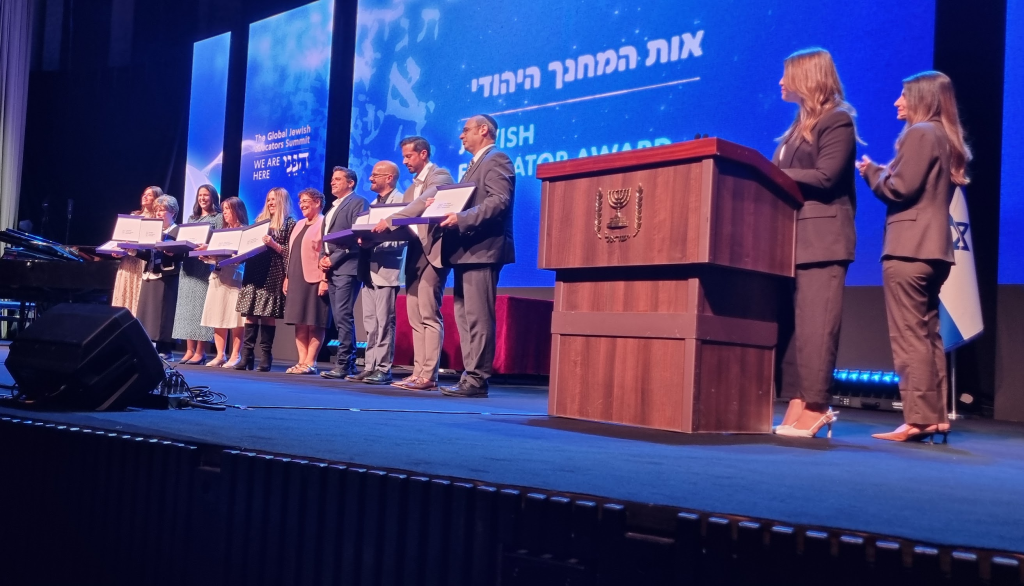
I returned from the Global Jewish Educators Summit in Jerusalem last week feeling deeply moved, inspired and, more than anything, reminded of just how important the work we do as Jewish educators really is.
The summit brought together 250 Jewish educators from 34 countries, alongside 100 educators from Israel. Principals, deputies, heads of department, teachers and Jewish educational leaders came together around one fundamental question: What is our responsibility in shaping the future of Jewish education?
The theme was “Hineni”. Here I am.
We have heard those words a lot over the past few years, particularly since October 7. Perhaps they have even become familiar. But sitting in that room, surrounded by educators from across the world, I was reminded that “Hineni” is not simply about being present. It is about being willing to answer the call. It is about recognising that there is work to be done, that it matters, and that we have a responsibility to do it.
One of the most moving aspects of the summit was hearing from people whose lives and experiences brought that responsibility into sharp focus. We heard from President Isaac Herzog and from Miriam Peretz, whose extraordinary strength, commitment and dedication to the Jewish people, despite the unimaginable loss of two sons in different wars, were profoundly humbling.
Miriam spoke about Moshe at the burning bush and his response to Hashem’s call: מִי אָנֹכִי? Who am I?
On one level, Moshe was expressing his humility. Who was he to take on such an enormous responsibility? How could he possibly be the person to lead an entire people out of Egypt?
But I found myself thinking about those words from another perspective, too.
Who am I? Who are we? What defines us? Where do we belong? What gives us our sense of identity?
Moshe’s question is particularly interesting when we consider his own life. He was born a Hebrew, raised in the Egyptian royal household and eventually lived as a shepherd in Midian. He had lived between different worlds, with different experiences of belonging. And now, at the burning bush, he was being asked to lead a people whose future would depend on him.
Perhaps his question was not only about whether he was worthy of the task, but also about who he understood himself to be.
And that brings us to something fundamental about Jewish education.
I came across a phrase at the summit that stayed with me: “When you know who you are, you can be anything.”
There is something incredibly powerful in that idea. Knowing who you are does not limit you. It gives you a foundation from which to grow, to explore, to take risks and to find your place in the world. A strong sense of identity gives a child roots, but it also gives them wings.
And that is part of what we are here to do.
We are not simply teaching children Hebrew, Jewish history, Torah or Jewish values as separate subjects on a timetable. We are helping them understand who they are, where they come from, what they belong to, and what responsibilities come with that belonging. We are giving them the knowledge, the language and the connection to understand their place within the Jewish story.
One of the speakers said something that I have thought about repeatedly since returning: “The school you choose for your children today is not only who your children will be; it’s who your grandchildren will be.”
Just think about the implications of that.
The education a child receives today can shape the Jewish home they establish tomorrow, the values they pass on, the traditions they uphold, the language they speak, and the connection they nurture with Israel and the Jewish people. What happens in our classrooms does not necessarily end when a child leaves our school gates. It can continue through their children and their grandchildren.
We are not only educating the generation in front of us. We are helping shape generations we will never meet.
Doron Perez, whose son Daniel was tragically killed on October 7, 2023, and whose body was taken captive for two years, captured this beautifully when he addressed the summit. Speaking about the Jewish people, he reminded us that we may be the smallest nation, but we are the biggest family.
He spoke about education as the means through which the soul of a society passes from one generation to the next. Education, he explained, is not primarily about passing on knowledge, but about distilling the core values of Jewish identity and transmitting them from one generation to another.
That message stayed with me because it speaks directly to the heart of what we do.
One of the things that really stood out for me throughout the summit was just how fortunate we are here, across the oceans, at the tip of Africa. Hearing from educators working in such different communities and circumstances reinforced just how much we have here in Johannesburg, and how much we are able to offer our children. We have something genuinely special, and I think we should be proud of that. No, we cannot be complacent. But we really are doing incredible work.
And yet, with that privilege comes responsibility. If the school we choose today can help shape who our grandchildren will be, then the work we do here carries enormous weight.
It is one thing to sit in Jerusalem, surrounded by hundreds of educators, listening to extraordinary speakers and feeling inspired. It is another thing to return to school and translate that inspiration into the everyday work we do.
It happens in our classrooms. In the Hebrew we teach, the questions we ask, the values we model, the standards we uphold, the relationships we build, and the moments when we help a child feel that they belong to something bigger than themselves.
It happens when we help a child move from asking מי אני?, Who am I?, towards developing a sense of identity and belonging that allows them to face the world with confidence.
Sometimes, we may never know the full impact of those moments. We may not see the results immediately. We may never know how a conversation, a lesson or a relationship with a teacher influences a decision that child makes years later, or what they eventually pass on to their own children.
But that does not make the work any less important. It makes it even more important.
I returned from Jerusalem feeling incredibly proud to have represented King David on a global stage and, more broadly, the South African Jewish community. I came back grateful to be part of this community and more convinced than ever of the significance of our work.
We are entrusted with something precious: the next generation of our people. We have the privilege of helping children discover who they are, and the responsibility of ensuring that they have the knowledge, the confidence and the connection to carry their identity forward.
That is not simply a job. It is holy work.
And so, when we speak about “Hineni”, perhaps the question is not only whether we are here, but what we are here for.
We are here for our children. We are here for their future children and grandchildren. We are here for the continuity of Jewish life, for the transmission of our values, for our language, our heritage, our people and our connection to Israel.
And when the responsibility feels enormous, as it sometimes does, perhaps we can remember Moshe at the burning bush. He asked, מי אנכי? Who am I to do this?
And yet, despite his doubts, he answered the call.
That is our responsibility, too. Not because we have all the answers, or because the task is easy, but because it matters, and because we have been entrusted with it.
“Hineni”.
Here I am.
Here we are.
And the generations who come after us will, in part, be shaped by the answer we give.