The Soviet Court That Never Left
Lithuania’s free-speech performance collapses when Facebook posts and YouTube videos become state files.
Lithuania left the Soviet Union in 1990. Its courts and regulators still behave, in the cases that matter to the state, as though the verdict arrives first and the reasoning is written afterward.
That is a claim about public documents, official decisions, state rhetoric, regulatory actions, and prosecutions Lithuania itself has placed on the record. The full architecture is laid out in my Substack article, Verdict First, Reasoning Later. This is the shorter point: Lithuania’s claim to free speech and independent courts has become a diplomatic performance. The domestic record shows something older, uglier, and more familiar.
Two current cases expose the farce.
Stanislovas Tomas, who is not Jewish, was fined €2,500 by the Lithuanian Radio and Television Commission over a YouTube comparison. Artur Fridman, a Jewish citizen of Lithuania, was charged under Article 170² §1 and Article 313 §2 of the Lithuanian Criminal Code over a Facebook post honoring his grandfather, Aron Fridman, a Jewish soldier who fought Nazi Germany in the Red Army. Different speakers. Different procedures. Different statutes. The same institutional reflex.
The state dislikes the speech. The state finds the instrument. The file is constructed to deliver the result.
This is not adult rule of law. It is a child’s imitation of legality. A mature state answers evidence. Lithuania labels the person who brought it. A mature court tests competing claims. Lithuania produces conclusions that make protected national memory safe. A mature regulator applies rules symmetrically. Lithuania applies them directionally.
The verdict comes first. The reasoning comes later.
The Soviet mechanism
Soviet legal culture had a name for the mechanism: telephone law. The phrase describes a system in which political expectation precedes legal reasoning. The judge or official does not need a written order. The desired outcome is understood. The file is then dressed in procedure.
Lithuania will object that it has independent courts, European Union membership, NATO membership, legal codes, prosecutors, regulators, and appeal rights. The Soviet Union had codes too. It had courts. It had procedures. The question is not whether institutions exist. The question is how they behave when state memory is at stake.
Eugene J. Levin’s Lithuania Confessed from the Floor of Parliament matters because it identifies the language of instruction. On April 1, 2021, MP Mindaugas Puidokas described me on the parliamentary record as the etatinis Lietuvos juodintojas, the salaried or professional blackener of Lithuania. That was not a legal argument. It was a role assignment. Once the state labels a Holocaust-memory complainant as a permanent enemy of Lithuania, its institutions know how to read the file.
They read it exactly that way.
In 2022, Lithuania’s Journalist Ethics Inspector issued Decision S-424 against me. I had complained that the state Genocide and Resistance Research Centre, the LGGRTC, publicly named me and asserted that my submissions had “possibly violated” Lithuania’s Constitution and Criminal Code. The Inspector rejected my complaint. The theory was that I had become a “public person” because of my book, my Times of Israel authorship, my website, my public Holocaust-accountability work, and my Honorary Consul status.
In other words, the more publicly a Litvak descendant challenged Lithuanian Holocaust distortion, the less protection Lithuania said he deserved.
Applied symmetrically, the same logic would have made the LGGRTC director, a highly visible state official, subject to narrower protection as well. It was not applied symmetrically. It ran in one direction.
That is the doctrine. Visibility created by Holocaust advocacy becomes permission for state exposure.
The free-speech farce
Lithuania now presents itself internationally as a defender of media freedom. In 2025, Lithuania’s Foreign Ministry proudly advertised that the country ranked first in the Index on International Media Freedom Support, praising its work in the UN, UNESCO, the Media Freedom Coalition, and support for journalists fleeing repression. That is Lithuania’s export product: media freedom for foreign audiences.
At home, the product is different.
In the same period, Reporters Without Borders dropped Lithuania six places in its 2024 World Press Freedom Index, from seventh to thirteenth. RSF noted that Lithuanian “courts sometimes prioritize the protection of personal data over freedom of the press”, and that Lithuanian state institutions “often refuse to provide information to the media without any explanation.” Lithuania’s diplomatic register and Lithuania’s domestic-application register are not the same register. The Foreign Ministry somehow missed this factoid in it’s boasts about media freedom.
A Facebook post can become a criminal indictment. A YouTube comparison can become a regulatory fine. A state Holocaust institution can publish the false claim that the United States Congress “completely exonerated” Juozas Ambrazevičius-Brazaitis and avoid comparable sanction. A Lithuanian parliamentarian can attribute Holocaust perpetration to Jews on International Holocaust Remembrance Day and avoid prosecution. A Jewish citizen who honors his anti-Nazi grandfather on Facebook receives a 220-page criminal file.
That is not free speech. That is permissioned speech.
The absurdity should concern every foreign employer, university, NGO, law firm, and media organization sending people into Lithuania. Can an employer confidently send staff to Vilnius if a Facebook post about Lithuanian history can become a criminal matter? Can a university assign a researcher to Lithuania if a YouTube comparison can trigger a state fine? Can a foreign company tell employees that personal social-media activity enjoys the same practical protection in Vilnius that it would in Berlin, Paris, or Stockholm?
The safe answer is no.
The risk is no longer theoretical. It is materialized in current named cases. Lithuania may not be classified as authoritarian. Its current institutional behavior, however, creates speech risk inconsistent with the ordinary European rule-of-law assumption.
Foreign employers should read the Lithuanian files before they send employees into the Lithuanian jurisdiction. They should not rely on Lithuania’s Ministry of Foreign Affairs press releases.
The courts themselves
Lithuania’s pretense of judicial innocence is also contradicted by Lithuania’s own record.
On February 20, 2019, Lithuania’s Special Investigation Service announced the largest corruption investigation into the judiciary in the country’s history. Twenty-six people were arrested. Eight sitting judges were among them, alongside five attorneys. The total number of suspects in the probe rose to forty-eight. Suspected bribes ranged from €1,000 to €100,000. The aggregate value of bribes paid or promised was estimated at €400,000.
The judges arrested were not minor figures. Egidijus Laužikas was a sitting justice of the Lithuanian Supreme Court. Viktoras Kažys, Konstantinas Gurinas, and Valdimaras Bavėjanas were sitting judges of the Lithuanian Court of Appeal. Henrichas Jaglinskis sat on the Vilnius Regional Court. Robertas Rainys sat on the Vilnius City District Court. Arūnas Kaminskas sat on the Vilnius Regional Administrative Court. Gintaras Čekanauskas sat on the Kaunas Regional Administrative Court.
Lithuania’s Prosecutor General Evaldas Pašilis described the case as exceptional, both for its scale and for its consequence. In his published statement, the case represented “a loss of people’s trust in justice.” Lithuania’s Judicial Council later concluded that the senior judges named in the probe had “humiliated the name of a judge” through their conduct. President Gitanas Nausėda dismissed Jaglinskis from office and asked the Seimas to remove Laužikas of the Supreme Court and Gurinas of the Court of Appeal. Parliamentary impeachment proceedings were opened against four senior judges named in the probe.
That was not Kremlin propaganda. That was Lithuania’s own anti-corruption agency, prosecutor general, judicial council, and head of state.
Lithuanian polling confirms what the institutional record shows. A 2019 Baltijos tyrimai poll found that only 33 percent of Lithuanians trusted the courts, the lowest trust score among major Lithuanian institutions. A 2020 Vilmorus survey found Lithuanians ranked the courts among the most corrupt institutional areas in the country, at 37 percent perceived corruption. In the 2021 Global Corruption Barometer of the European Union, 21 percent of Lithuanians named judges and magistrates among the most corrupt actors in the country.
The Lithuanian public has reached its own empirical conclusion about its own courts. Western institutions, working from Lithuania’s diplomatic register rather than from Lithuanian domestic data, have not yet caught up. The information asymmetry favors Lithuania abroad.
These are the courts that will sit in judgment of Artur Fridman. They are courts whose own anti-corruption agency, judicial council, and head of state have publicly determined are compromised at the level of the Supreme Court and the Court of Appeal. They are courts the Lithuanian public itself does not trust. A state that has documented corruption in its judiciary, documented directional enforcement in speech cases, and documented Holocaust-memory selectivity does not get to demand automatic belief in judicial independence. It must earn belief by conduct.
It has not.
Delfi chose the kippah
The Tomas case also reveals the visual grammar of Lithuanian exposure.
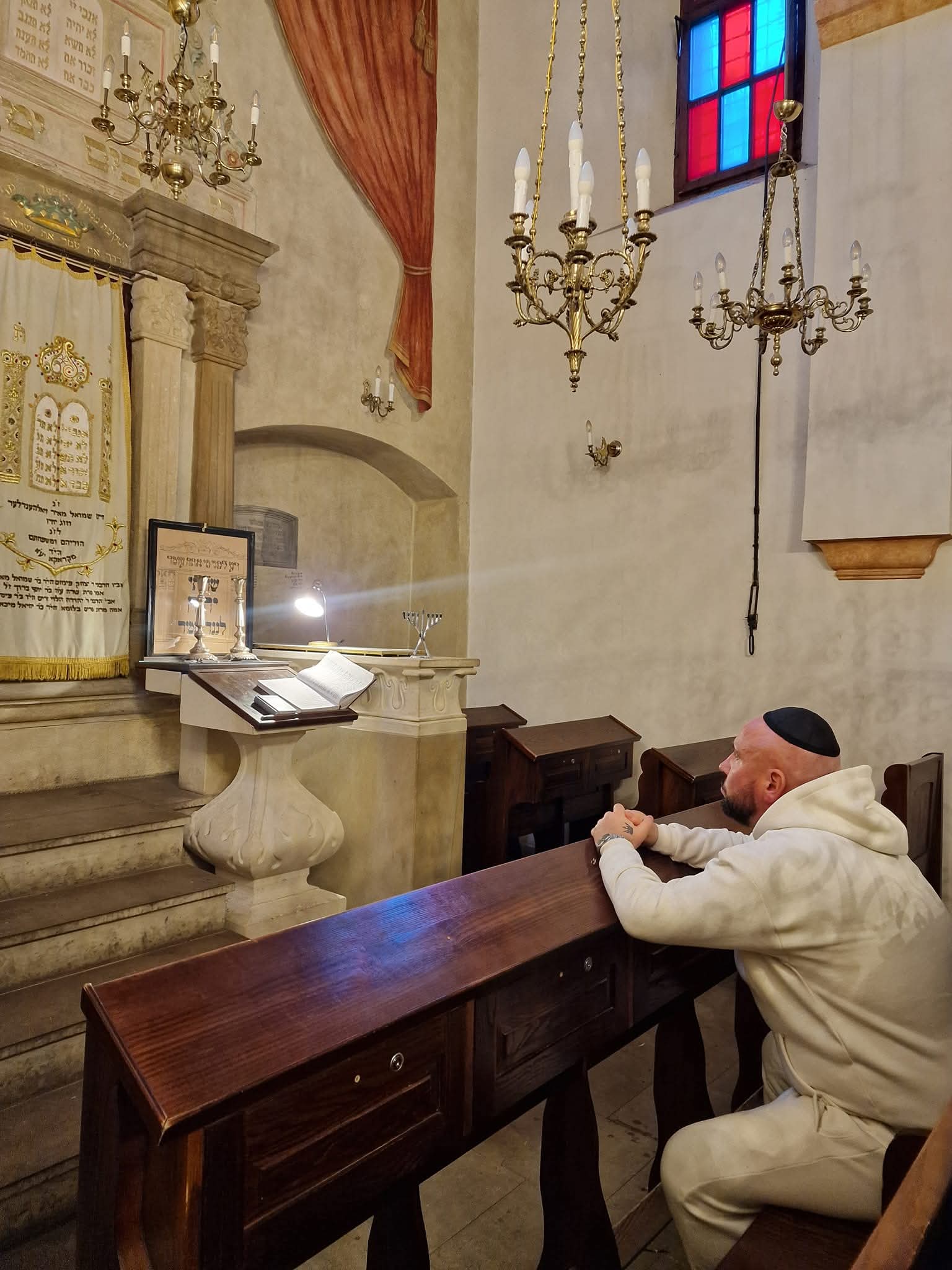
Delfi reported the LRTK fine with a photograph of Tomas wearing a white kippah at the Western Wall, with Orthodox Jewish men visible behind him. Tomas is not Jewish. The regulatory dispute had no Jewish content. The image had no factual relationship to the YouTube comparison.
It performed a function. It visually coded a non-Jewish Lithuanian dissenter as Jewish before readers reached the substance.
Eugene Levin named the technique in Delfi Chose the Kippah. After his article appeared, Delfi silently replaced the photograph with a generic image of a computer. No correction notice appeared. No explanation appeared. No reckoning appeared.
That is Lithuania’s institutional style in miniature: exposed, cosmetic adjustment, silence, no accountability.
Lithuanian institutional behavior is the point. The significance of Tomas being non-Jewish is that the mechanism is broader than antisemitism. Antisemitism is its sharpest expression because Jews carry the documentary record Lithuania cannot answer. But the machinery activates whenever protected state memory is threatened. If the critic is Jewish, Jewishness is used openly. If the critic is not Jewish, Jewishness can be manufactured visually.
That should both disgust and inform any honest editor.
Fridman is the reachable version
Fridman’s case is the criminal altitude of the same structure.
For years, I asked Lithuania to apply Article 170² §1 to the LGGRTC’s Holocaust distortions. Lithuania refused. When Valdas Rakutis attributed Holocaust perpetration to Jews in 2021, Lithuania did not charge him. When Artur Fridman posted about his grandfather and criticized a state-honored figure, Lithuania found prosecutorial confidence.
The statute did not suddenly acquire moral force. It acquired a reachable Jewish defendant.
That matters because I live in California. Lithuania reaches me through reputation, diplomatic insult, institutional labeling, and administrative findings. Fridman lives in Lithuania. Lithuania reaches him through criminal process.
This is the territorial axis. Reputational attack when the critic is outside reach. Criminal procedure when the critic is inside reach. Regulatory sanction when that tool is available. Media coding across all of it.
The children in the room
Lithuania wants to be treated as a grown-up European democracy. Then it should act like one.
A grown-up state retracts false Holocaust claims. Lithuania preserves them. A grown-up state confronts its own institutional antisemitic vocabulary. Lithuania leaves unretracted the LGGRTC’s statement placing “certain Jews” alongside “neighbors from the East” and stupid Lithuanians. A grown-up state answers four direct questions from Jewish civic organizations. Lithuania refuses. A grown-up state does not need American Jewish Committee photographs to prove it is safe for Jews. Lithuania keeps seeking Jewish institutional proximity while refusing the record.
This is why the American Jewish Committee’s proximity matters. Lithuania uses Jewish institutional engagement as proof of legitimacy. AJC may believe it is producing quiet influence. The empirical question is simpler: has the proximity changed the architecture? Has it stopped the Fridman prosecution? Has it forced retraction of the 2015 LGGRTC vocabulary? Has it produced equal application of Article 170²? Has it required the 157-measure Action Plan to name what it claims to correct?
The public record points one way.
The farce ends when the record is read
This article is a pointer. The full record is in Verdict First, Reasoning Later. The Substack piece documents the Public-Person Doctrine, the unretracted LGGRTC “Agents of the East” statement, Article 170² selectivity, the Delfi image substitution, the forty-nine formal submissions to Lithuanian state bodies since 2015, and the legitimization role performed by Western Jewish institutional proximity.
The Tomas and Fridman cases are the current public examples. They are not aberrations. They are symptoms.
Lithuania’s courts and regulators have not grown up since the Soviet era in the category that matters most: the willingness to let law decide before power does. The flag changed. The vocabulary changed. The diplomatic packaging improved. The mechanism remains visible.
Free speech in Lithuania is a farce when Facebook posts become criminal files and YouTube comparisons become regulatory fines. Judicial independence is a farce when outcomes in state-memory cases resemble verdict first, reasoning later, and when Lithuania’s own anti-corruption agency has documented compromise at the highest levels of the bench. Holocaust reckoning is a farce when the state prosecutes Jewish memory speech while preserving its own distortions.
Lithuania’s architecture cannot survive accurate description.
That is why it must be described accurately.