
Crisis Communicator, Droll Dragon
The Standard Depends on the Target
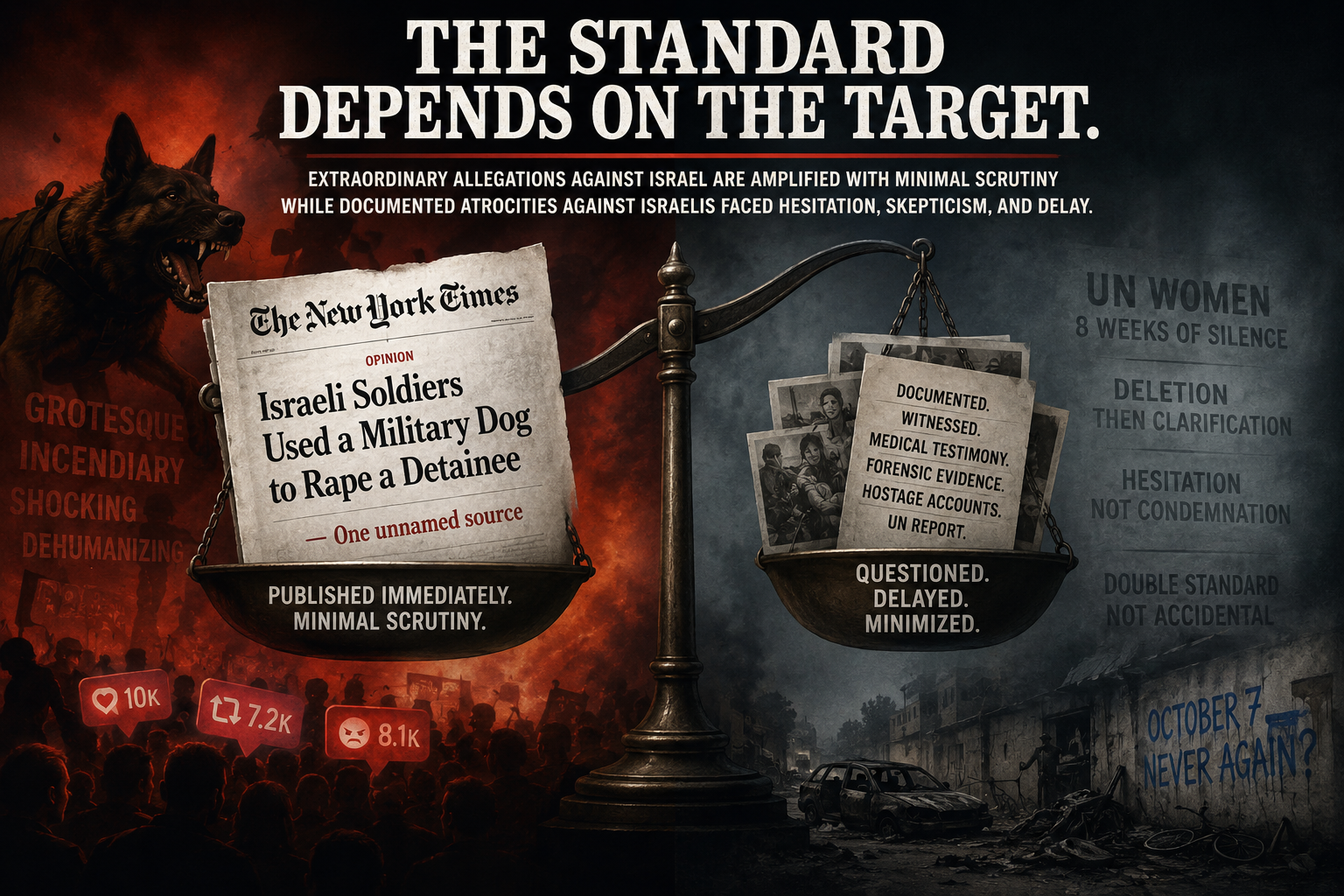
How extraordinary allegations against Israel are amplified with minimal scrutiny while documented atrocities against Israelis faced hesitation, skepticism, and delay.
The New York Times published a piece this week by Nicholas Kristof (and I am not linking to it) containing a claim so grotesque and incendiary that, under almost any other circumstance, editors would have demanded overwhelming corroboration before allowing it into print.
The allegation was that Israeli soldiers used a military dog to sexually assault a Palestinian detainee.
Pause there for a moment!
A trained rape dog. In the pages of the New York Times. In 2026.
The claim appears to rest on one unnamed source. No named witness. No publicly presented forensic evidence. No visible corroboration. No extensive evidentiary discussion warning readers that this allegation remains unverified and extraordinarily difficult to substantiate. It is simply presented as part of a broader narrative of abuse and absorbed into the flow of the article as though it were just another reported detail.
That editorial decision deserves scrutiny.
A claim like this is not routine. It is not merely inflammatory. It is civilization-level inflammatory. It invokes imagery so horrifying and emotionally overpowering that the accusation itself becomes the story, regardless of what may later be clarified, disproven, contextualized, or challenged.
And that matters because once imagery like this enters the bloodstream of public discourse, the evidentiary battle is often already over.
I know this dynamic well; I work in crisis communications and have spent years watching what happens when grotesque allegations and emotionally charged imagery are introduced into the public sphere before facts are fully established. Once the image is implanted, the accusation frequently becomes permanent in the public mind. Corrections rarely travel as far as the original allegation. Caveats are forgotten. Nuance disappears.
People do not remember sourcing standards months later. They remember the image: The monster. The humiliation. The depravity.
Once those associations harden, evidence often stops mattering. The emotional architecture of the story has already been constructed. That is precisely why extraordinary accusations require extraordinary evidence and extraordinary editorial caution.
The New York Times, of course, understands the power of narrative imagery better than almost anyone on earth. Its editors know that allegations involving sexualized torture are not consumed analytically by readers. They are absorbed emotionally and visually. A claim involving a “military dog” used as an instrument of sexual abuse is not “just another allegation.” It instantly brands the accused side in the minds of millions, and once that branding occurs, it is almost impossible to reverse.
This becomes even more striking when contrasted with the institutional hesitation shown after October 7, 2023 regarding documented allegations of Hamas sexual violence. In that case, there were released hostages, eyewitness testimony, medical professionals, forensic indicators, recovered bodies, and subsequent findings by UN representatives concluding there were reasonable grounds to believe rape and gang rape occurred during the attacks and in captivity. Yet many institutions, activists, and media organizations responded slowly, cautiously, skeptically, or with visible discomfort.
It took weeks for some organizations even to issue condemnations acknowledging the reports. Some readers notice asymmetry like this.
The issue is not whether allegations against Israeli soldiers should be investigated or reported. Of course they should. Democracies require scrutiny, especially during war. The issue is whether the standards for publishing grotesque and civilization-shaping allegations remain consistent regardless of who the accused party is.
Journalism cannot insist on exhaustive corroboration in one case while appearing satisfied with dramatically lower thresholds in another without eroding public trust. Yet that erosion is already happening. More and more people believe that certain narratives are treated as presumptively credible while others must survive impossible evidentiary hurdles before institutions are willing to fully acknowledge them. Whether fair or not, that perception is growing because readers are watching the standards themselves appear to shift in real time.
The danger here is larger than one column. It is the growing belief that some accusations are emotionally useful enough to publish first and interrogate later, even when the allegation itself carries the power to permanently stain individuals, institutions, militaries, or entire populations long before proof arrives. That is, coincidently, why the role I serve continuously becomes more important.
And history teaches us that once those kinds of images are unleashed, they rarely disappear. In periods of rising antisemitism, Jews have repeatedly become convenient vessels onto which societies project fear, rage, cruelty, conspiracy, and moral collapse. That is why standards matter so much. Because, when institutions with enormous credibility relax those standards in cases involving Jews or Israel, they do not merely shape opinion. They help normalize suspicion, hostility, and dehumanization on a mass scale.
Nicholas Kristof built his reputation as a serious moral journalist willing to confront difficult truths and human suffering with rigor and conscience. That is precisely why his column is so troubling. A responsible journalist should understand better than most the irreversible power of grotesque allegations, especially when the corroboration presented to the public appears so thin relative to the magnitude of the claim.
As for the New York Times, if it continues down this path, it will indeed be seen as the Der Stürmer of our age.
Related Topics
Related Posts