The Stones That Remember (Parashat Ki Tavo)
The generation Moses addresses at the end of his life is not, for the most part, the generation that left Egypt. These are the children of those who escaped slavery – a second generation of survivors, born in the wilderness and entrusted with memories of events they did not personally experience.
In that sense, they are much like each of us.
We inherit stories that happened before we were born. And when ritual works, we do more than recall them. At the Passover seder, we are commanded to see ourselves as though we personally emerged from Egypt. Our bodies were not there, but somehow our souls remember. Jewish tradition collapses time, transforming inherited testimony into lived responsibility.
We make memory tangible. We place mezuzot upon our doorposts, fulfilling the commandment of the Shema while also echoing the final act of our ancestors in Egypt, when they marked their doorposts before liberation. The doorway becomes more than an entrance. It becomes a vessel of memory, a physical place where history touches the present.
Parashat Ki Tavo offers another powerful technology of remembrance. Moses commands the Israelites that, after crossing the Jordan, they must erect large stones, coat them with plaster, and inscribe upon them the words of Torah:
“As soon as you have crossed the Jordan into the land that the Eternal your God is giving you, you shall set up large stones. Coat them with plaster and inscribe upon them all the words of this teaching. (Deut. 27:2–3)”
Plaster was an ancient method of preservation. These stones were meant to withstand weather and time so that generations not yet born could encounter the testimony of those who crossed into the land.
Years ago, I was blessed to travel through Birmingham, Montgomery, and Selma, Alabama, confronting the sacred and painful history of the American civil rights movement. I met Joanne Bland z”l, who had been a child when she crossed the Edmund Pettus Bridge on Bloody Sunday and was beaten alongside peaceful marchers, including Congressman John Lewis z”l. At the time, some were calling for the bridge to be renamed in honor of Lewis. Joanne resisted. John Lewis deserved every honor, she explained, but she had not been beaten on the John Lewis Bridge. She had been beaten on the Edmund Pettus Bridge.
Her words taught me that the landmarks of history must sometimes retain names that make us uncomfortable. We must cross places that force us to remember what happened there. Memory is not meant only to console us. Sometimes it must confront us.
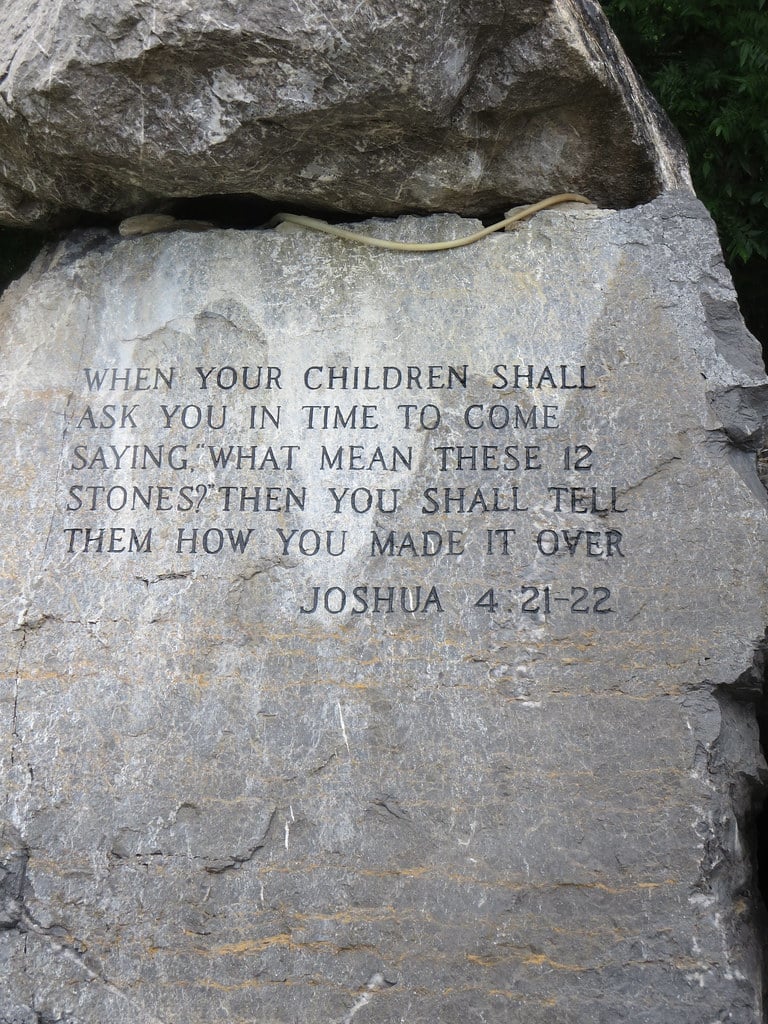
After crossing the bridge in Selma, one encounters a monument inscribed with words from the Book of Joshua, describing the stones erected after the Israelites crossed the Jordan, the ones commanded through Moses in this week’s portion. The parallel is breathtaking: a people crosses through dangerous waters toward freedom, and stones are placed so that future generations will ask what happened there.
Each of us is both an inheritor and a channel of history. There are events we have experienced that our children and grandchildren will know only through testimony. My children did not live through September 11, but they know something of it through my memories and the memories of countless others. One day, an entire generation will be born that did not live through October 7. I was not alive during the Six-Day War, yet I can speak of it with a sense that, as Rabbi Abraham Joshua Heschel z”l wrote, “history and I were one.”
We owe that connection to those who taught, told, recorded, sang, and testified. Elie Wiesel z”l taught that whoever listens to a witness becomes a witness. But that sacred chain endures only if we accept our responsibility to transmit what we have received.
Moses knows that he will not accompany the people across the Jordan. And so he commands them to write. He urges them to preserve. He teaches them that memory cannot depend forever upon the presence of its first witnesses.
Plaster was the technology of an earlier age. Today we preserve memory through books, music, ritual, teaching, philanthropy, communal leadership, and countless forms of creative expression. The question is not whether we will leave testimony. The question is whether we will transmit it faithfully and powerfully enough to shape those who come after us.
May we allow our tears to flow when memory demands them. May we tell both the painful and triumphant chapters of our lives. And may future generations learn from the choices we make today about what – and how – we remember.
We are the stones upon which history is being written. May we carry its testimony well.