
Where history exposes power and moral failure
The Stories Nations Must Tell About Themselves
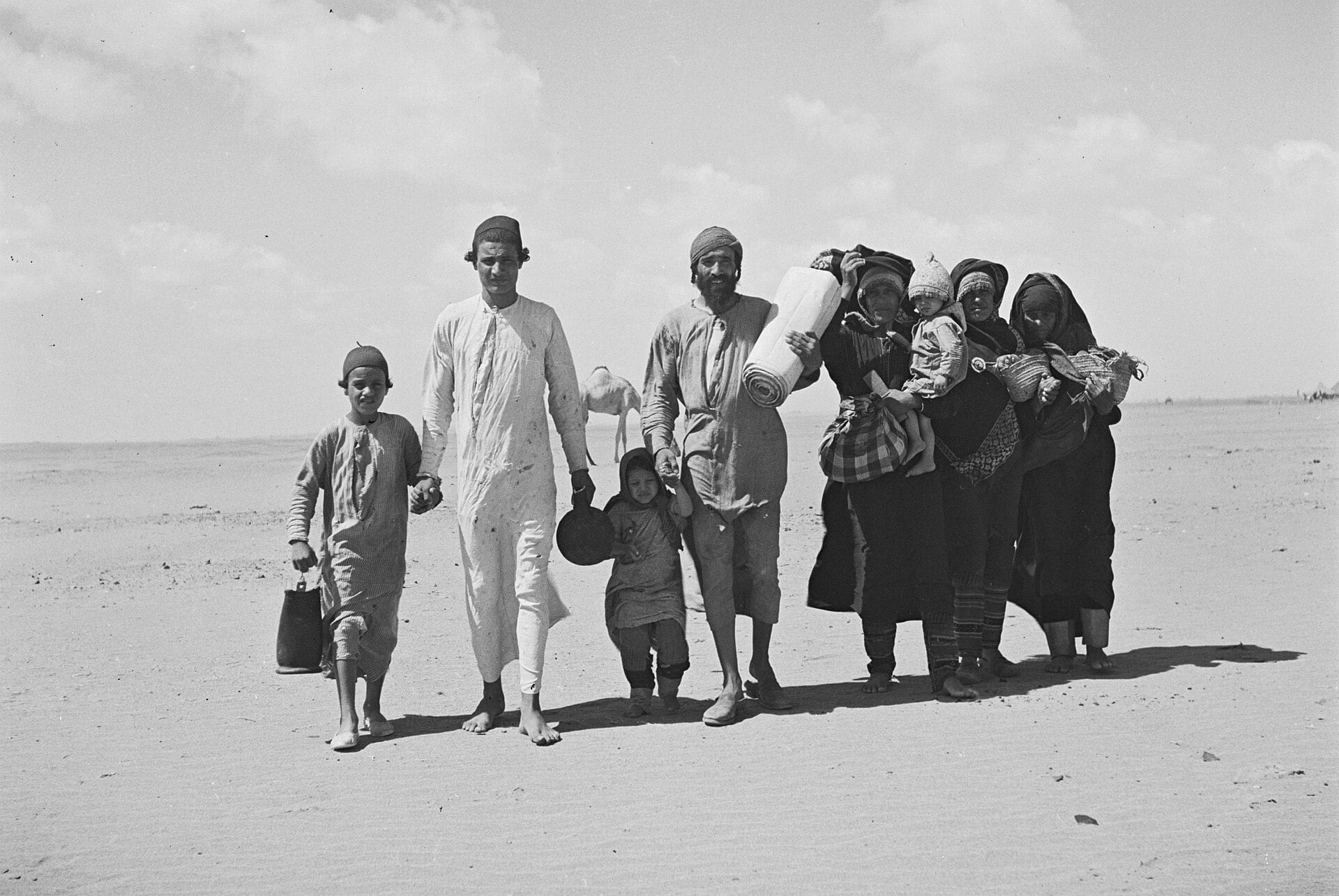
Public-domain photograph by Zoltan Kluger of a Yemenite Jewish family walking through the desert to a reception camp near Aden during Operation Magic Carpet, November 1949.
Many Israelis, or members of their families, arrived in modern Israel under terrible, complicated, or what must have felt like impossible circumstances. Tens of thousands of Teimanim, Yemenite Jews, were brought to Israel through Operation On Wings of Eagles, commonly called Operation Magic Carpet, in 1949 and 1950 after a period that had included the 1947 Aden pogrom and longstanding pressure upon Jewish communities in Yemen.
Thousands of Beta Israel came from Ethiopia through Operation Moses in the 1980s, followed by more than 14,000 Ethiopian Jews airlifted during Operation Solomon in 1991 as the government of Mengistu Haile Mariam collapsed. Other Israeli families had lived in Ottoman and Mandatory Palestine long before the establishment of the modern state. Others came from places where forced conversion, antisemitism, pogroms or political violence made Israel a place of safety, while still others made aliyah from the enormous global Jewish diaspora for reasons that were less immediately desperate.
And, of course, there are the descendants of victims and survivors of the Shoah, the Holocaust, a genocide with no past or present equivalent.
Historians have to care about the why of migration because movement on a map tells only part of the story. Passenger lists and immigration records are exceptionally useful for establishing who went where, on what date, aboard which ship, and occasionally with how much luggage or money. They are much less useful for telling us what made somebody leave home. A person fleeing a pogrom or genocide and another seeking a university education might both appear under the same bureaucratic category of immigrant.
An Ethiopian Jew carried out through an Israeli rescue operation and an American Jew making voluntary aliyah decades later have both moved to Israel, and a Palestinian refugee to Syria and Ukrainian Jew moving to New York City may be immigrants, but their histories must not be conflated and cannot be equally understood by treating the movement itself as the interesting fact.
America250 makes the same problem difficult to avoid in the United States. Americans have arrived because of religious persecution, war, poverty, political repression, educational opportunity, economic ambition and restrictions imposed upon women in societies from which they wanted to escape. Millions of other Americans descend from people who were transported into the country against their will as enslaved human beings in a vicious transatlantic trade that sold humans for centuries.
Before any European power could issue a land grant, negotiate a treaty or draw a territorial boundary, North America was already inhabited by complex Indigenous societies whose populations, landholdings, languages and political independence were devastated by conquest, disease, forced removal and the expansionist ideology later called Manifest Destiny.
National stories usually become easier to tell when some of that is edited out.
Fiction can participate in the editing. Ayn Rand’s Atlas Shrugged is an obvious example of a novel built so thoroughly around an ideological worldview that treating its fictional America as politically neutral would be a bit silly. Such attempted analysis is often rightfully disregarded by scholars as unserious. Leon Uris’s Exodus presents a more historically interesting problem because it became enormously influential in the way Americans, particularly many American Jews whose families had come to the country generations before the Shoah, understood the creation of the modern state of Israel.
Published in 1958, Exodus translated Zionism and the Israeli founding story into a language already very familiar to American readers: pioneers, hostile territory, determination, national liberation and the construction of a new society by people convinced that history had given them no reasonable alternative.
There was real history inside that story, but there was also its author. There was also Leon Uris.
The novel gave Jewish persecution, displacement and the need for refuge enormous emotional and narrative weight while Palestinians occupied a far less complicated place in the world it created. Its popularity consequently matters to historians beyond the question of whether it was good literature. Millions of readers encountered a version of Israel in which Jewish movement toward the land had been made immediately intelligible through a heroic American frontier vocabulary. America already had a terra nullius national mythology in which pioneers moved westward into territory waiting to become productive. Asking too many questions about who was already living there had been inconvenient in the American version as well.
Government and law can preserve the same habits long after the novel has been returned to the shelf. American property law still carries the ancestry of the Doctrine of Discovery, incorporated into federal jurisprudence in Johnson v. M’Intosh in 1823, when the Supreme Court treated Indigenous occupancy as subordinate to the superior title claimed through European discovery. The Black Hills offer a particularly unpleasant demonstration of how the principle operated in practice. The Treaty of Fort Laramie of 1868 recognized the Black Hills within the Great Sioux Reservation. Gold was discovered there. The United States wanted the land, repeatedly violated the treaty and took the Black Hills by congressional action in 1877 without obtaining the consent the treaty required. Americans can now encounter much of this landscape through national parks, monuments and the familiar language of wilderness without necessarily being confronted by the fact that people had to be removed before the land could become conveniently pristine.
Israel has developed its own legal and physical methods for managing history that interferes with a preferred account of settlement. The 2011 legislation commonly called the Nakba Law allows reductions in state support under specified circumstances when publicly funded institutions commemorate Israeli Independence Day or the establishment of Israel as a day of mourning. The Absentees’ Property Law of 1950 became one of the principal mechanisms through which the property of Palestinian refugees and internally displaced Palestinians passed under the authority of the Custodian of Absentees’ Property. The 2018 Nation-State Basic Law explicitly declares the development of Jewish settlement a “national value” and commits the state to encouraging its establishment and consolidation.
The landscape contains its own record. Afforestation and park development have covered or incorporated the remains of depopulated Palestinian villages, sometimes leaving visitors inside carefully maintained landscapes with remarkably little indication of what had previously stood there. Archaeology can illuminate history, but archaeology conducted within a national project can also decide which centuries receive signs, pathways and interpretive attention. The remains of Palestinian and Bedouin communities do not become historically incidental because trees have grown around them.
None of this turns Jewish people outside Israel into representatives of Israeli government policy. Jewishness predates the modern State of Israel by millennia, and Jews in New York, London, Paris, Buenos Aires or Melbourne are not emissaries for whichever coalition happens to govern from Jerusalem. The current Israeli government has produced ample evidence through its treatment of Palestinians, settlement policy and approach to institutional restraints for critics to examine directly. Making Jewish identity answer for those choices introduces an antisemitic premise into an argument that did not need one.
The same demand for historical precision applies to the Shoah. Holocaust denial should be confronted severely wherever it appears, and Holocaust education needs to improve considerably. Jews and synagogues have been attacked in Western countries while online spaces have made spectacularly old antisemitic conspiracies available to anybody with a username. The documentary record of the Holocaust is immense. German perpetrators produced enormous quantities of paperwork; photographs, transport records, camp records, correspondence, physical evidence and survivor testimony confirm one another across archives and countries. Six million Jews were murdered through an explicitly exterminatory racial project, and contemporary denial survives despite the evidence rather than because evidence is lacking.
Allowing that denial to become socially ordinary creates obvious danger. People inclined toward another antisemitic project benefit enormously if the previous one can first be converted into a matter of opinion.
Hypocrisy will not make Holocaust memory stronger. Israel cannot reasonably demand intellectual seriousness about the erasure of Jewish catastrophe while Palestinian displacement becomes something state-supported institutions may be financially punished for mourning. Americans cannot devote 2026 to a national celebration of liberty, immigration and settlement while treating Indigenous dispossession as scenery somewhere behind the covered wagon.
The histories themselves remain distinct. The Shoah has no past or present equivalent. The Nakba has its own history, as do Atlantic slavery and the destruction and displacement of Indigenous societies in North America. Historical comparison becomes useful only when those differences remain intact.
Israel and the United States both have national histories in which arrival could mean rescue, survival, ambition or freedom. Those reasons deserve to remain visible because they explain why people crossed borders and oceans and sometimes risked death to reach another country. The people who were already living on the land belong in the same historical account, together with what happened to them after everybody else arrived.
A national story becomes considerably less comfortable once everybody is allowed to stay in it, but it is more honest, more full, and more valid that way.
SELECTED SOURCES
Abu El-Haj, Nadia. Facts on the Ground: Archaeological Practice and Territorial Self-Fashioning in Israeli Society. Chicago: University of Chicago Press, 2001.
Banner, Stuart. How the Indians Lost Their Land: Law and Power on the Frontier. Cambridge, MA: Belknap Press of Harvard University Press, 2005.
Hilberg, Raul. The Destruction of the European Jews. 3 vols. 3rd ed. New Haven, CT: Yale University Press, 2003.
Israel. Knesset. Absentees’ Property Law, 5710–1950. Laws of the State of Israel, vol. 4 (1950): 68–82.
Israel. Knesset. Basic Law: Israel—The Nation State of the Jewish People. Passed July 19, 2018. Sefer Ha-Chukkim [Book of Laws], no. 2743 (2018): 898–900.
Israel. Knesset. Budget Foundations Law (Amendment No. 40), 5771–2011 [The Nakba Law]. Passed March 22, 2011. Sefer Ha-Chukkim [Book of Laws], no. 2288 (2011): 764.
Johnson v. M’Intosh, 21 U.S. (8 Wheat.) 543 (1823).
Khalidi, Walid, ed. All That Remains: The Palestinian Villages Occupied and Depopulated by Israel in 1948. Washington, DC: Institute for Palestine Studies, 1992.
Masalha, Nur. Expulsion of the Palestinians: The Concept of “Transfer” in Zionist Political Thought, 1882–1948. Washington, DC: Institute for Palestine Studies, 1992.
Morris, Benny. The Birth of the Palestinian Refugee Problem Revisited. 2nd ed. Cambridge: Cambridge University Press, 2004.
Ostler, Jeffrey. Surviving Genocide: Native Nations and the United States from the American Revolution to Bleeding Kansas. New Haven, CT: Yale University Press, 2019.
Palestine (Mandatory Government). Census of Palestine 1931: Population of Villages, Towns and Administrative Areas. Directed by Eric Mills. Jerusalem: Greek Convent & Goldberg Presses, 1932.
Parfitt, Tudor. Operation Moses: The Story of the Exodus of the Falasha Jews from the Sudan. London: Weidenfeld & Nicolson, 1985.
Rand, Ayn. Atlas Shrugged. New York: Random House, 1957.
Segev, Tom. 1949: The First Israelis. Translated by Arlen Neal Weinstein. New York: Free Press, 1986.
United States. Treaty with the Sioux—Brulé, Oglala, Miniconjou, Yanktonai, Hunkpapa, Blackfeet, Cuthead, Two Kettle, Sans Arcs, and Santee—and Arapaho [Treaty of Fort Laramie]. Signed April 29, 1868. Ratified February 16, 1869. 15 Stat. 635.
Uris, Leon. Exodus. Garden City, NY: Doubleday, 1958.
Wolfe, Patrick. “Settler Colonialism and the Elimination of the Native.” Journal of Genocide Research 8, no. 4 (2006): 387–409.
Related Topics
Related Posts