The views expressed herein are solely mine.
The Strike That Resets the Middle East
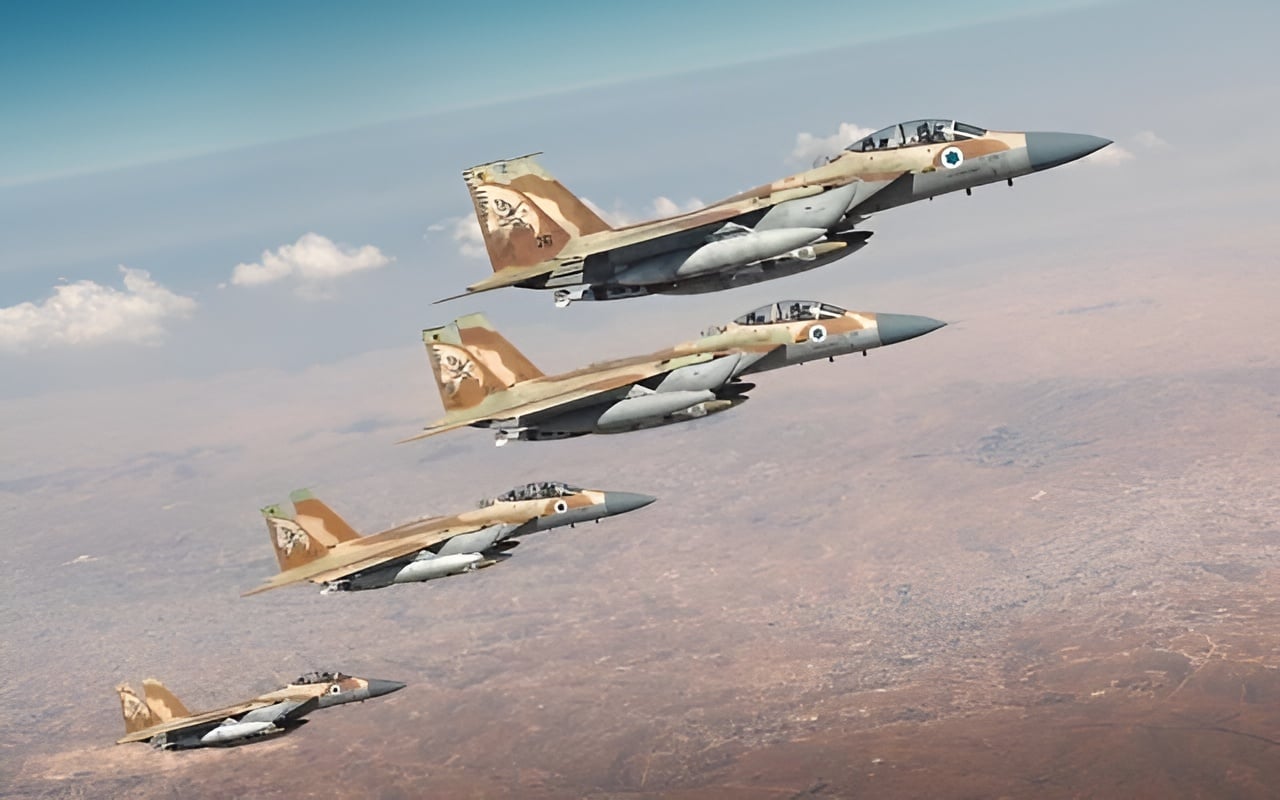
Israeli Air Force F-15 fighter jets fly over Israel en route to carry out strikes in Iran, in a handout photo published on June 25, 2025. (Israel Defense Forces).
U.S.–Iran negotiations have collapsed. Not with drama, but with inevitability.
For years, diplomacy slowed escalation without stopping it. What was framed as stability became a mechanism for delay. Incremental enrichment normalized Iran’s threshold status. Each round of talks bought time; each pause allowed centrifuges to spin. Process replaced resolution. Restraint disguised acceleration.
That phase is over.
When a superpower exhausts diplomacy against a regime whose nuclear ambition is woven into its ideological identity, the menu narrows. A U.S. strike, if it comes, would not be impulsive. It would be the endpoint of diplomatic attrition — the moment when negotiations cease to manage risk and begin to institutionalize it.
And this would not be episodic retaliation. It would be an architectural disruption.
The objective would not be symbolic punishment, but structural degradation: enrichment facilities, command-and-control nodes, IRGC projection assets, and the logistical arteries that bind Tehran to Hezbollah, the Houthis, Hamas, and Iraqi militias. Not messaging. A capability reset.
The rationale is systemic. A nuclear Iran does not merely add another weapon to the region; it fractures the deterrence architecture stretching from the Gulf to the Mediterranean. Alliance assurance erodes. Escalation control deteriorates. Under those conditions, force is framed not as escalation, but as restoration.
Yet the deeper story is geopolitical.
For two decades, Iran functioned as the region’s organizing threat variable. Its nuclear trajectory and proxy network structured alignments. Through securitization, Tehran was framed as existential — and that framing legitimized missile-defense integration, intelligence fusion, covert coordination, and ultimately the Abraham Accords. The threat did not simply reflect reality. It organized it.
If a strike materially degrades Iran’s projection capacity, that organizing variable weakens. And when the variable weakens, the alignment logic shifts.
Saudi Arabia becomes the hinge. Riyadh’s hedging has never been ideological; it has been rational balancing under uncertainty — counter Iran while insuring against American inconsistency. War alone does not eliminate hedging. Ambiguity sustains it. But if Iran’s ability to project power contracts in measurable ways, ambiguity narrows. The cost of normalization drops. Missile-defense integration becomes consolidation rather than provocation. Intelligence cooperation shifts from quiet coordination to structural anchoring of a post-Iran security order.
Inside Iran, cohesion will be tested. War can generate short-term rally effects. But cohesion under shock is not the same as cohesion under contraction. Sustained degradation strains patronage networks, intensifies elite competition, and constrains proxy financing. Repression can preserve control; but it cannot indefinitely compensate for strategic shrinkage. Rally effects are immediate. Structural erosion is cumulative.
Meanwhile, China will probe, but Beijing’s Gulf posture is transactional and energy-driven. It avoids deep entanglement in kinetic theaters. Hence, a weakened Iran becomes less valuable as a counterweight and more costly as a liability. If regional states consolidate around integrated security frameworks, China’s leverage narrows rather than expands.
On the other hand, Lebanon recalibrates next. Hezbollah’s deterrence was never mystical; it was subsidized. Funding, logistics, strategic direction. Constrain the sponsor and the spear loses inevitability. As Tehran contracts, Hezbollah shifts from a forward deterrent to domestic burden inside a fragile state that needs capital more than confrontation.
The same logic applies to Hamas, Iraq’s Hezbollah, and the Houthis. Their leverage depends on centralized financing and coordination. If Tehran absorbs strategic blows while demanding escalation, proxies face a dilemma: expand conflict while their patron weakens, or conserve strength and risk fragmentation. Either path reduces coherence.
Why? Because decentralization without resources does not produce resilience; it yields fraying.
Escalation risks are real — maritime disruption, energy shocks, missile exchanges. But systemic deterrence erosion carried its own escalatory trajectory. A strike interrupts that slope rather than sliding further down it.
The irony is unavoidable. Diplomacy prolonged the very threat architecture it aimed to manage. By exhausting diplomacy first, Washington legitimizes rupture.
Plainly, this would not end the regime. It would not erase ideology. But it would redefine capacity. And in geopolitics, capacity shapes reality more than rhetoric ever does.
Centrifuges matter. The regional order they helped structure matters more. If that structure cracks — if Iran’s ability to finance, arm, coordinate, and intimidate contracts — then the regime does not project inevitability. It projects limitation.
And regimes built on projection rarely decay with spectacle. They decay with shrinkage — quieter, slower, but unmistakable.
Related Topics
Related Posts