
Journalist, Commentator on Middle East Issues
The Struggle for the Mediterranean: Between Cooperation and Risk of Confrontation
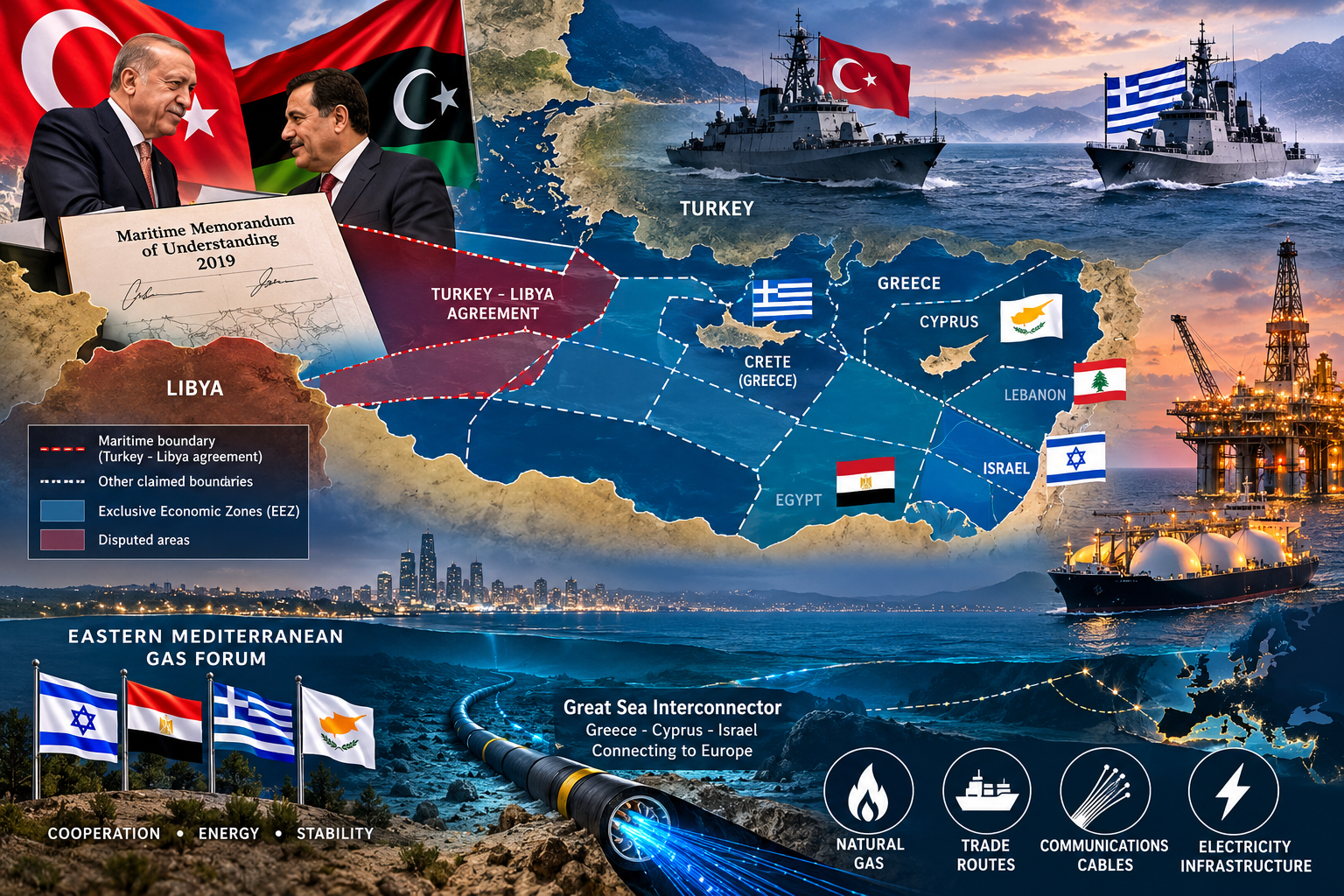
AI Illustration
The approval of the maritime agreement between Turkey and Libya has brought the struggle for control of the eastern Mediterranean back into the spotlight. For Israel, this issue extends far beyond maritime maps, touching on national security, regional alliances, and the future of energy infrastructure.
The decision by Libya’s eastern-based House of Representatives on October 20 to approve the maritime memorandum of understanding signed between Turkey and the Tripoli government in 2019 is a development of strategic significance. Israel condemned the decision, arguing that it undermines the sovereign rights of its allies in the region and destabilizes the eastern Mediterranean.
At the heart of the dispute is the delimitation of Exclusive Economic Zones (EEZs), which grant countries rights to exploit natural resources, including natural gas and oil, as well as certain economic rights at sea. The Turkish-Libyan agreement establishes a maritime boundary that, according to Greece, disregards the maritime rights arising from Greek islands, particularly Crete. Athens argues that the agreement violates international law, while Ankara presents it as a fair arrangement intended to protect the rights of both Turkey and Libya. It is important to note that the agreement’s legal validity remains disputed and has not been settled by an international court ruling.
Maritime Alliances and the Struggle for Energy Resources
Turkey’s move does not stand alone. In 2020, Greece and Egypt signed an agreement delimiting part of their respective Exclusive Economic Zones, a move also seen as a response to the Turkish-Libyan agreement. Cyprus has signed maritime agreements with Egypt and Israel, while the 2022 maritime boundary agreement between Israel and Lebanon demonstrated that even countries engaged in political confrontation can reach an arrangement through negotiations and American mediation.
Natural gas is the main resource driving this struggle, but it is not the only one. Maritime areas are also vital for trade routes, communications cables, and electricity infrastructure. The Eastern Mediterranean Gas Forum, whose members include Israel, Egypt, Greece, and Cyprus, seeks to advance regional cooperation in the energy sector. It offers an alternative model based on shared interests rather than competition alone.
For Israel, its ties with Greece and Cyprus are a strategic asset in both security and energy. One of the key tests is the Great Sea Interconnector, an undersea electricity cable project intended to connect Greece and Cyprus, and eventually Israel, to the European electricity grid. The project, estimated to cost approximately €1.9 billion, has encountered delays amid the maritime dispute with Turkey.
Risks and Opportunities for Israel
The immediate danger is escalation triggered by an encounter between warships, research vessels, or ships conducting seabed surveys. Such an incident could develop into a crisis between Turkey and Greece, both NATO members, and draw in additional countries. At the same time, legal and political uncertainty could delay gas investments, complicate infrastructure development, and turn economic projects into instruments of political pressure.
For Israel, the appropriate response should not be limited to strengthening its alliance with Greece and Cyprus. It should combine security coordination, the protection of maritime infrastructure, the advancement of economic agreements, and the use of diplomatic channels to reduce the risk of friction. At the same time, Israel cannot ignore Turkey’s importance as a regional power with significant military capabilities and influence in Libya and the eastern Mediterranean.
This is also where an opportunity lies: developing mutually agreed mechanisms for maritime delimitation, encouraging international mediation, and expanding energy cooperation could transform the Mediterranean from a focal point of confrontation into an arena of shared interests.
The strategic conclusion for Israel is clear: In the eastern Mediterranean, military strength and alliances are essential to protecting national interests, but they cannot replace legal arrangements and diplomacy. The challenge will be to safeguard Israel’s freedom of action and its partnerships without becoming entangled in a wider naval confrontation that could undermine regional security, economic stability, and peace.
Related Topics