The Sukkah: Making Space for What Comes Next
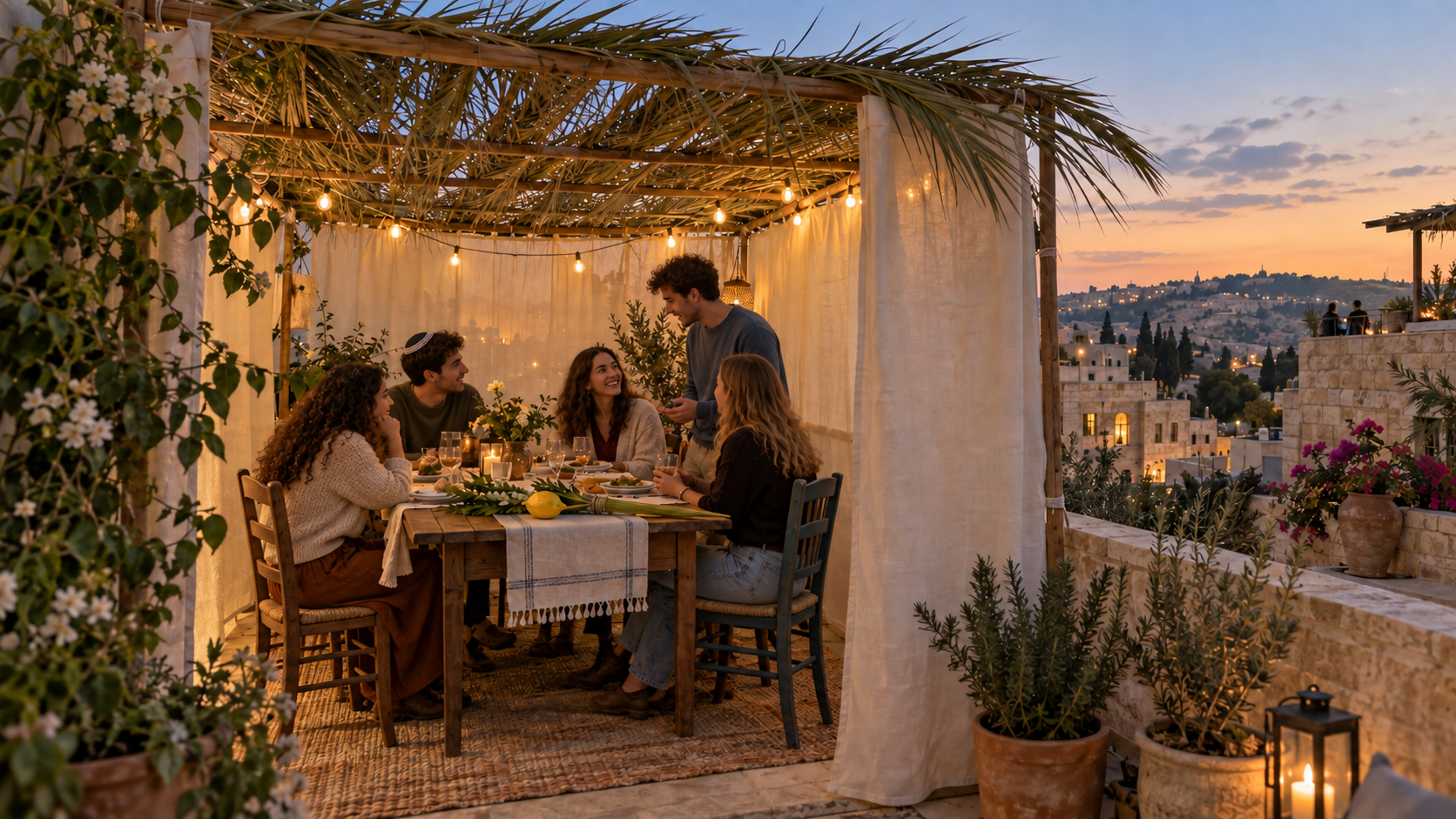
After the intensity of Rosh Hashanah and Yom Kippur, Sukkot arrives with a very different energy. We have spent days reflecting, praying, asking for forgiveness, and imagining the year ahead. And then, almost unexpectedly, the Torah asks us to stop. Build a sukkah. Sit inside it. Eat there, talk there, learn there, invite people in. Just be there.
Making Space
There is something striking about this mitzvah. We are not asked to accomplish something in the sukkah. We are asked simply to dwell in it, to allow ourselves to be surrounded by it. At the beginning of a new year, that is exactly what we need: a pause before we plunge into everything that lies ahead, a chance to breathe, regroup, and gather ourselves.
It is no coincidence that Sukkot also asks us to bring different things together. We take four very different species, the etrog, lulav, myrtle, and willow, and hold them together as one. They look different, grow differently, and represent different qualities. Yet the mitzvah depends on all of them. The message is not that we should become the same. It is that our differences can belong together.
That is true of us as well. We each carry different experiences, communities, places we call home, languages, strengths, uncertainties, and aspirations. We are not monolithic. Growth does not mean choosing among the different parts of ourselves; it means discovering how they can come together to create something larger.
This is especially meaningful for young people beginning a new chapter. A North American student studying in Israel does not have to choose between the world she comes from and the world she is entering. She brings her family, her education, her Jewish community, her questions, and her perspective as she becomes part of Israeli academic and social life. The experience is not a choice between identities, but an opportunity to integrate them.
This is at the heart of what we hope to foster at The Future is Calling. We believe that when North American students and Israeli universities come together, each has something to offer the other. The student brings her experiences and perspective; the university brings its knowledge, community, and opportunities. When those worlds meet, something new can emerge that neither could have created alone.
Stepping Into What Comes Next
But before we step into something new, Sukkot asks us to pause.
The sukkah is deliberately temporary. Its walls offer protection, but its roof remains open to the sky. We cannot control everything that happens around us. We don’t know whether the weather will cooperate, and we don’t know exactly what the coming year will bring. And yet we are asked to dwell there with joy.
The openness of the sukkah is a reminder that uncertainty does not have to close us off. Its open roof invites us to look beyond the structures we have built and remain open to possibilities we could not have anticipated. We can prepare without pretending that we can predict. We can make plans without assuming that we know exactly how they will unfold. We can step into something new while leaving room for the unexpected.
For a student considering a degree in Israel, that openness can be transformative. There is often a desire to have everything figured out before taking the next step. But sometimes a new chapter begins by making room for a possibility we had not previously considered. Sometimes we discover that the worlds we thought we had to choose between can actually enrich one another.
And we do not have to figure it all out alone.
The sukkah teaches us that our lives are built through relationships. We may strive for independence, but independence does not mean isolation. Being capable does not mean never needing help. Moving forward often means knowing when to ask a question, seek guidance, hear from someone who has been there before, or simply allow another person to help us see possibilities we could not see on our own.
That is part of what The Future is Calling hopes to provide: not simply information about Israeli universities, but the connections and human guidance that can help students and families imagine what is possible and navigate the path toward it. And just as students bring something of their own world with them, we hope to help Israeli universities better understand and welcome the students who arrive from North American communities.
Eventually, Sukkot ends, and we leave the sukkah. But we don’t leave simply to return to where we were. We leave having paused, gathered ourselves, opened ourselves to possibility, and remembered that we are part of something larger. Then we step back into the world.
We build, learn, connect, and contribute. We ask for help when we need it and offer it when someone else does. We bring everything we have gathered with us, while remaining open to what the year may yet bring.
This is the invitation of Sukkot: to bring our different pieces together, make space, breathe, and then step forward without needing to know exactly what comes next.
Sometimes, the most important thing we can do before beginning a new chapter is to leave the door open for a possibility we haven’t yet imagined.
Chag Sameach