
Urban sociologist and geopolitical commentator
The Sultan’s Algorithm
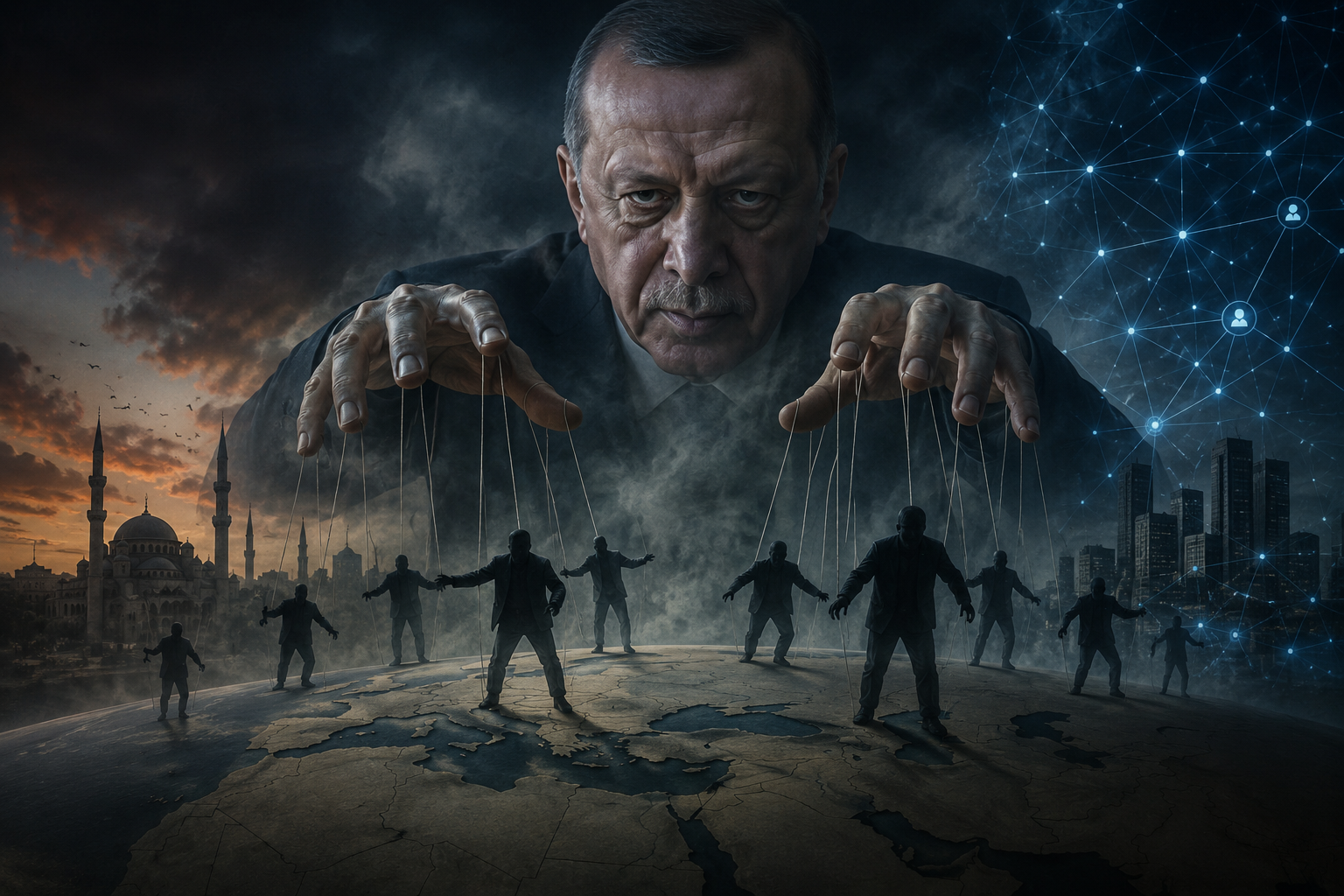
Turkey and Transnational Illiberalism. AI Illustration. (Credit: ChatGPT)
Turkey, Transnational Illiberalism, and the Poverty of Our Political Vocabulary
There is a particular kind of danger that arrives not as an army but as a narrative, one that does not breach a border so much as dissolve the very idea of one. The world has grown reasonably competent at recognizing the former kind of threat. It has built treaties, doctrines, and deterrents to manage it. But the latter kind, ideological, digital, transnational, operating through the capillaries of social media rather than the arteries of state power, continues to metastasize in a conceptual vacuum. We lack, quite simply, the words to describe what is happening. And without the words, we cannot build the institutions. And without the institutions, we are defenseless.
Turkey’s evolving role in this landscape is one of the most instructive and least examined case studies in contemporary geopolitics.
The Transformation of a Pivot State
To understand what Turkey has become, one must first appreciate what it was meant to be. The republic that Atatürk forged from the ruins of the Ottoman Empire was, whatever its contradictions, a deliberate wager on secular modernism. For decades, Turkey served as a living proof-of-concept for the proposition that a Muslim-majority society could sustain Western-style institutions, participate in NATO’s collective security architecture, and orient itself toward European norms. It was a hinge state: imperfect, contentious, but strategically indispensable to the liberal international order.
That hinge has now turned in a different direction. Under President Recep Tayyip Erdoğan, Turkey has undergone a profound reorientation, ideologically, institutionally, and geopolitically. The erosion of judicial independence, the systematic hollowing of press freedom, the imprisonment of journalists and political opponents, the replacement of technocratic governance with personalist rule, and the invocation of Islamic identity as a political instrument: these are well-documented by organizations ranging from Freedom House to Reporters Without Borders. What is less examined is how this domestic transformation has acquired an international vector, how Turkey’s illiberal turn has become, through design or diffusion, an export.
The New Anatomy of Influence
Classical theories of geopolitical influence were built around hard instruments: armies, sanctions, alliances, the control of territory and resources. Soft power, Joseph Nye’s elegant formulation, acknowledged that attraction could substitute for coercion. But neither framework was designed for what we now observe: the engineering of ideological atmospheres across borders through digital platforms, the algorithmic amplification of divisive narratives, and the cultivation of transnational communities of ideological alignment that owe no formal allegiance to any state yet serve its strategic interests.
Turkey has developed a sophisticated ecosystem for projecting influence in this mode. The state broadcaster TRT World delivers programming to global audiences in multiple languages, framing Turkish foreign policy interests within a veneer of journalistic credibility. The Diyanet İşleri Başkanlığı, Turkey’s Directorate of Religious Affairs, operates one of the largest networks of mosques and religious institutions outside the Muslim world, functioning in effect as a soft-power infrastructure with reach into Central Asia, the Balkans, Africa, and Western Europe. The Turkish Cooperation and Coordination Agency (TİKA) deploys development aid as a mechanism of cultural alignment. These institutions do not constitute a propaganda ministry in the crude Cold War sense. They constitute something more sophisticated: an ideological supply chain.
What travels through this supply chain is not merely pro-Turkish sentiment. It is a coherent worldview: conservative, majoritarian, suspicious of liberal pluralism, hostile to feminism and LGBTQ+ rights, resentful of Western cultural hegemony, and deeply invested in an alternative civilizational narrative in which Islamic identity and strong-state nationalism are presented as authentic antidotes to decadent Western liberalism. This worldview circulates through social media networks that are formally private, algorithmically driven, and genuinely transnational. Turkish-linked accounts and content ecosystems have been documented amplifying anti-feminist, anti-secular, and conspiratorial content across multiple languages and jurisdictions.
The Specific Weaponization of Gender
Among the most consistent and underanalyzed features of this influence apparatus is its focus on gender as a political battlefield. The Istanbul Convention, the Council of Europe’s landmark treaty on violence against women, was withdrawn by Turkey in 2021, a decision Erdoğan justified by asserting that the treaty threatened traditional family structures and was being used to “normalize homosexuality.” This was not merely a domestic policy choice. It was a signal, one enthusiastically received by illiberal actors across Eastern Europe, who subsequently used Turkey’s withdrawal to legitimize their own opposition to gender equality frameworks.
Online, the pattern is more granular and more insidious. Networks promoting hyper-traditional gender roles, portraying feminism as a Western civilizational attack on Muslim societies, and framing women’s autonomy as a form of cultural betrayal have proliferated across platforms in Arabic, Urdu, Bengali, Indonesian, and other languages. These narratives do not require direct Turkish state direction to serve Turkish state interests. They cultivate ideological terrain in which illiberal governance appears not as an aberration but as a defense of authentic identity. They are, in the precise sense, pre-political: they shape the emotional and cultural substrate upon which political choices are made.
The Indian Vulnerability
For India, the implications are acute in ways that deserve specific attention rather than generic concern. India is the world’s most populous democracy, home to the second-largest Muslim population on earth, and a society navigating extraordinary internal tensions between constitutional pluralism and majoritarian politics. It is also a country with some of the world’s highest rates of social media penetration relative to digital literacy, a combination that creates structural vulnerability to transnational influence operations.
The concern here is not that Turkey controls Indian public discourse. It does not. The concern is more subtle and more serious: that a broader ecosystem of illiberal ideological content, of which Turkish-linked networks form one node, finds fertile ground in contexts where communal tensions are already high, where trust in institutions is contested, and where digital platforms amplify emotional content over reasoned argument. The narratives that weaponize gender, demonize religious minorities, and frame pluralism as weakness do not arrive in India labelled as Turkish exports. They arrive as memes, as viral videos, as seemingly indigenous expressions of cultural resentment. Their transnational origins are invisible; their domestic effects are not.
The Conceptual Crisis
Here the essay’s deepest argument must be confronted directly. The problem with Turkey’s role in the global diffusion of illiberal influence is not merely political, it is epistemological. Our inherited vocabulary of international relations is simply inadequate to the phenomenon we are observing.
The concept of sovereignty, as enshrined in the Westphalian tradition and the UN Charter, treats states as the primary actors in international life and their domestic affairs as beyond external jurisdiction. But when influence operates through formally private platforms, through diaspora networks, through algorithmically distributed content that crosses borders in milliseconds, sovereignty becomes a concept of limited analytical utility. The content is not sent by Turkey; it is amplified by Turkish-adjacent networks; it is received by algorithms indifferent to national origin.
The concept of intervention, similarly, was designed to address the direct exercise of coercive power by one state against another. What Turkey’s influence ecosystem represents is not intervention in any conventional sense. No troops cross borders. No embassies are directed to subvert foreign elections. The influence is structural, ambient, and deniable, operating through the background radiation of global information networks rather than through targeted action.
The concept of soft power, while closer to the mark, was developed in a pre-algorithmic era and retains too much of an assumption of deliberate, state-directed communication. What we observe increasingly is something better described as ideological infrastructure: the construction of narratives, networks, and emotional communities that exist independently of direct state control yet serve state-compatible interests. Turkey benefits from a global ecosystem of conservative Islamic identity politics without needing to manage it in any bureaucratic sense.
We need new concepts. We need something like ideological externalities, the recognition that domestic political choices generate cross-border narrative effects analogous to the cross-border environmental effects of industrial pollution. We need digital sovereignty frameworks that acknowledge the state’s responsibility for the ideological outputs of networks operating within its jurisdiction. We need algorithmic accountability standards that require platforms to disclose the provenance and amplification patterns of politically significant content. None of these concepts yet exists in codified international law or norms.
The Paralysis of the Moment
One might expect that the severity of this challenge would generate urgent international attention. It has not, for reasons that are themselves revealing.
The major powers are consumed by crises that fit older conceptual frameworks: Russia’s war in Ukraine, tensions in the Taiwan Strait, competition for critical mineral supply chains. These are comprehensible threats. They activate familiar strategic vocabularies and institutional responses. The diffuse, ambient challenge of transnational ideological influence does not generate the same urgency precisely because it is not acute in the conventional sense. It accumulates rather than erupts. Its damage is to the texture of democratic life, to trust, to pluralism, to the quality of public reasoning, rather than to territorial integrity or economic capacity.
Turkey’s own strategic positioning further complicates the response. Turkey remains a NATO member, a state with significant military capacity, and a regional power whose cooperation is necessary for a range of Western interests, from migration management to Black Sea security. This creates a structural reluctance among democratic governments to confront Turkish influence operations with the seriousness they deserve. The ally relationship insulates Turkey from the scrutiny that would be brought to bear on a purely adversarial state.
Meanwhile, international institutions with potential relevance, the UN’s mechanisms for internet governance, the OECD’s work on disinformation, the Council of Europe’s digital rights frameworks, remain fragmented, underfunded, and politically constrained. The Budapest Convention on Cybercrime, the only major multilateral cybersecurity treaty, addresses criminal conduct rather than state-adjacent influence operations. The gap between the scale of the problem and the architecture of the response is extraordinary.
What Must Be Built
If this essay has a constructive obligation, and it does, it must extend beyond diagnosis to prescription, even if the prescriptions feel inadequate to the scale of the problem.
First, democracies must invest in narrative intelligence: the systematic study of transnational ideological ecosystems, their nodes, their amplification mechanisms, and their political effects. This is not the same as signals intelligence (SIGINT) or even traditional public diplomacy analysis. It requires interdisciplinary teams combining political science, computational social science, anthropology, and regional expertise.
Second, platform accountability must become a non-negotiable element of trade and diplomatic relationships. Democracies should require, as a condition of market access, that major platforms disclose algorithmically amplified content networks, foreign-linked coordination, and the geographic origin of viral political content. The EU’s Digital Services Act gestures toward this; it must be expanded and replicated.
Third, media literacy must be treated as a dimension of national security, receiving resources commensurate with that designation. This is particularly urgent in societies like India, where the gap between internet access and critical information literacy creates systematic vulnerability.
Fourth, and most importantly, scholars, policymakers, and international institutions must develop the new conceptual vocabulary that this moment demands. The challenge is not merely technical or institutional. It is fundamentally intellectual. We cannot govern what we cannot name.
The Larger Stakes
Turkey’s trajectory matters not only for what it tells us about Turkey. It matters for what it reveals about the structural vulnerabilities of the contemporary international order. A pivotal state, one that once served as evidence that Islamic democracy and Western liberalism could coexist, has become a node in the global diffusion of illiberal worldviews. This is not a story about Islam. It is a story about the political economy of identity, the strategic uses of digital platforms, and the failure of international institutions to keep pace with the realities of 21st-century power.
The question that remains, and it is not a rhetorical one, is whether the democracies of the world can develop the intellectual and institutional resources necessary to respond. History offers no guarantee that they will. But it insists, with some force, that the cost of failure will not be abstract. It will be borne, as it always is, by the most vulnerable, by women whose autonomy is treated as a cultural threat, by minorities whose existence is framed as a civilizational problem, by citizens whose capacity for democratic self-governance is quietly, algorithmically eroded.
The Sultan’s algorithm is patient. The response must be more urgent.
Related Topics
Related Posts