NAnews - Nikk.Agency Israel News
The sunflowers of Ilovaisk and the Jews and Israelis who died defending Ukraine
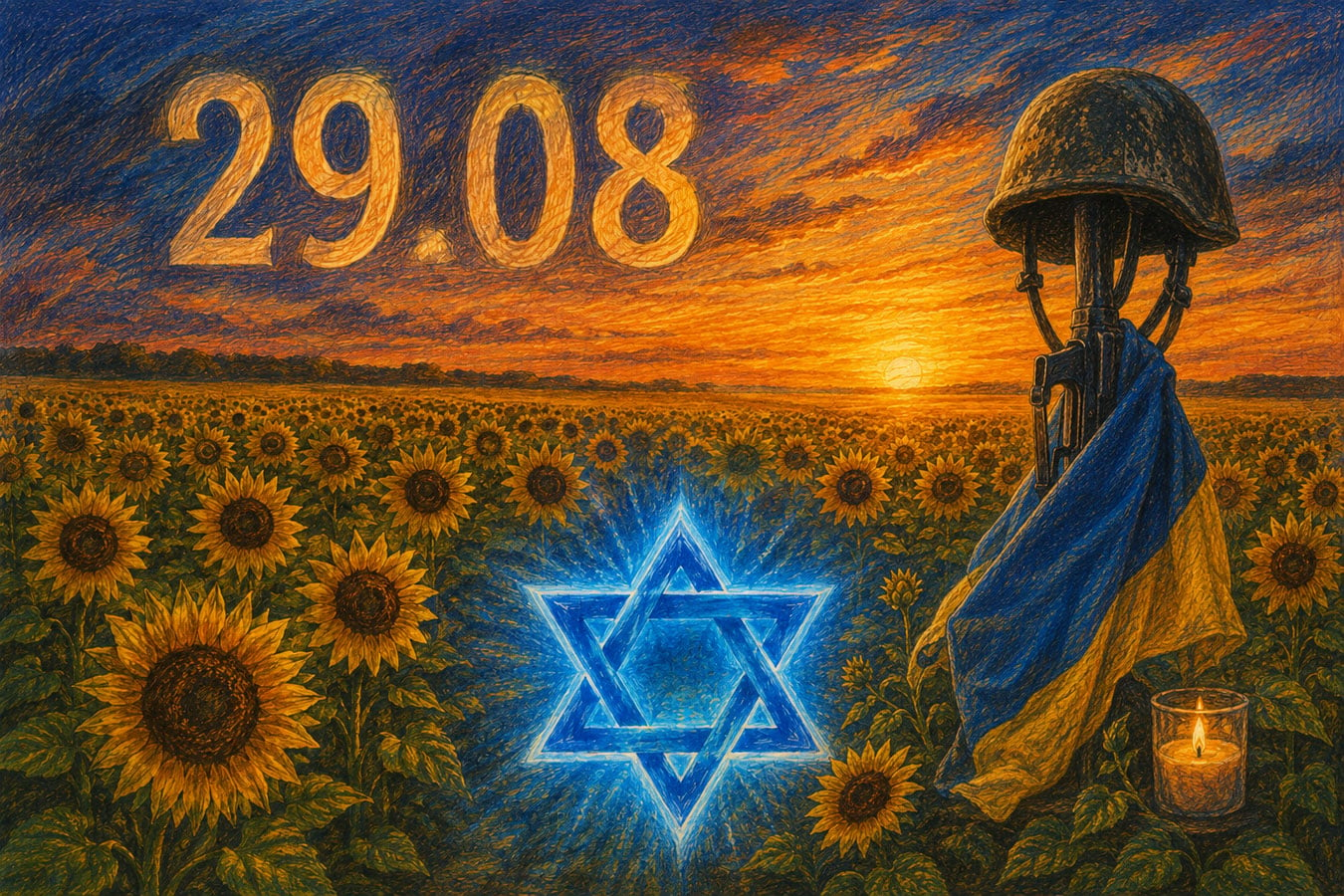
The sunflowers of Ilovaisk and the Jews and Israelis who died defending Ukraine. The image was created using AI.
On August 29, Ukraine remembers those who gave their lives defending the country’s independence and territorial integrity.
For Israelis, the emotional meaning of such a day needs a little explanation. It is not the Ukrainian equivalent of Yom HaZikaron — the histories and traditions are different — but the human language is familiar: names, photographs, families, unfinished lives, and the obligation to remember people as individuals rather than as statistics.
Ukraine chose August 29 because of one of the darkest episodes of the war that began in 2014: the battle of Ilovaisk.
On the morning of August 29, 2014, Ukrainian units began leaving an encirclement along a route that had been agreed with the Russian side. They had been promised safe passage.
Instead, Russian forces opened fire on the withdrawing columns with artillery and other heavy weapons.
According to the Ukrainian Institute of National Memory, 366 Ukrainian servicemen were killed, 429 were wounded, 158 went missing and 300 were taken prisoner during the Ilovaisk operation.
Some of the soldiers died among fields of ripening sunflowers through which the columns were moving.
That is why the sunflower became a symbol of Ukraine’s Day of Remembrance.
But August 29 is no longer only about Ilovaisk. Ukraine now remembers all those who have fallen defending the country since the beginning of the Russian-Ukrainian war in 2014.
And this is where another story begins — the reason I went back through the NAnews archives.
Among Ukraine’s fallen were Ukrainian Jews, Israeli citizens, former IDF soldiers, graduates of Jewish schools, and Jewish volunteers from other countries.
There was Polish Jew Daniel Sztyber. Italian-Dutch Jew Benjamin Giorgio Galli. Hungarian Jew Benjamin Asher.
They came from different countries and different Jewish worlds. Some had Ukrainian citizenship. Some had Israeli citizenship. Some had neither. Several simply decided that Ukraine was a country worth defending against Russia’s aggression.
I wanted to know who these people were.
So I began checking names.
An earlier NAnews project had identified 18 fallen defenders of Jewish origin. I then compared those names with a Ukrainian public list of Jewish participants in the war. At the time of my research, that list contained 63 entries.
But those 63 were not 63 dead soldiers.
The list mixed together the fallen, living servicemen, severely wounded veterans, missing soldiers and people whose current status was unclear. That immediately made one thing obvious: simply copying names from existing lists would produce errors.
So I went further — through Ukrainian memorial databases, international volunteer memorials, Jewish community publications, Israeli, Ukrainian, Polish and Jewish media, official documents and accounts from relatives.
The deeper I went, the less useful a simple number became.
The project eventually grew into 50 individual human stories — people who were killed, people who later died, people who remain missing, and cases that required additional verification.
The chronology stretches from Yevhen Yatsyna, killed on January 21, 2015 while defending Donetsk Airport, to Yuriy Urshansky, killed on August 26, 2025 after a Russian FPV drone attack.
Within those 50 cases, our working material contains 30 fallen defenders whose identities and deaths we were able to establish by name, another 11 deaths or wartime cases that had to be presented with explicit caveats, two publicly named missing servicemen, and several people whose current status could not be reliably established from open sources.
And even those 50 stories are only part of a much larger picture.
One of them is Dmytro Fialka, call sign “Shchif.”
Born in Lviv, Fialka moved to Israel as a teenager, became an Israeli citizen and served in the IDF. He took part in the Second Lebanon War. From 2008 to 2013, he coached children at Maccabi Be’er Sheva.
Later he returned to Ukraine.
After Russia’s full-scale invasion, he joined the Ukrainian military and became a platoon commander in the International Legion of Territorial Defense.
Fialka was killed near Bakhmut on September 1, 2022.
He was buried in the Jewish section of Lviv’s Yaniv cemetery. At his funeral stood two flags: Ukrainian and Israeli.
Another name is Vladyslav Holenkov, who was killed while serving in the Ukrainian army. His younger brother Mark is a footballer who moved to Israel and has been connected with Maccabi Haifa.
There is also Anton Samborsky, Matityahu, the adopted son of Ukraine’s Chief Rabbi Moshe Azman. He was killed in the Donetsk region in July 2024 and was posthumously awarded Ukraine’s Order for Courage, 3rd Class.
And there is Konstantin Mrochko, whose story illustrates how complicated these categories can become.
Mrochko spent years living and working in Israel, including at the Lev-Adam organic farm in Bat Shlomo, at the foot of Mount Carmel. He helped grow grapevines there.
He later returned to defend Ukraine and was killed.
Ukraine posthumously awarded him its highest title: Hero of Ukraine with the Order of the Gold Star.
His Israeli friends preserved his memory in another way: a rosé produced from grapes connected to the vines he had helped grow was named Kostia Rose in his honor.
People who knew him in Israel told NAnews that he was not Jewish. That detail matters. Memory should not require us to force someone into a category to which he did not belong.
There are stories without endings, too.
One fighter is known publicly only by his call sign, “Izya.” We know that he was wounded. We do not have reliable recent information about what happened afterward.
And here another number becomes important.
In January 2026, the Israeli investigative project Shomrim reported, citing Ukraine’s Coordination Headquarters for the Treatment of Prisoners of War, that at least 12 Israeli citizens were considered missing or held in Russian captivity in connection with the war in Ukraine.
Most had fought on the Ukrainian side.
Ukraine’s embassy in Israel separately confirmed to journalists at least eight missing Israelis. The real number may be higher, because not everyone with dual Israeli-Ukrainian citizenship had disclosed both citizenships to the authorities.
Those 12 cannot simply be added to the 50 cases I examined. Their names have not been published, and some may overlap with people already known to us.
That is precisely the problem with trying to turn this story into one definitive total.
The Jewish community’s own figures point to a much larger scale.
In September 2024, the Federation of Jewish Communities of Ukraine said it had helped arrange the funerals of 47 Jewish servicemen killed in the war.
By June 2025, a figure cited by The Jerusalem Post from the Federation put the estimated number of Jewish fighters killed at approximately 200.
Why such a gap between the names we can publicly reconstruct and the community’s estimate?
Ukraine’s military does not maintain a public casualty registry organized by ethnicity or religion. Not every Jewish soldier belonged to an organized Jewish community. Not every person publicly discussed his Jewish background. And dual citizenship adds another layer of uncertainty.
The awards tell another part of the story.
Among the people I traced are recipients of Ukraine’s Order for Courage, the Order of Danylo Halytsky, the Order of Merit, the Gold Cross and the Medal for Military Service to Ukraine.
Some received those honors while alive. Others were decorated posthumously.
Leonid Krasnov, from a Jewish family in Dnipro, received the Medal for Military Service to Ukraine, the Gold Cross, the Order for Courage, 3rd Class, and, after his death, the Order for Courage, 2nd Class.
But medals are not the reason I wanted to tell these stories.
I wanted to know who these people were before they became names on memorial pages.
Who returned from Israel to Ukraine? Who came voluntarily from Poland, Italy, the Netherlands or Hungary? Who was buried according to Jewish tradition? Whose body could not be recovered for months? Who survived terrible wounds? Who remains missing? Which families now carry this war with them in Israel?
The full research, biographies, dates, awards, disputed records and source material are collected in my NAnews investigation.
I began this work looking for a list.
I ended it much less interested in lists.
What matters are the names.
Behind them are synagogues and football clubs, Jewish schools and Israeli cities, Ukrainian military brigades, parents, wives, children and friends.
On August 29, Ukraine remembers those who died defending their homeland.
Some of their stories belong to Israel, too.
יהי זכרם ברוך — May their memory be a blessing.
Related Topics
Related Posts