Exploring Memory, War, and Survival
The Boy Who No Longer Trembled
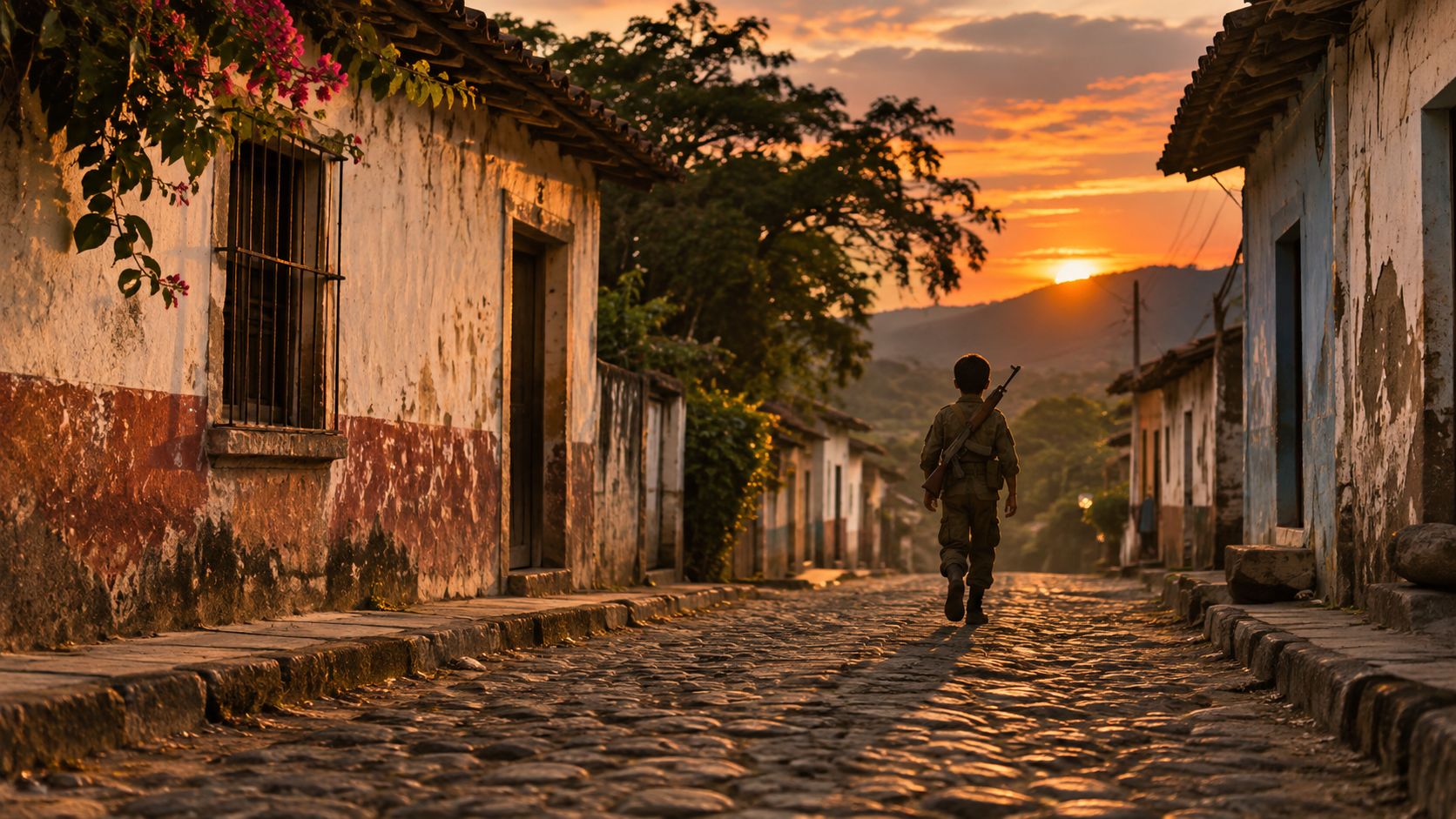
A child soldier walks away through a cobblestone street in a Salvadoran village at sunset, evoking the childhoods lost to the civil war. (AI-generated illustration)
Author’s Note: The names of certain individuals have been changed to protect their identities. All events are recounted as I remember them.
There are memories that do not arrive all at once. They return in fragments. A sound first. Then a face. Then years later, a detail someone whispers before dying, and suddenly the past changes shape again.
For most of my life, I thought I remembered only the gunshot. Now I understand I was remembering the collapse of a childhood.
I was a boy during the Salvadoran civil war when armed children entered San Jorge. They did not arrive with tanks or helicopters. They came on foot, descending the cobblestone road from the hills toward the market, carrying rifles that seemed too heavy for their bodies. Some looked barely older than I was.
That afternoon, fear spread faster than news. By three o’clock, people were already whispering that armed groups had entered nearby communities. Radios disappeared from tables. Store owners lowered their voices. Mothers called children indoors earlier than usual. By sunset, the town no longer felt like itself.
I remember standing outside my house beside my mother as the light faded behind El Tigre hill. Across the street, near the agro-supply store facing the market, stood a boy with a rifle. He could not have been more than ten years old.
His uniform hung loosely from his shoulders. Dust covered his boots. A scar crossed one eyebrow. What frightened me most was not the weapon, but his expression. His face carried none of the confusion I associated with children. His eyes looked dry, emptied of hesitation long before arriving in our town.
Then Ramón appeared.
Everyone in San Jorge knew him. He drank heavily, wandered from cantina to cantina, and spoke too loudly even during dangerous times. Adults often dismissed him with the tired tolerance reserved for men already half-destroyed by life. That evening he was drunk again.
He staggered into the street laughing, mocking the armed boy standing near the store. I no longer remember his exact words. Memory preserves emotion more faithfully than dialogue. But I remember the laughter, the provocation, the reckless humiliation of a child carrying a rifle in a town where everyone else had already learned to remain silent.
The boy said nothing.
That silence remains one of the most terrifying things I have ever witnessed. No anger. No warning. No trembling. Only stillness.
Then he raised the rifle and fired once.
The sound cracked through the street with shocking precision. Ramón collapsed instantly onto the cobblestones. Chickens scattered. Dogs barked wildly from distant yards. And then, almost immediately, silence returned.
I remember the blood moving slowly between the cracks in the stones. I remember neighbors watching from behind gates without stepping forward. I remember the armed boy lowering the rifle and walking away as calmly as he had arrived.
He passed directly in front of my house. I can still see his face. Not rage. Not triumph. Not fear. Nothing.
That frightened me more than the gunshot itself.
That night my mother gave me a cup of atol before bed. She did not ask questions. In war, adults often understood that children carried things they could not yet explain. I remember holding the warm cup while hearing the shot repeat itself inside my head.
For years, I thought the memory belonged only to death. But adulthood changed it.
Decades later, my sister told me things I never knew as a child. After Ramón died, the local priest had to gather donations from the community to help pay for a coffin because his immediate family could not afford one. Then something unexpected happened.
Another woman arrived from Intipucá. She came with relatives in a new pickup truck none of us had ever seen before. That was when many people in town discovered Ramón had lived another life beyond the one we knew. Another family. Other children. Other secrets carried quietly across neighboring towns while war consumed everything around us.
As a child, I believed the story ended with the gunshot. As an adult, I understand the tragedy had begun long before.
War destroys people before it kills them. It fractures identity. It divides families into hidden versions of themselves. It teaches children to fire weapons before they understand mercy. It teaches entire towns to witness horror without movement because survival itself becomes a moral negotiation.
What stayed with me most was never Ramón’s death alone. It was the boy. The unbearable reality that someone so young could kill without tears.
For a long time, I judged him in silence. Then age forced me to confront a harder truth: children are not born carrying that kind of emptiness. Someone places it there. War enters them long before they enter towns with rifles.
Sometimes I wonder what became of him.
People offered different stories over the years. Some claimed he died months later in the mountains. Others believed he crossed borders and survived somewhere far away. One rumor insisted he ended up in the United States selling used cars under another name. I do not know which version is true.
But every time I return in memory to that street in San Jorge, I still see him walking away after the shot, disappearing into the fading light while the town stood frozen behind him.
And I think about how war steals tears first.
After that, everything else becomes easier to take.
Related Topics
Related Posts