
The Surprising Sincerity of Evangelical Support for Israel
American evangelicals often profess deep love for and support of Israel, yet the motivations underlying that support have long been the subject of debate. A common critique holds that evangelical support is fundamentally instrumental rather than unconditional. According to this view, support for Israel is rooted less in concern for the Jewish state itself or in concern for the Jewish people than in eschatological beliefs linking Israel to the anticipated return of Christ. Critics further argue that, within this theological framework, the Jewish people are assigned a largely instrumental role in salvation history, with some contending that ultimate evangelical aims include Jewish conversion either before or after the Second Coming.
In the past eight years, we have been carefully measuring and analyzing evangelical public opinion toward Jews, Judaism, and the modern State of Israel. In our recent book, we present a complex picture of theological, societal, and political motivations that together bring this community – estimated at 80 million Americans – to favor Israel over the Palestinians. In our earlier work, we found that religious motivations are the primary drivers of evangelical support for Israel. Importantly, this support is driven less by expectations that the End Times are near than by the belief that Jews remain God’s Chosen People.
In December 2025, we had a unique opportunity to dig even deeper. We commissioned an online survey of 3,800 self-identifying evangelicals (such as Baptists, Pentecostals, non-denominational, etc.) and mainline Protestants (such as Methodists, Presbyterians, etc.). Our analysis here is based on properly weighted individual-level data, aligned with the population estimates reported by Pew’s Religious Landscape Study (2024). Our credibility intervals range between ±1.9 and ±2.3 percentage points per question. Because our pool of respondents is generated via non-probability sampling, we report credibility intervals rather than a more conventional “margin of error.” A credibility interval functions similarly to a margin of error but is designed for surveys such as this one that do not use random sampling.
Because self-identification alone does not always capture the theological core of evangelical belief, we also incorporated a doctrinal measure based on the widely used framework developed by the National Association of Evangelicals (NAE). Under this approach, an individual is classified as evangelical if they strongly agree with four core statements of faith: that the Bible is the highest authority for belief, that encouraging non-Christians to trust in Jesus Christ is personally important, that Christ’s death on the cross is the only sacrifice capable of removing sin, and that eternal salvation is granted only through trust in Jesus Christ alone.
At the same time, our previous surveys have shown that evangelical identity is best understood as existing along a spectrum, encompassing both a doctrinal core and a broader periphery of beliefs. To capture this variation, respondents were asked not only how they identified denominationally but also the extent to which they agreed with each of the four NAE statements. This design allowed us to distinguish respondents who strongly endorsed all four doctrinal criteria from those who did not.
For purposes of analysis, we classified respondents who strongly agreed with all four statements as “NAE evangelicals” and compared them with all other Protestant respondents, labeled more generally as “non-NAE Protestants.” We also ensured that the sample included at least 1,000 respondents who met the full NAE criteria, providing a sufficiently large group for meaningful comparison. 45% of self-identified evangelicals and 22% of self-identified mainline Protestants in our 3,800-respondent sample met the NAE threshold as well.
Christian End Days Expectations
Having distinguished between respondents who meet the NAE doctrinal threshold and those who do not, we next turn to one of the most consequential theological dimensions shaping attitudes toward Israel: beliefs about the End Times, or eschatology. While eschatological expectations are often discussed in traditional pre-millennial, a-millennial and post-millennial categories as well and by traditional conservative and liberal denominational preferences and distinctions between evangelicals and mainline Protestants – our analysis focuses instead on the differences between NAE evangelicals and non-NAE Protestants, regardless of how respondents initially self-identified their expression of faith. This distinction allows us to move beyond labels and examine whether those who hold the core doctrinal commitments associated with evangelicalism also differ systematically in their understanding of biblical prophecy and its connection to contemporary events.
Over the last four decades, awareness of concepts such as the millennium, the rapture, and Armageddon has been heightened through the preaching of televangelists such as Oral Roberts and Jerry Falwell, as well as widely read older works like Hal Lindsey’s The Late, Great Planet Earth (1970). Respondents who met the NAE threshold are considerably more likely to interpret these prophecies in relation to current events and social trends, viewing contemporary developments as potential signs of biblical fulfillment. By contrast, respondents outside the NAE doctrinal core tend to approach eschatology through a more symbolic and allegorical lens rather than utilizing a more literal hermeneutic. This leads to a less event-driven manner which interprets End Times language as historically fulfilled (Preterism) providing theological building blocks for deeper theological or moral reflection rather than as a literal roadmap for present-day politics.
In the survey, we asked two questions that tap directly into the End Times beliefs: “We are living in or nearing the End Times,” and “The Modern State of Israel represents the fulfillment of biblical prophecies.” The results are striking. Approximately half of all Protestant respondents expressed at least some agreement that we are living in or near the End Times, and nearly half likewise agreed that, at least to some extent, the contemporary State of Israel represents a fulfillment of biblical prophesies. Among NAE evangelicals, however, these levels of agreement were substantially higher, ranging from 75 to 85 percent. These findings suggest that eschatological expectations remain highly salient among all American Protestants, but are especially pronounced among those who adhere to the doctrinal core of evangelical Christianity.
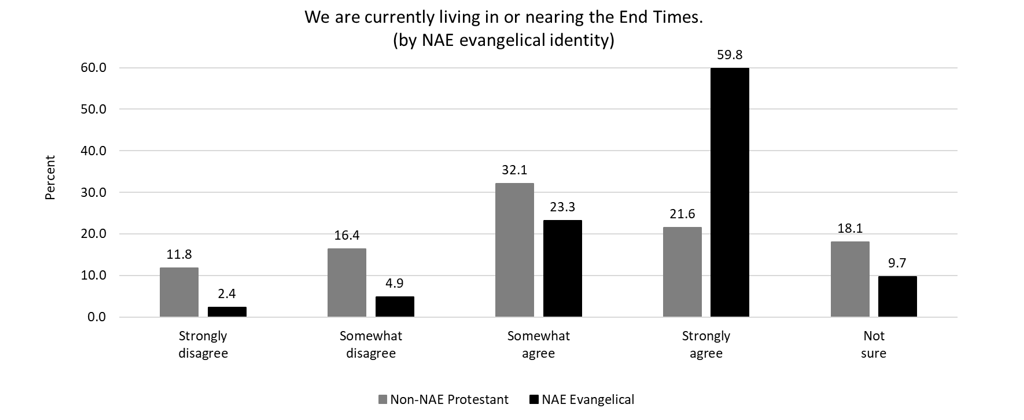
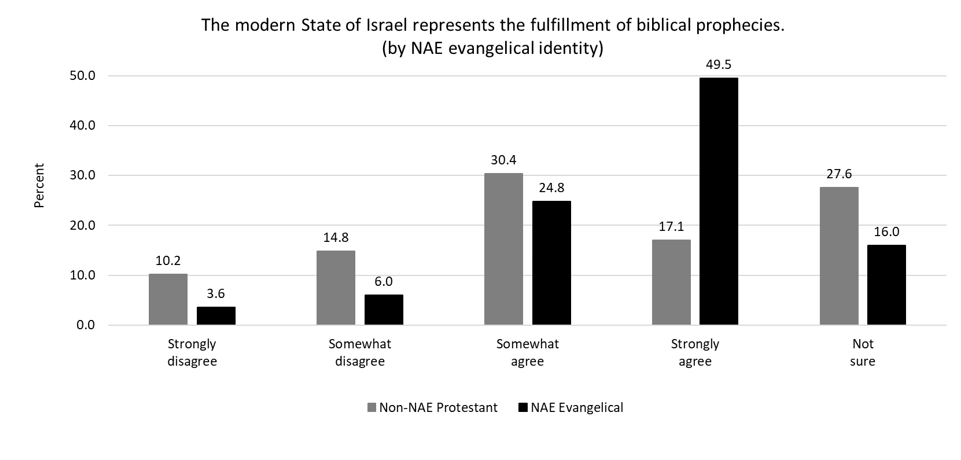
(All the tables in this blog belong to the authors and are used with their permission).
With such high support for End Times expectations among Protestants, one could expect that support for Israel is indeed primarily instrumental, especially among those who so strongly believe the Second Coming is near. However, the data shows that such a conclusion would be misplaced.
We asked the respondents to rank an additional set of statements about their attitudes and views toward Jews. The statements included:
- Christians should love and support Jewish people whether or not they accept Jesus as Messiah.
- My support for Israel comes from caring about the Jewish people today, not from beliefs about the End Times.
- God offers Jews a path to Him through their covenant, just as Christians have theirs through Jesus.
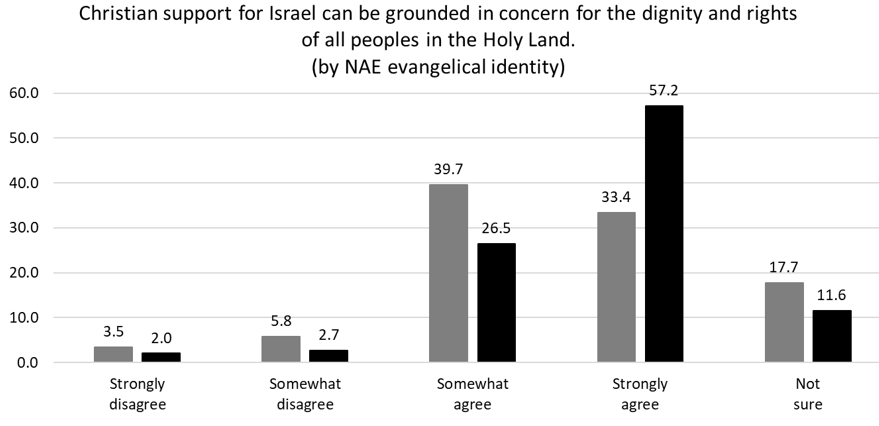
- Christian support for Israel can be grounded in concern for the dignity and rights of all peoples in the Holy Land.
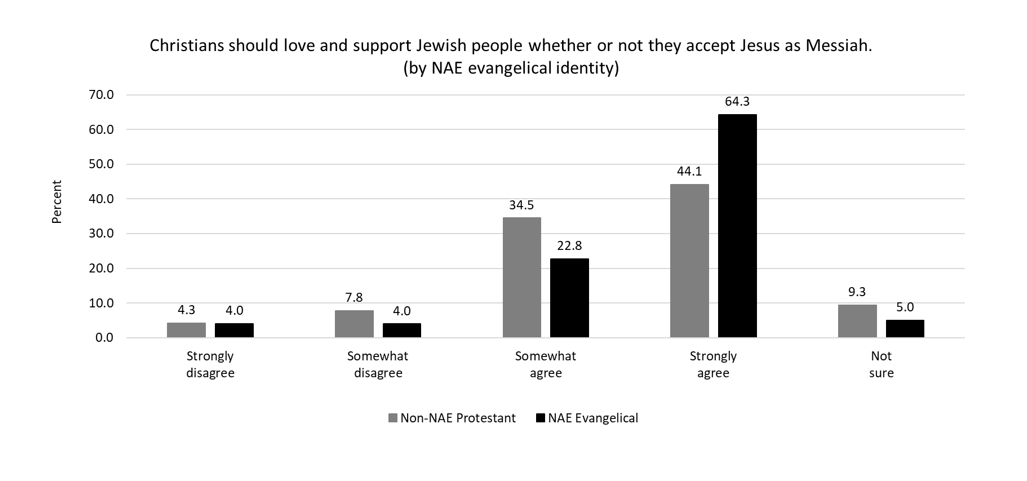
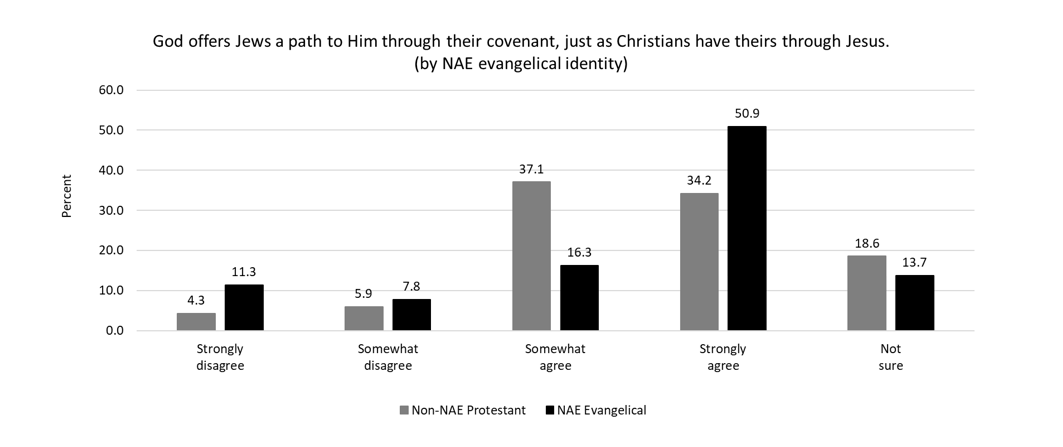
As the figures below show, NAE evangelicals consistently express more inclusive, less exclusivist, and more theologically generous orientations toward Jews than their non-NAE Protestant counterparts.
First, NAE evangelicals overwhelmingly reject the notion that Christian love or support for Jews depends on Jewish acceptance of Jesus as Messiah. Nearly two-thirds of NAE evangelicals (64.3%) strongly agree that Christians should love and support Jewish people regardless of whether they accept Jesus, compared to 44.1% of non-NAE Protestants. When combined with “somewhat agree,” 87.1% of NAE evangelicals affirm this unconditional stance, exceeding the already substantial 78.6% among non-NAE Protestants. Importantly, outright disagreement is rare in both groups, but especially so among NAE evangelicals (only 8.0% total disagreement, compared to 12.1% among non-NAE Protestants).
Second, NAE evangelicals are more likely – not less – to endorse the idea that Jews have their own path to God. A majority of NAE evangelicals (50.9%) “strongly agree” that God offers Jews a path to Him through their covenant, compared to 34.2% of non-NAE Protestants. While non-NAE Protestants are more likely to cluster in the tentative “somewhat agree” category (37.1% vs. 16.3%), NAE evangelicals are substantially more likely to express clear and confident theological affirmation rather than ambivalence. While this endorsement of a separate Jewish salvation path is at least somewhat inconsistent with general Christian soteriology (understanding of salvation), which affirms exclusive salvation through Jesus Christ, this pattern is also inconsistent with claims that evangelicals broadly deny Jewish spiritual legitimacy apart from Christian conversion. Although it must be balanced by understanding that the NAE definition of Evangelical affirms the exclusivity of salvation through Christ alone.
Third, NAE evangelicals also endorse universal moral concern within the Holy Land, rejecting zero-sum or ethnically exclusive moral reasoning. A striking 57.2% of NAE evangelicals strongly agree that Christian support for Israel can be grounded in concern for the dignity and rights of all peoples in the region, compared to 33.4% of non-NAE Protestants. Again, combining strong and moderate agreement reveals that 83.7% of NAE evangelicals affirm this inclusive moral framing, versus 73.1% among non-NAE Protestants. This directly contradicts portrayals of evangelical Israel support as inherently indifferent to Palestinian well-being.
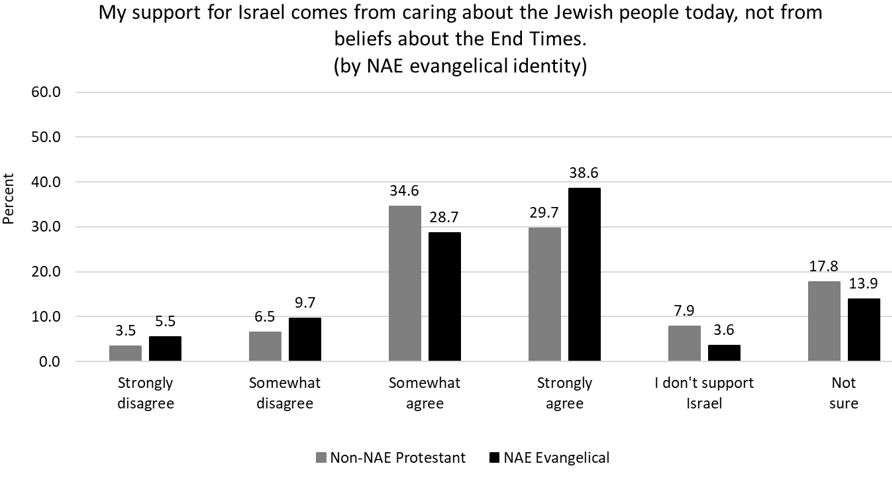
Finally, while NAE evangelicals are more likely than other Protestants to hold End Times beliefs, their support for Israel is not dependent on this belief. A majority of NAE evangelicals (67.3%) agree that their support for Israel comes from caring about Jewish people today, rather than beliefs about the End Times – exceeding the comparable share among non-NAE Protestants (64.3%). These numbers reinforce the conclusion that their support is relational and people-centered and not just prophetic.
Taken together, our findings underscore that among theologically-grounded evangelicals, support for Israel is not merely eschatological or instrumental but is deeply intertwined with inclusive moral commitments to Jewish dignity, a respect for Judaism as an independent religion, and unconditional concern for Jewish well-being in the present.
–
This op-ed was written jointly by Drs. Kirill Bumin and Motti Inbari.
Dr. Kirill Bumin is the Associate Dean of the Metropolitan College and the Director of the Summer Term at Boston University and Dr. Motti Inbari is a Jewish Studies professor at UNC Pembroke. They are the authors of Christian Zionism in the Twenty-First Century: American Evangelical Opinion on Israel.