The views expressed herein are solely mine.
While Europe Lectures, Uganda Backs Israel
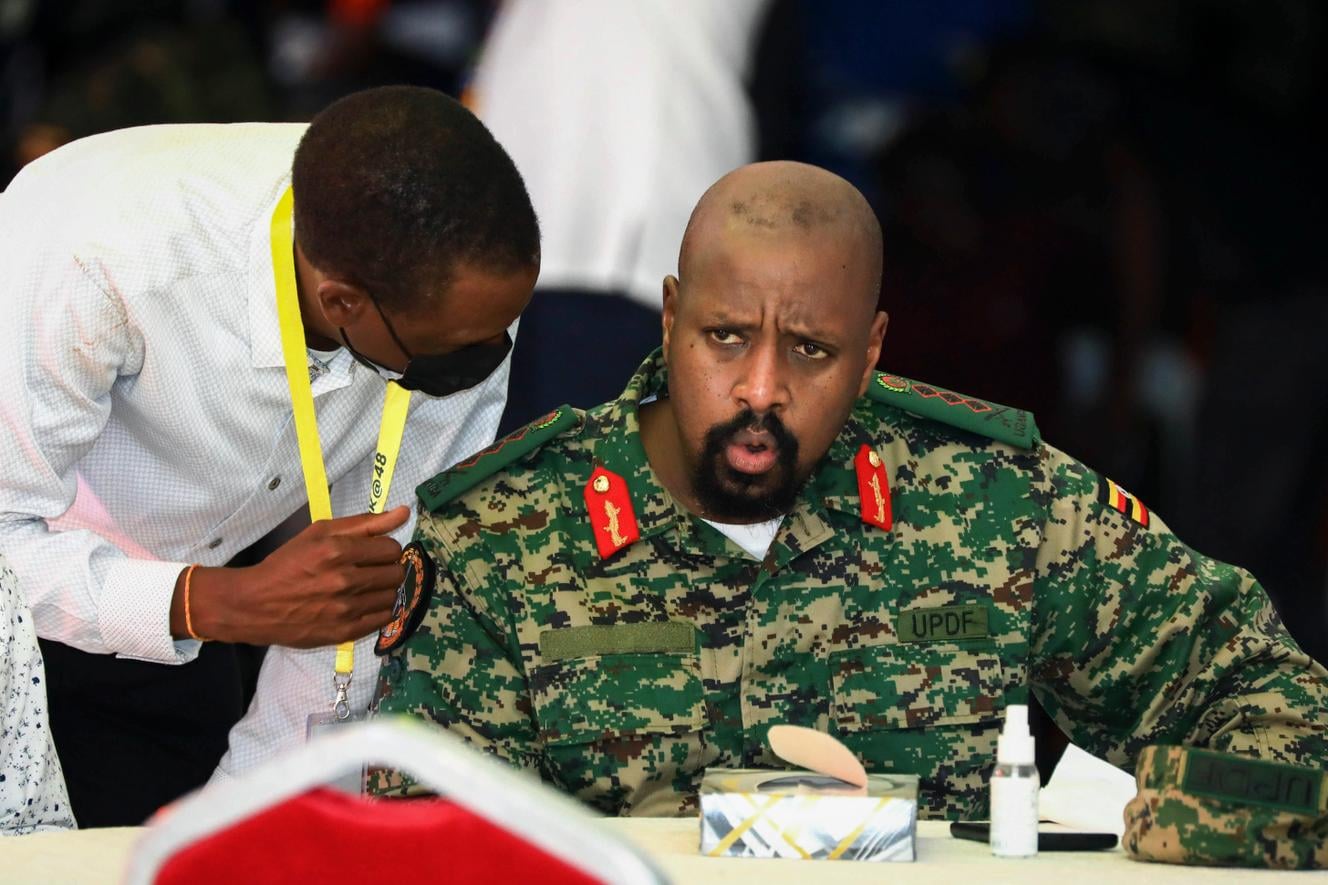
Lt. Gen. Muhoozi Kainerugaba, right, son of Uganda's President Yoweri Museveni, speaks to Attorney General Kiryowa Kiwanuka, left, at a "thanksgiving" ceremony in Entebbe, Uganda on May 7, 2022. HAJARAH NALWADDA / AP.
Lieutenant General Muhoozi Kainerugaba, commander of Uganda’s 45,000-strong army and son of President Yoweri Museveni, recently did what no European foreign minister dares: he picked a side and meant it. “We want the war in the Middle East to end now. The world is tired of it”, he tweeted. Then the punch: “But any talk of destroying or defeating Israel will bring us into the war. On the side of Israel!”
This is combat-hardened realism from a nation whose troops have actually fought and whose leaders remember who stood with them when no one else would—not empty noise from a paper tiger.
Flash back to the 1960s. Israel’s ‘Doctrine of the Periphery’ was in full swing: forge alliances with non-Arab states on the Arab world’s fringes to break the encirclement.
Uganda was prime real estate. Israeli advisors and Mossad operatives trained Idi Amin’s army, equipped his forces, and even helped consolidate his 1971 coup. Post-Six-Day War, Jerusalem sold Kampala $7 million in weapons and poured development aid into roads, farms, and infrastructure. Amin himself got personal military training from the Israelis. It was classic realpolitik: Israel defended a Christian-majority African partner; Uganda gave Jerusalem a foothold deep in the continent.
Then came betrayal. In 1976, Palestinian and German terrorists hijacked an Air France flight and parked it at Amin’s Entebbe airport, threatening to slaughter the Jewish hostages. Israel sent commandos 4,000 km across hostile skies. They killed the terrorists in minutes, blew up 11 Soviet MiGs on the tarmac, and rescued 102 of 103 hostages. The only Israeli fatality was Lieutenant Colonel Yonatan “Yoni” Netanyahu (Israeli Prime Minister Benjamin Netanyahu’s eldest brother). The raid humiliated Amin and froze relations for decades.
Now the circle is closing under geostrategic clarity. In February 2026, Muhoozi announced that Uganda would erect a statue of Yoni Netanyahu exactly where he fell at the Entebbe airport. He called it a symbol of “close blood relations” and was candid about the personal driver: Jesus Christ appeared to him in dreams for four years, ordering the memorial.
That faith resonates in an 82-percent Christian Uganda where Pentecostal pastors like Robert Kayanja of Miracle Center Cathedral have packed rallies explicitly to push leaders toward pro-Israel votes at the United Nations and the African Union. But the real engine here is reciprocity, not romance: Uganda is finally repaying the country that once trained its army, built its farms, and proved it would not abandon allies under fire.
The numbers show the payoff is already material. In 2024 alone, Uganda exported $25 million to Israel—mostly coffee and fish. Jerusalem sent back roughly $15 million in high-tech irrigation systems and agricultural know-how that have turned arid zones like Karamoja green. MASHAV, Israel’s development agency, invested $45.5 million from 2009 to 2021 in water, health, and farming projects across Uganda and several other African states.
A 2022 defense memorandum of understanding reopened the training pipelines: Israel Defense Forces doctrine, counter-insurgency gear, and upgrades against Iran-linked groups like the Ugandan Allied Democratic Forces. Jerusalem sells $200–400 million in drones, cybersecurity, and precision munitions yearly across Africa; Uganda now gets the same battle-tested playbook forged against the proxies now targeting the Jewish state.
Israel confronts raw geostrategic arithmetic in a continent of 1.4 billion people wielding 54 United Nations votes. Jerusalem maintains full diplomatic ties with 41 of 44 sub-Saharan states, staffs 12 embassies, and in 2025 opened a new mission in Zambia. Uganda’s ironclad pro-Israel posture steadily dismantles the Arab-Islamic bloc that dictates United Nations General Assembly outcomes.
In the Red Sea, where Iran funnels arms to Houthi militants and Hezbollah cells, East African partners lock down vital sea lanes and starve terrorists of sanctuaries. Most North Atlantic Treaty Organization members limp along at 2 percent of gross domestic product on defense while sermonizing to the Jewish state on proportionality, and much of Africa votes with Tehran’s allies. Yet, Kampala breaks ranks: it pledges combat troops if Israel ever falters, repaying the peripheral doctrine in blood, not rhetoric.
Entebbe proved Israel would never bargain with its destroyers. Uganda now shows it has learned that lesson and stands ready to enforce it. Africa’s lions have chosen sides. The question is whether a gutted Europe still has the spine to stand with them.
Related Topics
Related Posts