
Bridging faith. Defending truth. Confronting hate
The Theology of an Empty Throne: How Shi’ism Learned to Live with an Absent Imam
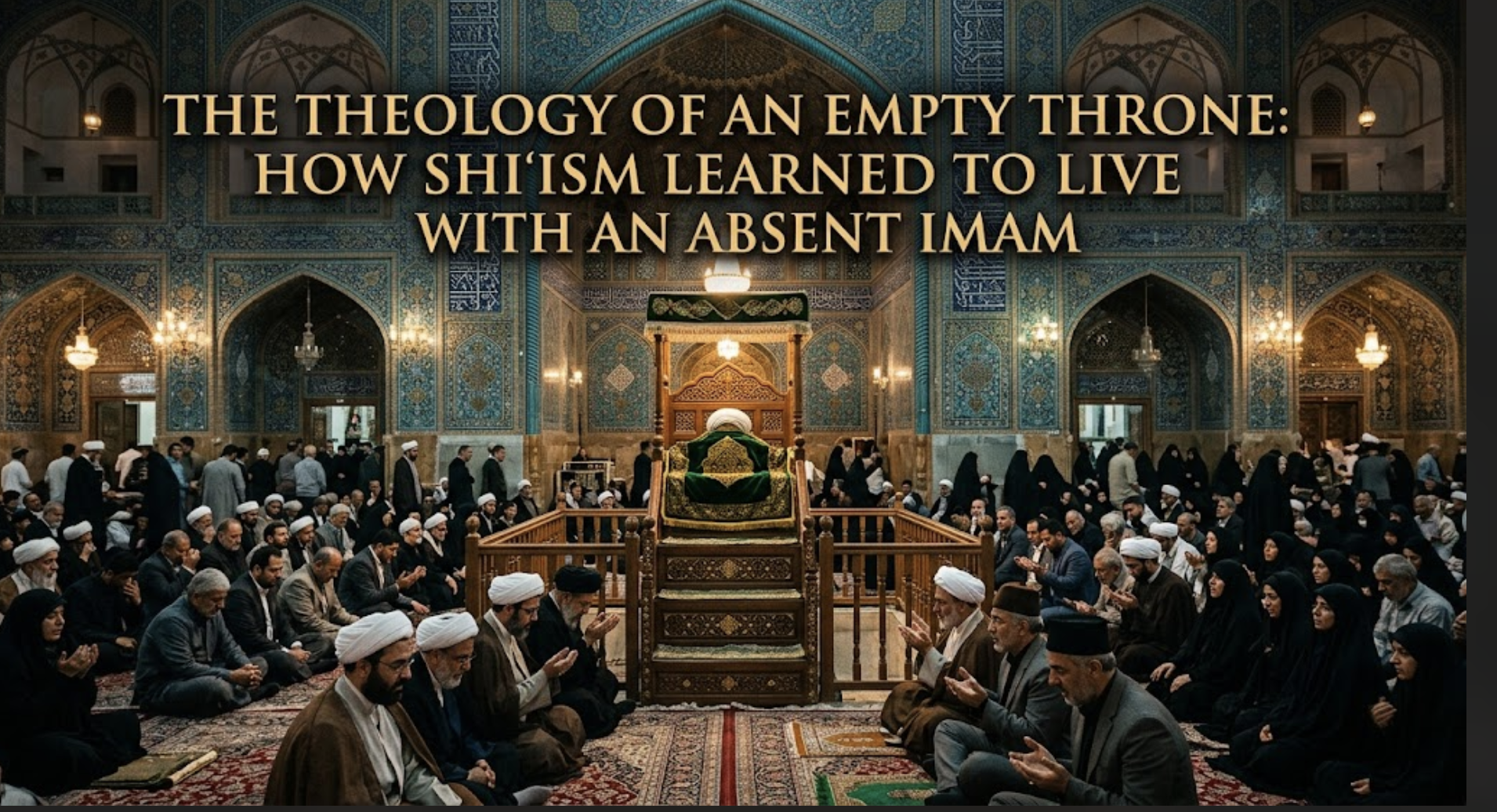
Image created from Google Gemini by Tim Orr
The doctrine of the occultation, which is the theology that heavily influences the Iranian Revolution, is central to Twelver Shiʿite theology because it provided a rationale for the continued guidance of God when his divinely-appointed Imam was no longer publicly accessible. Twelvers believe that the twelfth Imam was concealed by God and did not die but remains alive until he returns as the promised Mahdi.
This concept, however, developed first into a theological crisis of epic proportions in the year 874 CE. That year marked the point at which the Imam whose presence alone made continuous divine guidance possible could no longer be found in public. Imam Hasan al-ʿAskari, the eleventh Imam of Imami Shiʿism, passed away without publicly producing a son to succeed him. The question this raised went far beyond deciding who should lead the community next. If God had guaranteed that there would always be a divinely appointed Imam to lead the community, what did it mean when there simply was not? As Said Amir Arjomand shows, occultation was invented in the middle of precisely this crisis surrounding the Imamate and succession. It then underwent numerous theological developments that would permanently transform Twelver Shiʿism.
Developed out of that crisis was the claim that Imam Hasan al-ʿAskari had secretly fathered a son. This son, it was claimed, was living in occultation: concealed from public view but still very much alive and properly serving as Imam. What is fascinating about this claim is not merely that it managed to endure. It is how the claim eventually developed. Slowly, occultation helped transform the Imamate from a principle of legitimate succession revolving around ʿAli’s descendants. It became fully integrated into Shiʿi ideas about how humanity receives divine salvation. The once tentative solution to a crisis of leadership became a comprehensive explanation for how the law, religious authority, and community life could survive in the Imam’s physical absence.
What makes occultation historically significant is how theologians transformed a succession crisis into a durable theological system. Shiʿism did not get around the crisis by declaring the Imam physically unnecessary. Rather, it got around the crisis by building a theological framework in which the Imam could be absolutely necessary without being ordinarily accessible. Shiʿi theologians therefore had to explain how the Imam could remain necessary even when believers could no longer reach him.
The Crisis That Forced Theology to Develop
It would be a mistake to read back the final form of the occultation doctrine into the ninth century. When developed in later centuries, Twelver theology understands the occultation as follows: there was (and is) a twelfth Imam. He went into occultation, communicated with the community through agents for a time, then stopped communicating through agents, and will one day return as qaʾim or the Mahdi. But this full theology was not yet in place at the time of Hasan al-ʿAskari’s death. Rather, Arjomand reconstructs a lengthy process in which ideas that were originally intended as chiliastic responses were integrated into systematic theology and law. (Chiliastic means related to the belief in a coming thousand-year period of divine rule or earthly peace, often associated with the Messiah’s reign.)
The reason that succession could produce such a theological development was because of the Imam’s role in earlier Imami thought. Summarizing his argument at one point, Arjomand describes the Imams as charismatic figures, authoritative teachers, and figures at the center of a “religious economy” structured by divine guidance. During the centuries before the occultation doctrine developed, their role had made each of their deaths a potential crisis point because it reopened the question of who was to legitimately take their place. Hasan al-ʿAskari’s death triggered the most severe of these crises due to the lack of apparent successor.
However, during the Imams’ lives an embryonic clerical structure had started to take shape around them. Earlier Imams had begun appointing agents to represent them in different regions who would collect donations and communicate religious guidance. Over time these agents gained greater autonomy from their patrons. Arjomand refers to the resulting clerical network as a “nascent hierarchy of the learned.” Even the disappearance of the Imam did not fatally undermine this group. Over time it would come to form the most stable component of a clerical hierarchy that carried on without him.
There was, however, still an intellectual problem. If it was still necessary for the Imam to teach, to judge, to set things right, or to lead the community, what did it mean that he no longer publicly fulfilled these functions? How could the divine guidance he was supposed to provide continue if he ceased to provide it? The Imam’s absence raised a much more challenging question than simply determining whether he had indeed secretly appointed a successor. How could he be considered necessary for religious life if it was possible to continue without him?
It was this question that pushed theologians to refine their understanding of the Imam’s absence. Of course, Shiʿi theologians were not manufacturing doctrines to suit their needs. Arjomand dates the emergence of a distinct theological interpretation of occultation to around 900 CE, with its rational and legal explanations unfolding over the next century. The first thinkers to approach the problem in a distinctly theological way were Abu Sahl al-Nawbakhti and Ibn Qiba al-Razi. Both of these thinkers started disconnecting occultation from its chiliastic origins and placing it in a rational theological context.
Turning Rupture into Sacred History
One response to this crisis was to embed occultation in a larger story about sacred history. Collections of traditions were compiled about why God must always have an Imam, why there were twelve Imams, previous instances of the hiddenness of prophecy, expectations about the occultation of the qaʾim, and hopes for the continued existence of God’ proof (ḥujjat Allāh) even while that proof was occult. Armed with these traditions, believers could transform what might otherwise have seemed catastrophic. Rather than signaling an end to divine guidance, what looked like a breakdown in the system could be made to fit within a larger narrative about how God had been leading humanity all along.
One figure who was especially important for this development was Ibn Babuya. Arjomand details how Ibn Babuya created comparisons between the hiddenness of the Imam and the hiddenness or cessation of prophecy. Just as the sealing of prophecy with Muhammad had not caused prophetic guidance to disappear from religious life, so too the occultation of the Imam need not signal the end of the Imamate. By understanding these events as analogous to one another, the Imam could still “have a real place in the history of salvation” even while remaining occult.
A religious tradition faces a serious crisis when events appear to contradict what it claims about God’s activity in history. Rather than producing anxiety, the “event can now be explained.” Arjomand calls this process rationalization: constructing ‘a meaningful conceptual world’ in which previously disruptive events could be explained.
The Theodicy of the Hidden Imam
Even this solution did not resolve a deeper theological dilemma. If God was just and wanted humanity to have divinely sanctioned guidance, then how could the divinely sanctioned leader become hidden? This was all the more perplexing because the Imam was not simply one teacher among many. He instantiated a feature of the cosmos through which divine guidance was thought to extend throughout history.
Arjomand quite rightly refers to the developed theological response to this dilemma as theodicy. The problem is not so much evil itself but the disconnect between divine justice, the ongoing need for guidance, and the hiding of the individual through whom guidance had previously been ensured. Ibn Babuya had begun to speak of occultation along these lines. Rationalist theologians would expand upon this notion in more rigorous terms. Framed in this way, the occultation of the Imam ceased to be solely a question about who the Imam was and became a question about the faithfulness and justice of God.
The later theological answer made use of ideas only developed through rigorous debate with Muʿtazilite theology, namely, the notions of divine Justice and divine Grace. God could not ask human beings to do that which was impossible, and divine Grace mandated that human beings be given enough guidance to meet their moral responsibilities. What al-Shaykh al-Mufid was able to do was marry these theories to the Shii principle of an infallible Imam. This allowed theologians to argue that the Imam’s occultation did not undermine God’s continuing government through divine law.
Mufid solved another problem as well. Placing the burden of occultation on God had implied that something had gone awry with divine justice. God appointed the Imam, and if the Imam could not be accessible, then God was not meeting the needs that He had designed humanity to have. By arguing that God had done His part by appointing the Imam, Mufid shifted responsibility for the occultation’s effects onto human beings. Persecution, oppression, and disobedience might make it impossible for the Imam to appear publicly, but that failure was now purely human. Arjomand highlights Mufid’s discussion of occultation-induced legal and political chaos as the fault of humanity, which had forced the Imam to hide, rather than a fault of the divine order itself. It followed that God remained faithful despite the Imam’s absence.
Because accessibility did not equate to provision, divine guidance was not defeated when the bearer of that guidance withdrew from public view. Divine guidance still existed, even when historical circumstances prevented believers from receiving it directly from the Imam. The world was not guidedless but guided under conditions of hiddenness. What appeared as theological failure could be blamed on the corruption of history rather than the failings of God.
From the Imam’s Presence to the Law’s Presence
Occultation also changed what the Imamate meant. Ibn Babuya’ theological reconstruction increasingly moved the hidden Imam beyond the pressing historical question of whether or not a son of Hasan al-ʿAskari had indeed survived. The Imam increasingly became part of the unseen proof of God, and the cosmic guarantor through which divine guidance and salvation remained meaningful in the world. Arjomand describes this development as “alter[ing] the Imamate from a theory primarily concerned with authority into a theological principle inscribed within Shiʿi economy of salvation.”
The later rationalist theologians further pushed this argument in another way. Legal theorists like Mufid, al- Sharif al-Murtada, and al- Shaykh al- Tusi connected the ongoing necessity of the Imam to the ongoing validity of the Sacred Law itself. The Imam was necessary as the infallible guardian of that normative order, but the normative order itself no longer required his personal administration to remain valid. Law, interpretation, and moral obligation could continue under occultation.
While the Imam himself had not been rendered unnecessary, his physical presence had been rendered unnecessary for day-to-day assurance of the validity of the religious order. Arjomand refers to the resultant theology as a “nomocratic theology,” one which allows “religious law and belief” to maintain their effect despite “physical” obstruction by the Imam’s absence. In occultation, the Imam was therefore able to continue to serve as the ultimate theological guarantor of a religious system that had learned to operate without him.
This helps explain why occultation could endure for centuries. A religion cannot maintain a community for centuries if every legal pronouncement and moral obligation is perpetually placed on hold in anticipation of its leader’s imminent return. By making divine law continuously operative even in the absence of the Imam, and by retaining the hidden Imam as the continuing proof and guarantor of divine law, Twelver theology allowed its followers to carry on with their religious lives without divorcing themselves from the Imam.
From Emergency to Epoch
Occultation reordered how the community thought about time as well. Twelver tradition eventually came to differentiate between a time, when it was still possible to communicate with the occulted Imam via legitimate deputies, and the time after communication had irreversibly ceased upon the death of his final agent in 941 CE. Arjomand references both sets of traditions, those dealing with two distinct occultations and those that locate the end of communication with the Imam in the death of the final representative. What had begun as an unresolved interruption gradually became a defined period of sacred history.
This change allowed uncertainty to become chronology. The faithful were now able to conceive of themselves as living during a specific time between the manifest Imamate and the qaʾim’s eventual return. Time passing no longer necessarily counted as evidence against the doctrine. An extended absence had become something built into the system. What started as a state of emergency could be understood as an age.
Adding to this, Abbas Amanat observes that the Mahdi’s return could not be realistically expected to occur at any particular time. This encouraged a comparatively quietist trend within orthodox Twelver thought following the Greater Occultation. Religious scholars and jurists could therefore build institutions meant to endure without claiming that those institutions represented the final stage of history. Quietism was never total, and millenarian expectations would emerge from the population at regular intervals, but the indefinite nature of the situation allowed for law and religious scholarship to constitute the normal means by which religious life was conducted.
Occultation did much more than answer the question of where the twelfth Imam had gone. When he disappeared from history, Shiʿi thinkers were forced to articulate just how divine guidance would continue to operate on earth. Their solution made the rupture of sacred history, divine absence into a theodicy, and the physical departure of the Imam into a theological framework that could support religious life for generations. We might say that Twelver Shiʿism didn’t just learn how to wait for the Imam. It learned how to live with him.
Bibliography
Amanat, Abbas. Apocalyptic Islam and Iranian Shiʿism. London: I.B. Tauris, 2009.
———. “Islam in Iran v. Messianic Islam in Iran.” Encyclopaedia Iranica 14, no. 2 (2007): 130–134. Updated April 5, 2012.
Arjomand, Saïd Amir. “The Consolation of Theology: Absence of the Imam and Transition from Chiliasm to Law in Shiʿism.” The Journal of Religion 76, no. 4 (October 1996): 548–571.
Related Topics
Related Posts