More in love with my land and my people every day
The third Beit Hamikdash – a house we sit in together
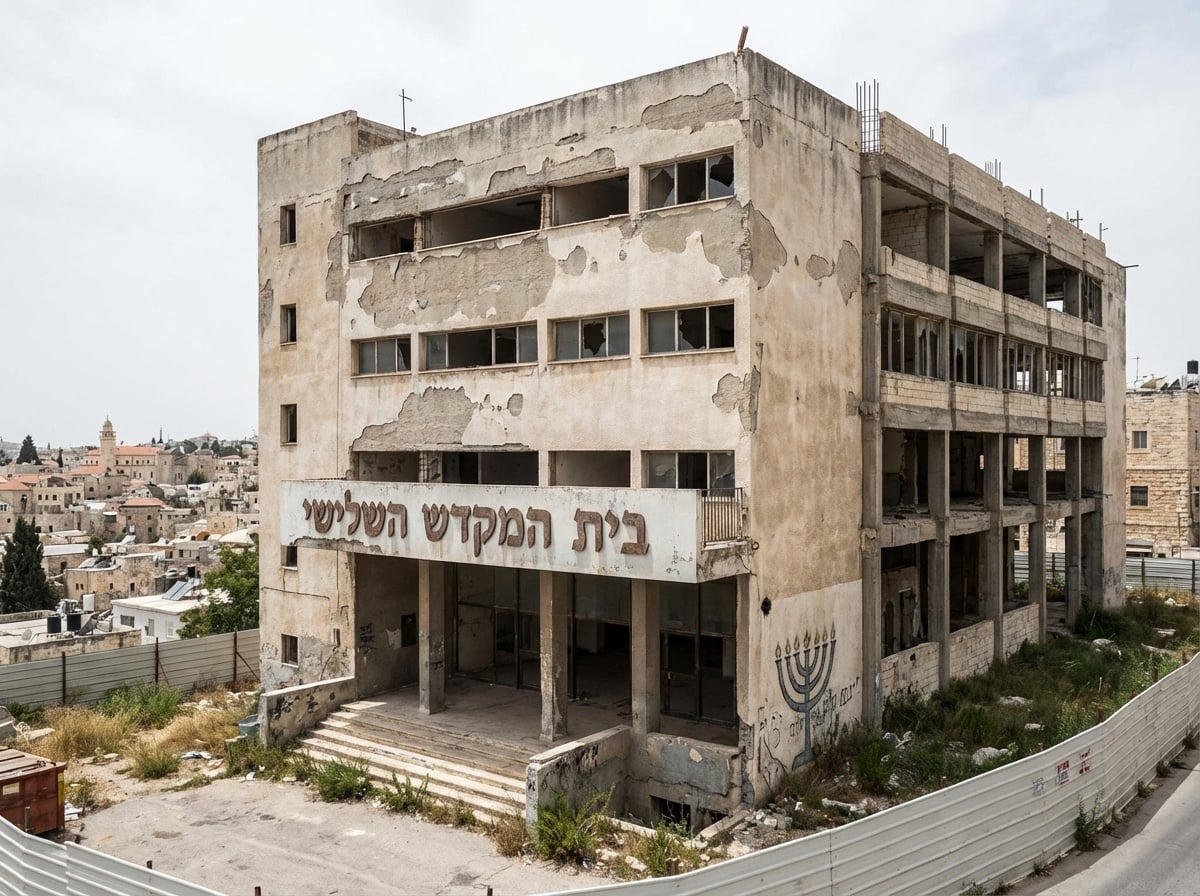
The third Beit Hamikdash (Temple) as a dilapidated Israeli government building (AI-generated, courtesy)
What if the geula (redemption) looks different from how we anticipated?
What if the Beit Hamikdash Hashlishi (Third Temple), at least in its first iteration, is not an elaborate building made of stone and gold, filled with precious metals?
What if it is simply a building — a shul, a beit midrash, or even a dilapidated Israeli government building — where Jews from different backgrounds choose to sit together and build a shared life? Where, despite our differences, our different tribal roots and our different hashkafot, we prioritise dignity, respect and shared values over what divides us.
I don’t pretend to know what this would look like. And I know that many factions within our nation see this as a pipe dream — a practical impossibility — given that our values and priorities can at times seem mutually exclusive.
But Bnei Yisrael was never meant to be monolithic. It was a federation of tribes. And we don’t know what they looked like. We don’t know who (if anyone) wore black hats or knitted kippot, who went bareheaded, what their kitchens looked like, or what colours they did or didn’t wear.
It’s easy enough to look back and imagine ourselves — and people who look like us.
The lens of history often seems monochromatic, while real life is anything but.
We might not know what they ate for dinner each night, but we do know what they told their children, because we continue to pass those messages and values on to our own. We do know that there are practices and values shared by all of Yaakov’s descendants who left Egypt.
Who is a Jew? How far does one have to stray from the fold, in any direction, before we consider them a stranger? I don’t know. I also don’t think it’s our question to ask. Only G-d truly knows what is in a person’s mind and heart, and how far is too far.
Our task is to make space for one another, and to choose to see the best in each other even when we disagree. Not to avoid disagreement, but to avoid violence; to seek peace wherever possible, and where it seems impossible — because we feel uncrossable boundaries have been crossed — to at least keep the door open and a light on.
I observe Jewish law. But I also see immense beauty and possibility in the State of Israel as a shared enterprise, even when it does not function according to strict Orthodox Jewish law. Because for the first time in 2,000 years, it is in this State, on this land — where we share a history and a destiny — that we are compelled (or can choose) to build a home together in which we can all coexist.
So I wonder whether, on some ordinary day, in an ordinary place in this extraordinary country, a group of Jews who look different but all raise their eyes to heaven will come together and begin to build the real Beit Hamikdash Hashlishi — a house we sit in together.
Related Topics
Related Posts