
The Third Pendulum: Extremists, Moderates, and Israel’s Path Forward
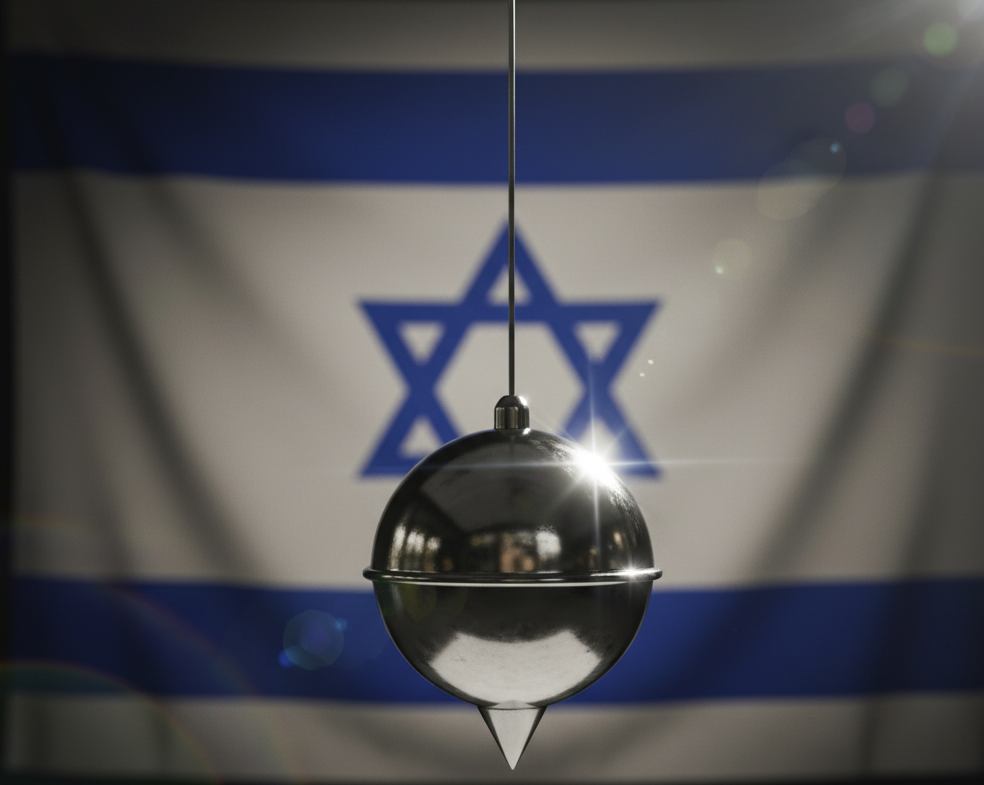
A common theory among historians argues that history moves in a perpetual pendulum swing – from chaos to stability, and back again. To illustrate, the two World Wars in the first half of the 20th century left behind a global trauma that gave rise to isolationism and stagnation in the decades that followed. In a sense, the hot wars paved the way for the Cold War. The wars of our time are likely to be fought between those who never experienced the devastation of the world wars, and those who have forgotten it.
A second pendulum movement, which may even directly influence the global pendulum, exists within domestic politics. Nations themselves swing from states of internal tension and conflict to periods of moderation and unity, and back again. In my view, these swings often move in the opposite direction of the global trends. When the world is in conflict, a country’s citizens often see the importance of uniting to support national victory and ensure the state’s survival.
But what happens when international conflicts turn inward, and the struggle for a nation’s survival is no longer against an external force but internal?
Today, I believe we are witnessing the emergence of a third pendulum swing. While in the past we primarily spoke of a direct confrontation between left and right, another process is now taking place: internal forces- sometimes generational processes- are encountering a powerful countermovement attempting to pull the pendulum back. This is the “backlash” movement- a broad trend present in nearly every Western country, seeking to restore order, identity, and values that have eroded over recent decades.
A striking example of this occurred last Saturday in central London. Hundreds of thousands took to the streets in massive protest against Britain’s lax immigration policy, under the slogan “Unite the Kingdom.” In contrast to the familiar images of anti-Israel or anti-Western demonstrations, which are often marked by looting, destruction, and the waving of Palestinian flags (including those of Hamas and Hezbollah), here we witnessed the opposite: a sea of British flags proudly flown, alongside numerous Israeli flags-and even IDF flags. It was a display of national identity, Western solidarity, and a desire to restore a sense of belonging.
In the United States, this countermovement is also gaining strength. Against immense pressure from radical factions, the “backlash” movement seeks to return public discourse to traditional American values- liberty, personal responsibility, clear borders, and governance. This is visible in massive protests over immigration and border issues, campus free speech debates, and local and federal elections where conservative candidates are succeeding over progressive opponents. The horrific assassination of Charlie Kirk certainly struck a blow to American civic discourse, yet I believe we can expect increased activism from conservative organizations and a rise in alternative conservative voices in traditional media. As Yair Stern, the Lehi leader, wrote, “In our place will come thousands of others,” and just as happened after his assassination, Kirk’s tragic death is likely to spur further conservative mobilization.
In Israel, the situation is different. Unlike in other Western countries, where left or right may push society toward violent confrontation, the main struggle here is between extremists and moderates. In an ‘opinion-exchange’ program I participated in several years ago, my discussion partner described his belief that the extreme left and the populist right have far more in common with each other than with the moderate wings of their own ideological camps. Both are agents of chaos, both employ toxic rhetoric based on identity politics and “us versus them,” both challenge the rule of law, and both are unwilling to compromise.
Conversely, the moderate camps also share much in common. Core values of Israeli identity: Zionism, community, productivity, and national security- can serve as a unifying umbrella even for those who differ on approach. In the Israeli neighborhood, an atheist, a high-tech professional, a kibbutznik, and a religious settler can serve in the same tank because they see themselves as participants in the same Zionist project envisioned by Herzl. And despite the anti-social media that highlights only hatred and division, for most of the population, connection outweighs their differences.
There is still hope.
Unlike American politics, which is based on the question of “what is right?”- conservatism or liberalism? capitalism or socialism? left or right? religion or atheism? in Israel, the question is “how?” How should we ‘manage’ the Jewish-democratic partnership? How should we maintain an ideal democratic system? How should we protect and provide national security? How should we maintain an effective system of checks and balances? Agents of chaos on the extremes might argue for a clash between progressive left and fascist right, but fortunately, Israeli politics is too narrow and pressured to allow such a confrontation. The burning issues in Western politics- immigration, gun rights, LGBTQ+ issues, abortion debates- hardly exist in Israel, at least not in a way that dominates public discourse as they do in the US.
As I see it, the Israeli divide is far less fundamental than the American one. Most Israelis agree on the “what.” Most agree on the historical and moral necessity of a Jewish state, the importance of a democratic system, and the revered status of the army. We disagree on the “how”.
When there is agreement on the “what,” disagreement on the “how” is allowed. It is not simple, it is not supposed to be easy, and it requires a culture of discussion and a safe space for dialogue. Today, many civil society organizations dedicate themselves entirely to this civic discourse and to resolving disagreements over the “how.” As often asserted by members of the “Fourth Quarter” movement (who recently launched the “Million Campaign” to generate waves of action across the social platforms), this is an existential issue that also demands engagement with the “why” and the natural challenge of the third and fourth generations to the state.
And it is possible.
Our challenge is not to stop the historical pendulum, but to ensure it is not hijacked by extremists on either side. The responsibility lies with all of us: to choose moderation over extremism and partnership over division. Only in this way can internal disputes become a unifying force, guiding Israel’s pendulum back to balance and stability.