
The Third Temple
This is a suggested address by President Herzog to the nation on the 80th anniversary of the bombing of the King David Hotel
A brief note: I live in Canada and certainly don’t presume to speak for Israel’s president, but the below is a speech I thought appropriate for this week’s important anniversary.
The eve of Tisha b’Av, 8 Av 5786 · 22 July 2026
My brothers and sisters. Citizens of Israel.
Eighty years ago tonight, in this city, a wing of the King David Hotel came down in fire and dust. Ninety one people were killed. They were British and Arab and Jewish. The explosives had been carried in milk churns and set beneath the offices of the Mandate. And when the smoke cleared, something more than a building had fallen.
I do not stand here to relitigate that day. Others have argued for eighty years about the warnings that were or were not given, about who bore the guilt and who bore the grief. I leave that to the historians. I want to speak about the wound underneath it, because the King David was never really a story about the British. It was a story about us. In those years we were a people learning, painfully, whether we could act as one. There had been the season we do not like to name, when Jews handed other Jews to the authorities, brother informing on brother. There would come, two years later, the guns of the Altalena, fired by Jews at Jews within sight of these shores. On the night of the King David, a resistance that had briefly stood together came apart, each faction certain it alone held the future in its hands.
We are marking this on the eve of Tisha b’Av. That was not my choosing. It was the calendar’s. And I have come to believe the calendar is trying to tell us something tonight, if we are willing to sit still long enough to hear it.
Baseless Hatred
Tomorrow we sit on the floor and read Lamentations. We mourn two houses of stone. And our sages, when they asked why the second of those houses fell, gave an answer we should read very slowly this year.
They said the second house did not fall for idolatry. The people of that generation studied Torah day and night. They kept the commandments. They gave charity to the poor. By every visible measure they were devout. And still the house fell. The reason our sages gave was one thing only. Sinat chinam. Baseless hatred, one Jew for another. And they said something that should stop the breath in our chests: that on the scale of heaven, baseless hatred weighs as much as idolatry and bloodshed and every forbidden thing, all of them together.
Hold that in your hand for a moment. A generation that kept every law, and hated the brother standing beside it, lost everything. Their piety did not save them. Their learning did not save them. Nothing saves a house that has gone to war with itself.
For two thousand years since then we have prayed for a third house. And I want to say something tonight that some of you will hear as close to heresy, and I ask you to stay with me to the end.
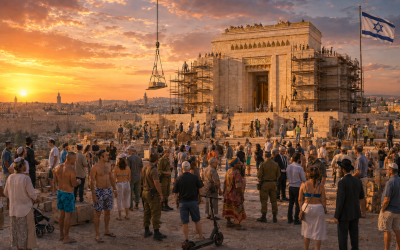
I do not believe the third house is waiting to be built. I believe we are standing inside it.
I do not speak of stones on the mountain. I do not speak of what some would raise on the Temple Mount, and God keep us from lighting that fire. I speak of the house we already live in. The sovereign home of the Jewish people, restored after two thousand years of exile, gathered out of the ash of Europe and the courtyards of Baghdad and the villages of the Atlas mountains and those new Olim from the Western world. The prayer we say in every synagogue on every Shabbat calls this state reishit tzmichat geulateinu, the first flowering of our redemption. Words, as it happens, that my own grandfather’s hand helped to set down, in the year the state was born.
The third house is not made of cedar and gold. It is made of us. Nine million of us. It is made of the Jew in Kiryat Shmona and the Jew in Beersheba, of the citizen who prays three times a day and the citizen who has never prayed at all, of the soldier and the scholar and the farmer and the nurse. That is the sanctuary. And here is the thing I need you to understand tonight, the reason the calendar has brought us to this eve: a house made of living people is destroyed in exactly the same way a house of stone was destroyed. Not by Rome. Not by Babylon. Not by any army that has ever massed at our borders. It is destroyed from the inside, by baseless hatred, with a book of law lying open on the table.
Still Fighting
We are approaching three years since the morning of the seventh of October. You carry it. You carry the names and the faces from the posters that hung on every wall until the wind took them down.
And now, thank God, the hostages are home. The last of them are home. That is a mercy we begged for through a thousand nights, and we should never once speak of it lightly.
But I will not stand in this hall and tell you the war is over, because it is not over, and every one of you knows it is not. Even now, even as I speak these words in the warmth and safety of this room, there are young men and women of ours standing watch in the hills of southern Lebanon. There are soldiers on the Syrian line tonight, in the cold and the dark, straining to hear what moves on the other side of the wire. There are our sons in the ruins of Gaza at this hour, and somewhere in this country a family is sitting by a phone that has not rung, and does not yet know that the knock is coming. The war did not end when the cameras went home. It never does. So before I say anything else tonight, let me say this. To every soldier out there in the black, and to every mother and father and wife and husband and child waiting for a door to open: this house has not forgotten you. This house does not go on without you. You are the reason there is a house at all.
And it is because of you, because you are still out there, that I have to speak carefully about the temptation I feel in this country tonight.
There is a phrase I have heard in the markets and from my own family, said with love and with exhaustion. The show must go on. And I honor it. It is the oldest Jewish instinct there is, this stubborn insistence on life. We bury more than any people should, and still we plant, still we marry, still we send the children to school in the morning.
But a temple is not maintained by forgetting. A house is not made holy by looking away from the cracks in its walls. And we cannot close our reckoning while the war itself is still open, while our children are still standing in the dark on our behalf. We are the majority in our own land, and that is a gift no generation of Jews before us was able to hold. It means we get to decide when the show goes on. It means we set the tone. But the temptation of a people desperate to believe the bleeding has stopped is to move on before it has reckoned. To mistake a lull for the healing. To let the show go on so loudly that we can no longer hear the questions the seventh of October asked of the third house, and that we have not yet answered.
Who did we become in the hours when the state did not come? Who held the line, and who was held? Those are not questions for a commission alone. They are questions for the sanctuary. And a sanctuary cannot be sent back to work.
On Our Streets
Now let me speak plainly about the hatred that is loose in the streets of this house, because I am too old and this hour is too serious for anything else.
When we crossed the Jordan into this land, the tribes who wished to remain behind with their flocks were given one condition. They were required to arm themselves and cross over at the head of their brothers, and only when the land was secure could they return home. Chalutzim ta’avru. You shall cross over as pioneers, before your brothers. A share in the land was a share in its defense. There is no verse that says otherwise. There is no sage who taught otherwise.
For three years, our sons have gone to the border again and again and again, and as I speak to you they are still there, in Lebanon and on the Syrian line and in Gaza, standing in the dark on this very night. They have left their studies unfinished and their children growing up in photographs from the field. Some did not come home. Some will not come home from where they are tonight. And in those same three years, and at this very hour, while other men’s children keep the watch, we have watched factions who wrap themselves in the mantle of Torah block the highways, burn the tires, and raise their hands against soldiers and against police, declaring that the covenant of shared fate does not apply to them.
Let me be careful, because careful is what this moment demands. I do not speak against the ultra-Orthodox community. I do not speak against a single hour of Torah study, which I hold sacred, which is part of the breath of this people. Among the haredim are hundreds of thousands of good and gentle citizens, many of them as troubled by the violence as you are. I speak against the disorder. I speak against the men who set this country alight and call it faith.
And I speak to them through the calendar. The generation of the second house also studied Torah. Their study did not save the sanctuary, because they had learned to despise the brother beside them. So hear me clearly. To break the highways of this country in the name of heaven, to teach that the blood of one mother’s son is owed to the nation and the blood of another’s is not, is not to defend the third house. It is to burn it. Exactly as the second was burned. From the inside. With a book of law open in your hands. That is the sin our sages warned us weighs against all the others together, and a state that permits it in the name of mercy is not being merciful. It is handing torches to the very fire we will mourn tomorrow night.
Time for Fresh Faces
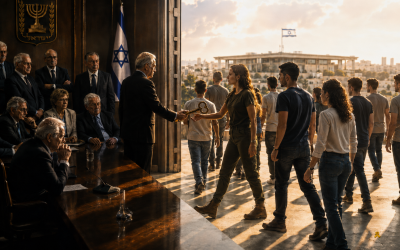
And so I come to the hardest thing I have to say, and it concerns those who lead this country, myself among them.
Look at us. Look at the faces on our stages and in our cabinet, and yes, in this office. We are old. We were raised on the wars of the last century, and we have tended this house as if we alone knew how. But it was not our generation that ran toward the gunfire on the seventh of October. It was the young. It was the boys and girls of the party in the desert who carried the wounded across open ground. It was the reservists who rose before any order came. A generation we had dismissed as soft, as lost to their screens, and when the hour came they were made of iron.
They earned this house that morning, and again in every month that followed. And we have thanked them with medals and speeches and everything except the one thing they have actually earned, which is a share of the power to decide what this house will be. So I say to the young men and women of Israel, and I mean more than sentiment: your country needs you not only in the reserves. It needs you in the Knesset, in the parties, in the unglamorous rooms where the real decisions are made and where, for too long, the same grey faces have refused to leave. Power is not given. It is taken up. Take it up. And to those of my own generation who have held their seats for thirty years, who have come to believe the state cannot survive their departure, I say only that the greatest of the founders knew when to hand the scroll to the next hand. Ben-Gurion went to the desert. A man can serve this country by leaving the stage.
Decide
In the months ahead you will be asked to decide. There will be an election, and there may be more than an election. There may be a referendum on the very frame of this house, on the compact that binds the citizen to the state and the state to the citizen. I will not tell you how to vote. It is not the place of this office.
But I will tell you what is on the ballot beneath the parties and the slogans. What is on the ballot is whether the third house stands or falls. Whether we remain a collection of tribes sharing a strip of land and a grievance, or become at last a people sharing a fate. That question has been open since the night of the King David Hotel. We have never quite answered it. In the season ahead we have the chance to answer it, and we should not waste that chance on the small quarrels that fill our screens.
Our Ideal
Let me close with the thing I most need you to carry out of this hall.
For a hundred years we told ourselves a story about Israel as an ideal. The light unto the nations. The startup nation. The land of milk and honey and fibre optics. And it is all true, and I am proud of every word of it. But an ideal does not bleed, and this house bleeds. An ideal does not stand in traffic on the way to a shiva. An ideal does not fight with its own children over who will carry the weight. The third house is not a gleaming thing on a hill. It is this one. The tired one. The one that argues in the checkout line and weeps at the airport and cannot agree on anything and would die for every one of its members without pausing to ask their politics. That is the sanctuary. That is the one whose soul we are trying to find. And you do not consecrate a house by loving the blueprint. You consecrate it by loving the walls you actually have.
Rav Kook, the first chief rabbi of this land, in whose seat my grandfather would later sit, left us one teaching for a night such as this. If the house was destroyed by baseless hatred, he said, then it will be rebuilt by baseless love. Ahavat chinam. Love that asks for no reason and demands no reward. Love for the brother who votes against you and prays differently than you and infuriates you in every possible way, offered not because he has earned it but because he is yours and you are his and the roof over both your heads is the same roof.
The third house is not finished. It may be that a house made of living people is never finished, that this is the most Jewish thing about it. It has no roof yet. It stands open to the sky. And it is not built of stone. It is built of ahavat chinam, slowly, by us, or it is not built at all.
Eighty years ago we let the future be written by the few, and we paid for it in fire. Tomorrow we mourn two houses that fell because we could not hold them together. The night after, we rise, as we always rise, and we light the lamps.
The third house is still open to the sky, my brothers and sisters. Let us go and build the roof together.
Kol HaKavod La’Tsahal, Am Israel Chai.