
The Time Freed by AI: What Will We Do With It?
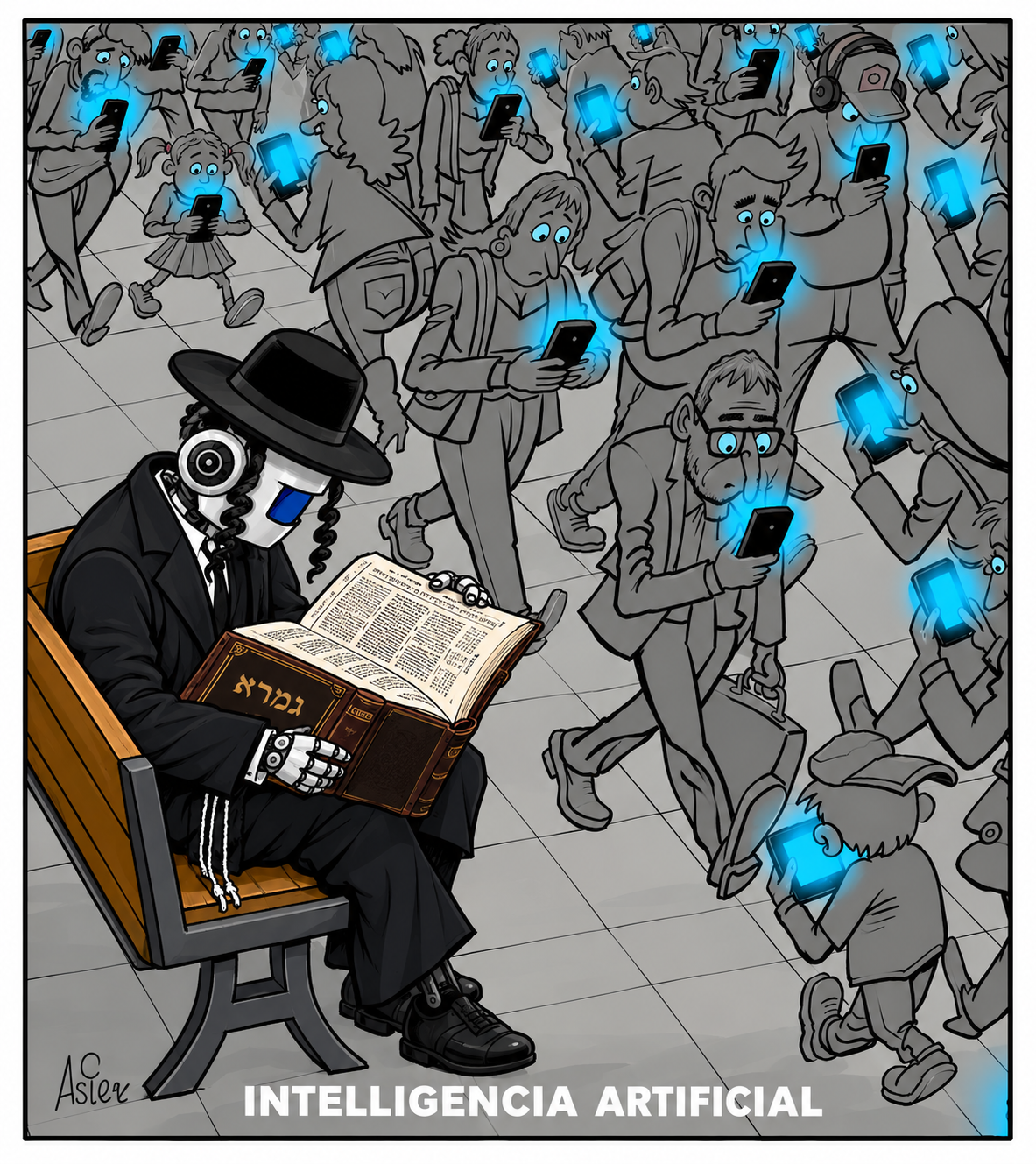
Work, Digital Distractions and Torah Study: A New Question for Israeli Society
We often measure the revolution brought about by artificial intelligence by the number of jobs it could eliminate.
Perhaps we should also measure it by the amount of time it could free up.
If AI can one day accomplish in thirty hours what currently takes forty, a question arises: what will we do with those hours we have gained?
More production? More consumption? Or more time for the things that give meaning to our lives?
This question takes on particular significance in Israel in the context of the debate over the integration of Haredi men into the workforce.
The Statistical Report on Ultra-Orthodox Society in Israel 2025, published by the Israel Democracy Institute, shows that 53% of working-age Haredi men were employed in 2025, compared with 86% of non-Haredi Jewish men. The report also notes that employed Haredi men work an average of 36.5 hours per week, compared with approximately 45 hours for non-Haredi Jewish men.
The combination of Torah study and employment is therefore not merely a theoretical construct: it already exists, in various forms, within Haredi society.
Why could AI not, in the future, expand this possibility?
Imagine a model in which a Haredi man spends twenty hours a week working and the rest of his time studying Torah.
This would obviously be neither a model for all Haredim nor the end of full-time Torah study. It would simply offer an additional possibility for those who wish to combine parnassah — earning a livelihood — with Torah — study.
Artificial intelligence could gradually make such a model more accessible by increasing the productivity of work.
The Haredi model sheds light on the risk of “free time”
For the technologies that free us from work can also become a source of alienation.
Algorithms, social media, short-form videos, games, streaming platforms and personalized content: digital systems have ever more sophisticated ways of occupying the time we hand over to them.
We therefore risk finding ourselves in a strange situation: working less without actually becoming freer.
The time we gain could simply be filled with more addictive distractions.
This is where study takes on a particular significance.
Study — and especially Torah study — is not simply another distraction designed to fill our free time. On the contrary, it requires us to deliberately step outside the logic of distraction and immediacy.
All serious study requires time, attention, memory, reflection and perseverance.
In a civilization where attention has become a coveted economic resource, the ability to deliberately devote time to an activity that is not designed to entertain us could itself become a form of freedom.
AI therefore raises a question far deeper than the possible elimination of jobs.
What do we want to do with the time it gives back to us, other than turn it into yet another source of distraction?
For some, it will mean more time with family; for others, creativity, culture or civic engagement.
And for some Haredim, this newly freed time could open a new path: greater participation in the workforce without giving up Torah study.