
The Torah Was Written for Someone
Understanding the Purpose of the Torah as a Book with a Targeted Audience
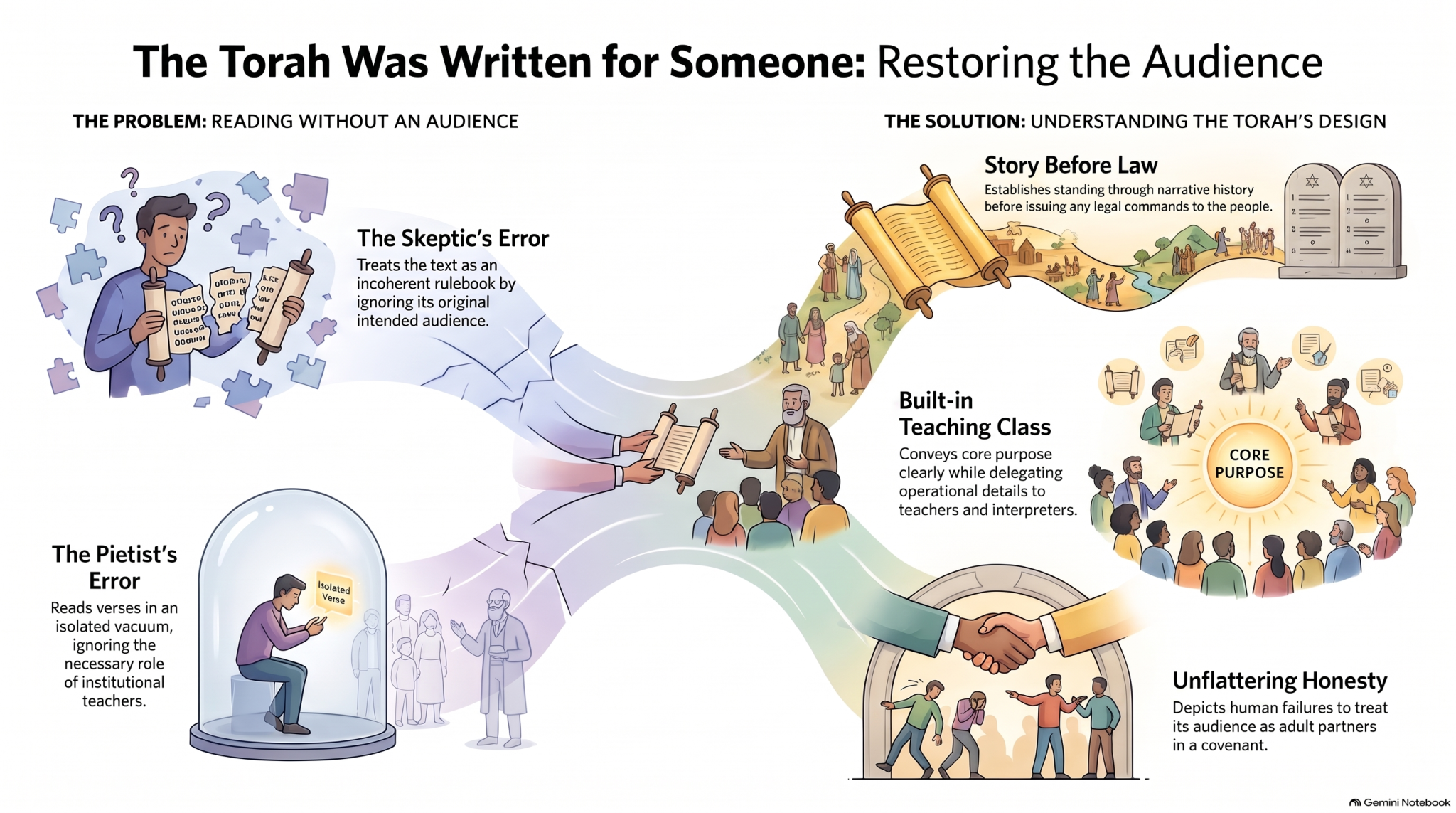
The Torah is not a free-floating sacred text addressed to everyone and no one. It is a book with a purpose, an intended audience, and a built-in method of transmission. Its purpose is to turn a people into a covenant community. Its audience is that whole people, from leaders to children to the resident stranger, and each generation after them. Its method is to convey the core of that purpose with great clarity while leaving the operational detail to a teaching class that the text itself creates. Readers who miss this tend to make one of two mistakes. They treat the Torah as a failed universal rulebook, or they treat it as a mystical object whose meaning is independent of any reader. Both mistakes come from asking what the Torah says without first asking what it is for and whom it is for.
The best picture of the book working as designed is not at Sinai. It is in Jerusalem, centuries later, in the square before the Water Gate. Ezra the scribe stands on a wooden platform and reads the Torah aloud from first light until midday to a crowd of men, women and everyone old enough to understand. The text says the Levites moved among the people and “gave the sense,” so that the people grasped what was being read. And the people wept. A reading, an audience, and translators in between: that is the Torah functioning as a Torah. It is not a tablet in a vault. It is a text in a public square, being explained to people who are expected to follow it.
Now compare the two ways most of us actually meet the book. The skeptic opens to Leviticus cold, finds sacrificial procedure and purity rules with no explanation, and concludes the book is incoherent or barbaric. The devout reader treats every verse as self-interpreting and self-sufficient, quoting it as though it were addressed to him alone, in a vacuum. If you have sat through a Shabbat table argument that ran on one of these two assumptions, you know how it goes. The skeptic and the pietist disagree about everything except the thing that matters: both have quietly removed the audience. One reads a document written for a people he is not part of, and the other reads a document with no people in it at all.
Put the audience back, and the book’s peculiar features start to make sense. Take its order. The Torah spends a book and a half on story before it issues a single law at scale. It does not open with “Thou shalt.” It opens with creation, a family, slavery and rescue, and only then says, “I am the Lord your God who brought you out of Egypt.” A lawgiver who must first establish standing with the people he addresses is writing for an audience that has the right to ask, “Why should we obey you?” The story is the answer, delivered before the question is asked.
Take also what the book is willing to say about its own heroes. It tells its audience about the golden calf, which the people build within weeks of the revelation. It reports that ten of twelve scouts talked the nation out of entering the land. It tells them that Moses, the founder, is not permitted to enter. A propaganda text for a people it wanted to flatter would not do this. A text that is shaping adults who must carry a covenant forward does exactly this, because it needs them to know how it fails, and that the failure belongs to them as much as to anyone. Its audience is being treated as a partner in a project, not a congregation of the already convinced.
And take the book’s ending. The Torah stops at the border. The land is in sight and not yet entered, and the last thing the reader holds is a charter and a task. Anyone who writes for a future audience, not a past one, ends that way.
None of this means the book is easy. Here is where the honest assessment has to cut against the apologist. The Torah is clear about its purpose and thin about its procedures. It forbids “work” on Shabbat and never defines the term. It commands, it gestures at principles, and it often leaves the application to someone else. Critical scholars read the duplications and tensions across its sections as the fingerprints of different sources stitched together. Traditional readers read the same features as proof that the written text was never meant to stand alone. These positions are very far apart, but they agree on the practical point: the book assumes a teacher. A strong constitution does not try to specify every future case. It states purposes, sets structures, and creates the institutions that will interpret it. The Torah’s institution is the teacher: the priest, the judge, the elder, and eventually the rabbi.
An obvious objection says that if the Torah is divine, its audience is irrelevant, and talk of a “targeted audience” shrinks a universal word into a tribal one. But the text itself resists this. It speaks to a particular people at a particular border and ties its commands to that people’s history. Where it imagines the nations, it imagines them watching Israel’s way of life and judging it wise, so its universality runs through its particularity rather than around it. A divine author can choose to address a specific audience. That is just what the book claims He did.
That leaves the question that matters for those of us reading this in the pages of a Jewish newspaper in 2026. If the Torah was written for a people and a teaching class, are we its audience, or are we observers of someone else’s mail? The reader who treats it as a museum piece has resigned from the audience. So has the reader who treats it as a closed rulebook and calls the teacher an inconvenience. The Torah’s own test of success is not whether it is believed or admired. Its test is whether it is taught, again, to another generation standing at another border. A book written for someone works only while that someone is still listening.