"These fragments I have shored against my ruins"
Featured Post
Taking the train to Auschwitz
On my way to a seminar about memory, I couldn’t help thinking of those who had traveled without choice, without luggage, without names
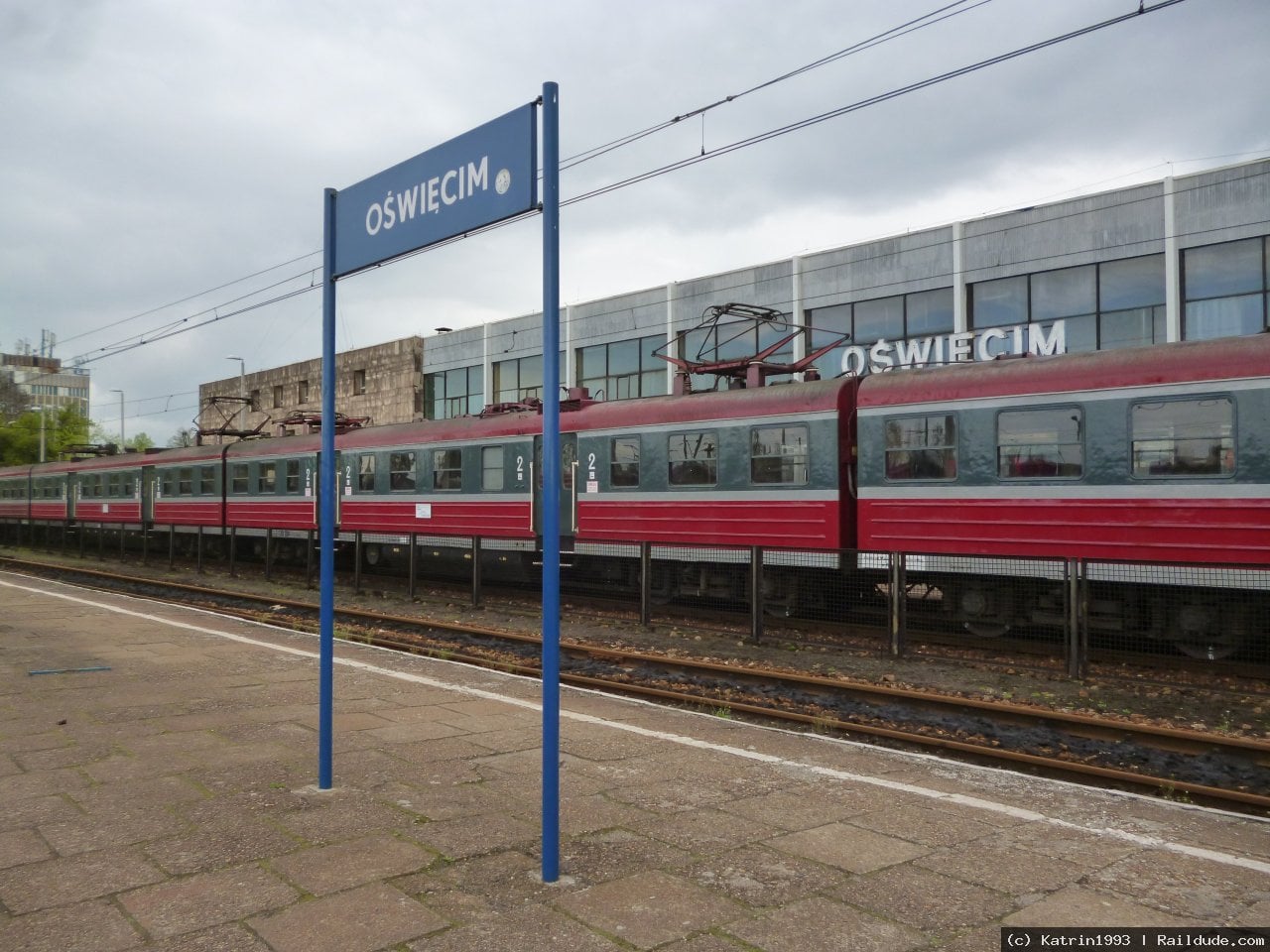
The train station at Auschwitz (Katrin via raildude.com)
“The train is leaving for Auschwitz.”
I can’t recall when I first heard it. Growing up in Budapest behind the Iron Curtain, it was a long time before I could fully comprehend it.
Years passed, and I heard it again. And again. As the system began to unravel in Hungary, it appeared on walls as graffiti, and eventually as a song, set to the tune of Guantanamera, chanted at football matches and the occasional protest.
“The train is leaving. To Auschwitz, the train is leaving.”
It was one of the rhymes I grew up with, along with the ominous, “Yitzhak, you won’t make it to Auschwitz (this time),” implying that the victims would not be deported, but rather harmed or killed locally, without wasting time, effort, or logistical apparatus.
During the last week of October, I took part in a media seminar organized by the Auschwitz Memorial for journalists. Because of a tight schedule and the lack of direct flights to Kraków, I had little choice but to take the train. So, as so many of my people once did, I took the train to Auschwitz. The ticket confirmation arrived: Your train to Oświęcim, Ms. Alexandra Ell, seat 102 as selected. I checked it as I would for any other itinerary, but this time I couldn’t help thinking of those who traveled without choice, without luggage, without names.
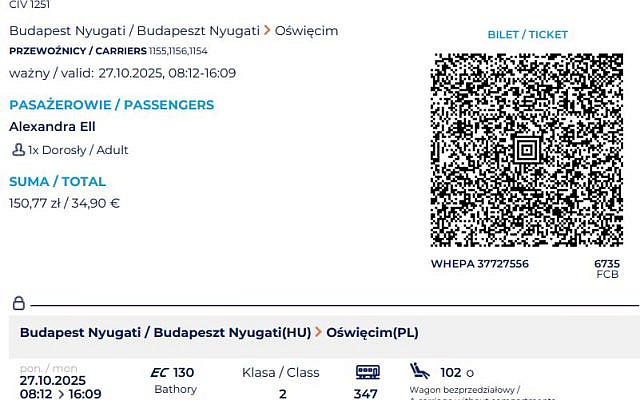
I won’t even try to explain all the emotional entanglements and taboos that choosing the train stirred in me. My unease at booking a window seat with access to USB ports and thinking that an eight-hour journey is too long was not just about time or comfort; it was something that is settled into my bones. Yes, I had the mercy of leaving from under the grand iron and glass canopy of Nyugati Railway Station, a marvel of nineteenth-century industrial engineering, not from a run-down freight terminal in the suburbs. And yes, while on the surface my biggest concern could have been being unable to buy a first-class ticket off-season, it was rather the knowledge that others once traveled in sealed cattle wagons, crammed together in silence and fear. I knew that this journey would not be an easy one.
The organizers, in an attempt to reassure me, mentioned that if I missed the last bus, it’s only a twenty-five-minute walk from the station to the camp. Even that sentence, meant to be helpful, landed with a different weight than intended. But when it happened, I was prepared. I wrapped my shawl around my head, grabbed my luggage, and walked into the drizzle, “toward death through the cooling twilight.”
Accommodation was provided on the premises of the Auschwitz Memorial, in their new hostel building (equipped with a restaurant where breakfast and dinner were provided), completed just before the High Holy Days last year, standing a few hundred meters from the barracks. That is where I walked after my train ride, opened a locker, obtained my room card, and settled in a twin room all for myself.
I wasn’t certain about this trip. Ever since the late 1980s, when visiting Auschwitz became a viable option, I’ve had my doubts.
Where exactly is the line that separates remembrance from dark tourism? Where is the boundary between bearing witness and becoming a collector of horror? What distinguishes learning from feeding on tragedy?
As I see it, every memorial risks becoming a spectacle. So, I kept wondering whether my presence sustains memory or consumes it. This question became especially urgent when institutionalized memory was transformed into infrastructure, equipped with single rooms and a restaurant. The contrast between sacred memory and practical convenience is deeply unsettling, even for a pragmatic person like me, who is emotionally not neutral.
Of course, I kept asking myself these questions, trying to reassure myself that bearing witness in Europe today is more important than it has ever been in the past 80 years. Probably part of what unsettled me is the shifting moral ground. In the last two years, remembrance has begun to feel outdated, as if an old narrative is being overwritten by new hostilities.
Holocaust memory often feels as though it is being relativized and recontextualized in post–October 7 Europe, where Israel’s actions are reshaping perceptions of Jewish victimhood. Increasingly, Jews are being viewed as a people capable of genocide and, as a result, their experience and suffering are being invalidated, rendered obsolete and irrelevant in the European discourse. That moral inversion — the transformation of the victim into the accused — is why the work of remembrance can no longer be ceremonial; it has become an act of resistance.
This is precisely why I decided to go. Not out of sentiment, but out of integrity and moral responsibility. I didn’t believe it was an opportunity I could ethically ignore, even if I knew it would leave a mark I’d carry.
The seminar was titled Auschwitz – History, Memory and Responsibility. And that was the point. What if there is a story with no one left to tell it but me? The stakes felt clearer than ever; bearing witness in these dark times isn’t just about remembering but about refusing silence while the ground shifts beneath us.
“The train is leaving. To Auschwitz, the train is leaving.”
And this time, I was on it.
Related Topics
Related Posts